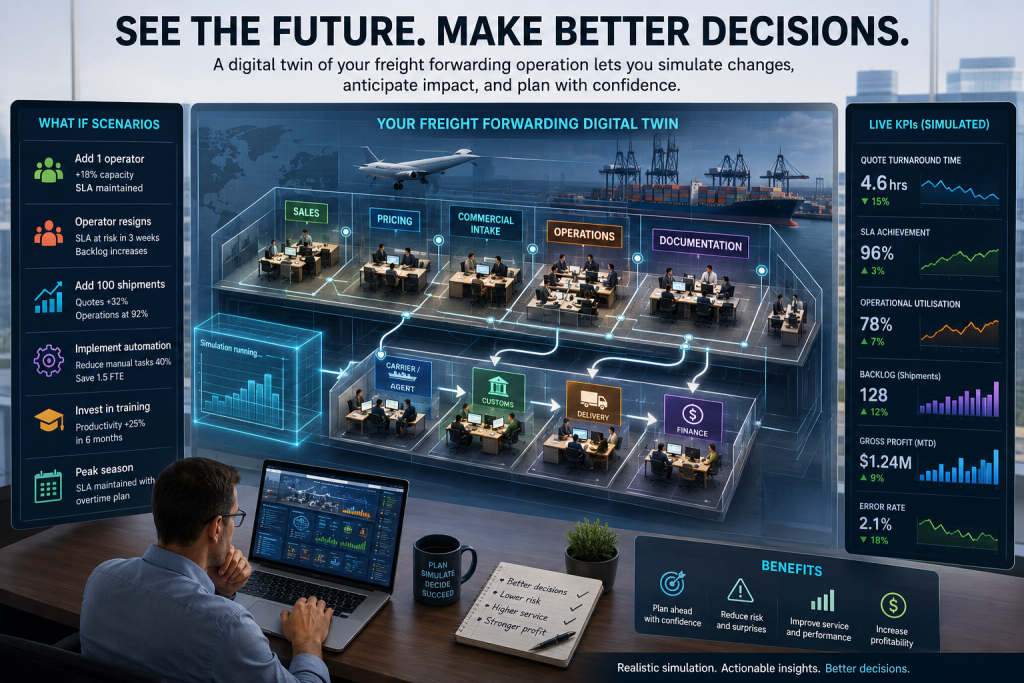
There are various use cases for an enterprise digital twin.
One use case is to understand the workload and identify bottlenecks within the operations department.
Maybe you are familiar with this scenario. You are the GM of a Freight Forwarder and your Operations Manager comes to you and says our LCL Export department is collapsing. There are too many jobs and they are doing overtime every day. The team is alright with the overtime pay but the OM is worried what would happen in case one of the operators falls sick. He is also not able to approve any leave. He requests for extra manpower.
Asking for additional manpower means checking budgets, checking revenue and GP, checking productivity levels of the staff, and speaking to sales if this additional job load is permanent or seasonal. If the case for more manpower is justified, we then need to make a business case to management.
What if you had a digital twin of your department which would actually show which department is stretched and to what point. And you could see this before your OM raises the alarm. Usually by the time operations raises issues to management, the house is already burning – at least that’s my experience.
The identification of bottlenecks and workload issues is therefore one use case of an enterprise digital twin.
A digital twin is a virtual model of a physical product, process or business. In freight forwarding, a digital twin simulates the day-to-day operation of a branch or an entire company, allowing management to test decisions before implementing them in the real business.
Traditionally, operational decisions are based on experience, intuition and historical reports. While experienced managers develop a good instinct, they still have no way of accurately predicting the consequences of a change before it happens. A digital twin changes that by providing a safe environment in which different scenarios can be tested and their operational and financial impact measured.
One of the most valuable applications is workforce planning. What happens if an additional sales executive brings in another 100 shipments per week? Can the existing operations team absorb the workload, or will turnaround times and service levels begin to deteriorate? Conversely, what happens if one experienced operator resigns, goes on extended medical leave or takes annual leave during peak season? How long can the department continue operating before service levels start to fail?
Most companies only recruit after problems have already appeared. By the time shipments are delayed, overtime becomes excessive and customer complaints increase, the business is already reacting rather than planning. A digital twin allows management to identify these risks months in advance and build business cases for additional headcount based on simulated outcomes rather than assumptions.
The simulator can also evaluate automation projects before any investment is made. Instead of asking whether a solution sounds promising, management can measure its actual impact. For example, could a rate management platform eliminate the need for a dedicated pricing desk? Would an operational compliance solution reduce enough manual checking to avoid hiring another compliance officer? Could document automation reduce quotation turnaround times sufficiently to increase conversion rates? Rather than relying on vendor claims, the digital twin allows competing solutions to be tested against the same operational environment.
Another important application is bottleneck identification. Freight forwarding processes are highly interconnected, and improvements in one department often shift the bottleneck elsewhere. If quotations are completed twice as fast, does the operations department become overloaded? If customs declarations are automated, does documentation become the new constraint? A digital twin makes these dependencies visible before changes are implemented.
Customer mix is another area where simulation provides valuable insight. Two customers generating the same revenue may create completely different workloads. For example, one customer shipping ten containers on a single Bill of Lading requires significantly less operational effort than ten different customers each shipping one container with separate documentation, communication and billing requirements. Revenue alone does not determine workload, and a digital twin helps quantify these differences.
The platform can also evaluate service performance during seasonal peaks. Can the organisation continue meeting its promised service level agreements during periods of high demand? At what utilisation level does overtime become excessive? Which department reaches capacity first? Understanding these thresholds allows management to prepare resources before peak seasons begin instead of responding once delays occur.
A digital twin also highlights the hidden financial impact of operational delays. Consider a situation where an overseas network office consistently provides destination charges after 48 hours instead of 24 hours. The delay may appear insignificant, but its downstream consequences can be substantial. Quotations are delayed, response times increase, conversion rates decline, customers approach competitors, and operations receive work later than planned. By simulating these effects, management can quantify the true cost of slow internal processes and justify improvements with measurable data.
The digital twin can also be used to measure the return on investment of training and employee development. Every operator can be assigned an experience level, which directly influences productivity, error rates, decision quality and the amount of supervision required.
For example, what happens if a junior export operator with six months’ experience replaces a senior operator with ten years’ experience? How much additional workload is created for the rest of the team? How long does it take before the new employee reaches full productivity? Is it more cost-effective to hire an experienced operator or invest in training an existing employee?
The simulator can also evaluate different training strategies. What is the operational impact if every employee receives two days of training per quarter? Does the temporary reduction in capacity result in higher long-term productivity? Which teams generate the greatest return from additional training?
Instead of viewing training purely as a cost, management can quantify its effect on operational capacity, service quality, error rates and profitability, making investment decisions based on measurable outcomes rather than assumptions.
Other practical scenarios include:
Evaluating the impact of opening or closing a branch.
Assessing whether a new product or trade lane can be supported with existing resources.
Determining the effect of centralising pricing or documentation functions.
Measuring the operational impact of winning or losing major customers.
Testing different organisational structures before implementing them.
Comparing the return on investment of hiring additional staff versus investing in automation.
Ultimately, a freight forwarding digital twin transforms operational planning from reactive decision-making into evidence-based management. Instead of asking, “Do we think we need another person?”, managers can ask, “What will happen to utilisation, turnaround times, customer service, profitability and workload if we hire one more operator, lose one team member, introduce automation or win a major customer?”
The difference is no longer opinion versus opinion. It becomes measurable outcomes before real money is spent and before customers are affected.