Introduction
Freight forwarding is at an inflection point.
On one side, digital-native players have shown that technology alone does not guarantee success. On the other, traditional forwarders that resist modernization risk gradual erosion of competitiveness.
The real challenge is not choosing between “digital” or “traditional.”
It is aligning business economics with the right technology — in the right sequence.
Many forwarders fail not because they lack software, but because their strategy, processes, and systems are misaligned. This is where structured business alignment becomes critical.
The Core Problem: Strategy and IT Often Move Separately
In many organizations:
- The management team defines commercial targets.
- Operations focus on service execution.
- IT implements tools in isolation.
The result is fragmented transformation.
Systems are installed without redesigning processes.
Automation is introduced without cleaning master data.
AI tools are layered onto inconsistent workflows.
Technology becomes an expense instead of a performance lever.
True digitization begins with business alignment — not software selection.
What Business Alignment Really Means
Business alignment in freight forwarding involves answering fundamental questions:
- Which customer segments are truly profitable?
- Which trade lanes generate consistent margin?
- Where does operational cost leak?
- Which processes create bottlenecks?
- How exposed is the company to rate cycles and working capital strain?
Without clarity on these fundamentals, digitization becomes cosmetic.
Alignment means defining:
- A clear commercial strategy
- A disciplined pricing and procurement model
- Standardized operational workflows
- Measurable performance indicators
- A realistic digital roadmap
Only then should technology be layered in.
The Role of Modern IT Partners
Forwarders do not need to build technology internally.
They need to integrate the right capabilities.
Modern IT providers in the logistics sector offer solutions such as:
- AI-driven data extraction from emails and documents
- Automated rate management systems
- Digital booking interfaces
- Carrier integration tools
- Compliance automation
- Visibility and control tower platforms
But tools must serve a defined objective.
For example:
If quoting speed is the issue, implement structured rate databases and automated comparison engines.
If margin leakage is the issue, implement profitability dashboards and financial controls.
If operational errors are frequent, automate document validation and milestone tracking.
The mistake is adopting tools without linking them to measurable business outcomes.
A Structured Transformation Approach
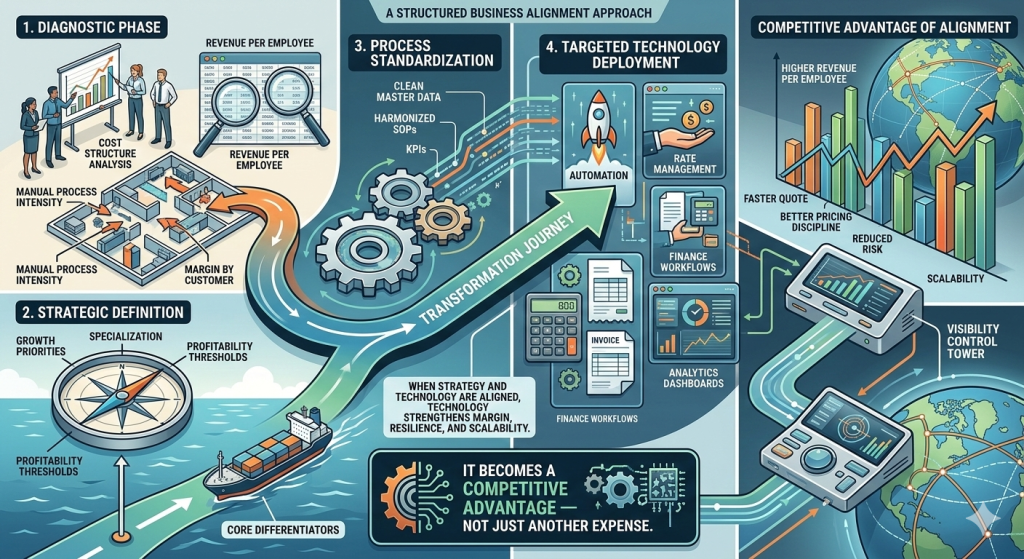
Effective transformation follows a clear sequence:
1. Diagnostic Phase
- Analyze cost structure
- Review revenue per employee
- Identify manual process intensity
- Map margin by customer and trade
2. Strategic Definition
- Define growth priorities
- Clarify specialization areas
- Set profitability thresholds
- Identify core differentiators
3. Process Standardization
- Clean master data
- Harmonize SOPs
- Define escalation logic
- Create measurable KPIs
4. Targeted Technology Deployment
- Introduce automation in repetitive tasks
- Implement rate management tools
- Integrate finance workflows
- Deploy analytics dashboards
This ensures that technology enhances economics rather than obscuring weaknesses.
The Competitive Advantage of Alignment
When strategy and technology are aligned, forwarders gain:
- Higher revenue per employee
- Faster quote turnaround
- Better pricing discipline
- Reduced operational risk
- Stronger capital control
- Scalability without proportional headcount growth
Digitization becomes a profit amplifier — not a branding exercise.
Why External Guidance Matters
Internal teams often struggle with transformation because:
- Operational teams are absorbed in daily execution
- IT teams focus on implementation, not strategy
- Leadership lacks neutral benchmarking
An external advisory partner can bridge commercial strategy and technical execution, ensuring that:
- Business objectives drive system selection
- IT investments are prioritized based on economic impact
- Implementation avoids unnecessary complexity
- Change management is structured and realistic
This prevents both under-digitization and over-investment.
Summary
Freight forwarding is not saved by technology alone, nor protected by tradition alone.
The companies that will lead the next decade are those that:
- Understand freight economics deeply
- Define clear commercial priorities
- Standardize and discipline operations
- Deploy targeted, well-integrated technology
Digital transformation is not about replacing people with software.
It is about aligning strategy, process, and systems so that technology strengthens margin, resilience, and scalability.
When business alignment comes first, IT becomes a competitive advantage — not just another expense line.