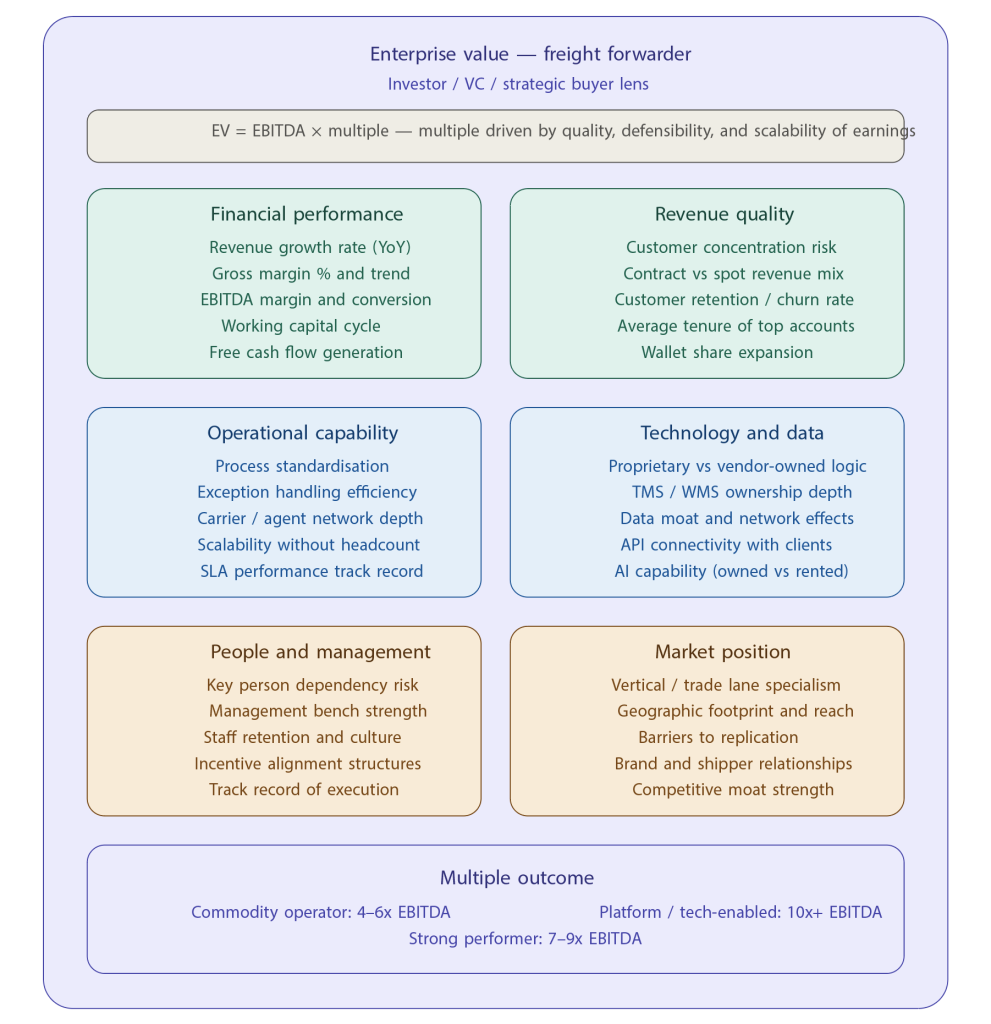
The freight forwarding industry has long been viewed through a transactional lens — margins are thin, volumes fluctuate with trade cycles, and differentiation is notoriously hard to articulate. Yet deal activity in the sector has intensified, with strategic buyers and private equity firms paying increasingly varied multiples for businesses that look, on the surface, remarkably similar. A forwarder turning $100 million in revenue at a 5% EBITDA margin might trade at 5x. Another with comparable financials might fetch 10x. The difference rarely comes down to the numbers themselves. It comes down to what sits behind them.
Enterprise value in freight forwarding is not simply a function of earnings. It is a function of the quality, defensibility, and scalability of those earnings. Investors and acquirers are asking a different set of questions than they did a decade ago — questions about data ownership, technology architecture, customer stickiness, and whether the business can grow without a proportional increase in headcount. Understanding how sophisticated buyers decompose value is no longer just useful for founders preparing for an exit. It is essential for any operator thinking seriously about how to build a business worth owning.
What Investors Are Actually Measuring
Financial performance: the starting point, not the conclusion
Every diligence process begins with the financials, but experienced buyers move through them quickly. Revenue growth rate, gross margin percentage, EBITDA conversion, and free cash flow generation are threshold questions, not differentiators. What matters more is the trajectory and the composition.
A forwarder growing at 15% annually on contracted revenue is a fundamentally different business from one growing at 20% on spot freight during a rate spike. Working capital management tells a similarly revealing story — a business with a tight cash conversion cycle signals operational discipline and pricing power, while a stretched debtor book often points to customer concentration problems or weak commercial terms. These dynamics are well understood by PE buyers, who will normalise EBITDA, stress-test margins across cycle scenarios, and build a clear picture of sustainable earnings before any multiple conversation begins.
Revenue quality: the first real differentiator
Once the financials are understood, attention shifts rapidly to revenue quality — and this is where many freight forwarders are surprised by how deeply buyers probe. Customer concentration is the most immediate concern. A top-ten customer representing more than 20% of gross profit introduces meaningful risk, particularly where that relationship is held personally by a founder or senior operator rather than embedded institutionally.
Beyond concentration, buyers examine the contract versus spot revenue mix, average customer tenure, churn rates, and evidence of wallet share expansion over time. A portfolio of long-tenured customers across diverse verticals and trade lanes, each deepening their commercial relationship with the forwarder year over year, is the kind of revenue quality that genuinely moves multiples. It suggests the business is providing something customers cannot easily replicate elsewhere — and that is the essence of defensibility.
Operational capability: scalability is the question
Operational strength in freight forwarding has historically been measured in execution reliability — on-time performance, exception resolution, carrier relationship depth. These remain important, but the investor lens has sharpened considerably. The question is no longer simply whether the business operates well. It is whether the business can scale its operations without scaling its cost base at the same rate.
Forwarders with highly standardised processes, documented SOPs, and systematic exception handling demonstrate the kind of operational architecture that supports margin expansion as volume grows. Those relying on tribal knowledge, individual expertise, and manual intervention at every inflection point face a structural ceiling. Buyers can see this ceiling clearly in the data — it shows up in headcount-to-revenue ratios, in SLA variance across customer accounts, and in the time and cost required to onboard new business. Process maturity is, in this sense, a form of leverage.
Technology and data: the emerging valuation frontier
No component of freight forwarder valuation has shifted more dramatically in the past five years than technology and data. What was once assessed as a hygiene factor — does the business have a functioning TMS? — has become a primary lens through which differentiation and defensibility are evaluated.
The critical distinction investors now draw is between forwarders that use technology and those that own it. A business running on vendor-provided platforms, with decision logic residing in external systems, has outsourced a meaningful portion of its operational intelligence. It may be efficient, but it is not differentiated — and its dependency on third-party tools creates both margin risk and switching cost vulnerability in the wrong direction. Conversely, a forwarder that has built proprietary workflows, owns its pricing and rating logic, has deep API connectivity with key customers, and generates data that compounds in value over time is building something qualitatively different. That compound data effect — where every shipment makes the next decision slightly better — is one of the few genuine moats available in this industry, and sophisticated buyers price it accordingly.
The rise of AI has added a further dimension to this assessment. Investors are now asking not just whether a forwarder has adopted AI, but where the AI capability resides. An AI tool licensed from a vendor improves efficiency but transfers value upstream. An AI capability built on proprietary data and embedded in internal workflows is a genuine asset. The distinction matters enormously to valuation.
People and management: the risk layer
However strong the financials and however impressive the technology architecture, people risk remains one of the most common reasons deal processes stall or multiples compress at the final stage. Key person dependency is endemic in freight forwarding, where customer relationships and carrier networks are frequently held by individuals rather than institutions. A business where the departure of one or two senior operators would materially affect revenue is a business with a structural fragility that no amount of EBITDA normalisation can fully address.
Buyers look for management bench strength, evidence of deliberate succession planning, incentive structures that align the leadership team with long-term outcomes, and a culture of accountability that extends beyond the founder. Track record matters too — not just revenue growth, but evidence that the management team has navigated difficult trading conditions, integrated acquisitions, or built new capability from a standing start. These are the signals that a business can continue to perform under new ownership.
Market position: the moat assessment
The final layer of investor analysis focuses on the structural position of the business within its market. Generalist freight forwarders operating across all modes, trade lanes, and verticals without particular depth in any of them face the most difficult valuation conversations. Specialism commands a premium — whether that is vertical expertise in a high-complexity sector such as pharmaceuticals, aerospace, or project cargo, or dominant positioning on specific trade corridors where relationships with carriers and agents are genuinely hard to replicate.
Geographic footprint is assessed both for its revenue contribution and for its strategic value to a potential acquirer. A regional forwarder with exceptional depth in Southeast Asian trade lanes may be worth considerably more to a global integrator than its standalone earnings would suggest. Brand reputation and the quality of long-standing shipper relationships round out this assessment — in an industry where trust is built slowly and lost quickly, reputation is a tangible asset.
Summary
Enterprise value in freight forwarding is not a mystery, but it is frequently misunderstood. The businesses that achieve the highest multiples are not necessarily the largest or the most profitable in absolute terms. They are the ones that have built earnings which are sticky, scalable, and defensible — revenue that does not walk out the door when a senior salesperson leaves, operations that do not require proportional headcount growth to expand, and technology that compounds in value rather than depreciates through dependency.
For operators building toward an exit — or simply building toward a better business — the framework is consistent. Revenue quality matters more than revenue size. Operational architecture matters more than operational reputation. Technology ownership matters more than technology adoption. And management depth matters more than management talent at the top.
The multiple a freight forwarder commands in the market is, ultimately, a verdict on the confidence an investor has that the earnings of today will persist and grow under their stewardship. Building that confidence is not a pre-sale exercise. It is the work of running the business well, from the inside out, over a long period of time.