Category: Business Strategy

  • A2A: The Future of Corporate Agents

    In the emerging age of agentic AI, the next revolution in enterprise technology will not be about connecting systems — it will be about connecting agents.

    For years, corporations have relied on APIs, middleware, and data pipelines to integrate their business applications. These mechanisms, while powerful, are rigid and costly to maintain. The next wave — Agent-to-Agent (A2A) architecture — replaces technical integration with cognitive collaboration.


    From Automation to Autonomy

    Leading enterprise platforms are already embedding intelligent agents within their ecosystems:

    • Salesforce has introduced Agentforce, capable of interpreting user prompts and generating contextual CRM actions.
    • Workday integrates BP Optimize Agents to streamline workforce and process efficiency and Contingent sourcing platforms now use AI agents to autonomously match talent to projects based on skill and availability.
    • Cargowise, long known for logistics automation, is now advancing into agentic AI functions that reason across workflows rather than merely execute them.

    The difference is profound. Automation follows instructions; autonomy understands purpose. Each of these systems now hosts specialized agents capable of perception, reasoning, and communication — forming the foundation for true A2A ecosystems.


    Role-Based Agents: The Next Layer of Intelligence

    The natural evolution of this trend is the rise of role-based agents — AI entities designed to perform specialized corporate functions within defined boundaries.
    A few early examples illustrate the concept:

    • Financial Audit Agent for Workday Adaptive: constantly monitors ledgers, forecasts, and anomaly reports, ensuring compliance with internal controls and external standards. It flags inconsistencies, queries variances, and even drafts summary notes for CFO review.
    • Procurement Compliance Agent: embedded within ERP systems to ensure all supplier actions adhere to sustainability, ESG, and cost policies.
    • Sales Forecast Agent: within CRM systems, dynamically adjusting pipeline projections based on market sentiment and customer behaviour.
    • Logistics Coordination Agent: in platforms like Cargowise, continuously assessing shipment milestones, carrier reliability, and exception risks.

    Each of these agents operates within its system domain — interpreting local data, reasoning over role-specific goals, and interfacing with others via A2A orchestration.


    A2A: Agents That Talk to Agents

    In the coming landscape, there won’t be a single universal communication protocol connecting all corporate software. Instead, A2A agents will emerge as intelligent intermediaries that interpret intent, select the relevant domain agent, and coordinate the exchange.

    Consider a scenario:

    A regional operations director asks, “Provide a profitability forecast for next quarter.”

    The A2A layer springs into action:

    • The Financial Audit Agent in Workday Adaptive analyzes revenue and cost projections.
    • The Sales Forecast Agent in Salesforce Agentforce provides order pipeline probabilities.
    • The Logistics Coordination Agent in Cargowise estimates capacity utilization and transport cost exposure.
    • The A2A Orchestrator Agent interprets the results, reconciles inconsistencies, and generates a unified executive summary — without any human needing to manually transfer data or align formats.

    This is cross-agent reasoning, not just cross-system integration.


    Security and Risk Management by Design

    Traditional integrations expose multiple endpoints to external networks. Every connection is a potential vulnerability.
    A2A architecture simplifies and secures this: only one orchestrator agent — the “frontline negotiator” — is accessible via the internet.

    All role-based agents (finance, HR, operations, logistics, etc.) remain behind internal firewalls, accessible only through the orchestrator’s verified handshake.

    This model minimizes the attack surface, enhances auditability, and satisfies zero-trust policies by enforcing compartmentalized access. In effect, the enterprise becomes a network of trusted agents rather than a web of exposed APIs.


    Why It Matters for Operations and Supply Chain

    For logistics and supply chain operations, where multiple applications coexist — from TMS and WMS to ERP and CRM — A2A unlocks enormous potential.

    Agents within each system can perform their own reasoning: forecasting volume trends, identifying bottlenecks, or validating customs documentation. The A2A orchestrator then synchronizes the insights across departments.

    This architecture enables modular transformation — companies can evolve system by system, replacing or upgrading individual applications without disrupting the overall intelligence network.


    The Road Ahead

    Over the next five years, we will see enterprises deploy layered agent frameworks:

    1. System-native agents (Salesforce, Workday, Cargowise, SAP, etc.) performing role-based functions.
    2. A2A orchestrators interpreting intent, delegating tasks, and consolidating outputs.
    3. Governance agents ensuring traceability, security, and compliance across all interactions.

    This is not just the future of automation — it’s the future of enterprise cognition.

    Just as APIs defined the last decade of digital transformation, A2A will define the next: a world where intelligent, role-based agents collaborate seamlessly, securely, and autonomously to deliver real business outcomes.

  • 🚢 Large vs. Small Freight Forwarders: What Makes Them Tick?

    Post 7/7: What Happens When They Compete Outside Their Sweet Spot

    When small forwarders pursue large global clients:

    • They may underprice or overcommit.
    • Risk reputational damage if execution fails.
    • Lose focus on their core SME base.

    When large forwarders pursue small clients:

    • Clients may feel neglected or priced out.
    • Service personalization often suffers.
    • Internal processes may not suit transactional needs.

    Bottom line:
    The winners understand their lane—and stay in it or grow with clarity.

    #LogisticsLeadership #FreightForwarding #SupplyChainStrategy #LargeVsSmall #Forwarders #SME #GlobalForwarding #BusinessStrategy #CorporateStructure #FreightForwardingStrategy #ClientFit #ForwarderGrowth #BusinessScaling #CustomerCentricity #LocalExpertise #ForwarderTech #Digitization

  • 🚢 Large vs. Small Freight Forwarders: What Makes Them Tick?

    Post 6/7: What Small Forwarders Struggle With

    Trying to do everything often backfires.

    Common pitfalls:

    • Limited rate leverage
    • Overstretching into services beyond core strength
    • Fragmented tech stack
    • Dependency on key staff or clients
    • Difficulty competing in global tenders

    #LogisticsLeadership #FreightForwarding #SupplyChainStrategy #LargeVsSmall #Forwarders #SME #GlobalForwarding #BusinessStrategy #CorporateStructure #FreightForwardingStrategy #ClientFit #ForwarderGrowth #BusinessScaling #CustomerCentricity #LocalExpertise #ForwarderTech #Digitization

  • 🚢 Large vs. Small Freight Forwarders: What Makes Them Tick?

    Post 5/7: What Small Forwarders Do Well

    Small forwarders build trust through agility.

    Strengths include:

    • Tailored service delivery
    • Personal client relationships
    • Speed in quoting & execution
    • Success in underserved or emerging markets
    • Entrepreneurial problem solving

    #LogisticsLeadership #FreightForwarding #SupplyChainStrategy #LargeVsSmall #Forwarders #SME #GlobalForwarding #BusinessStrategy #CorporateStructure #FreightForwardingStrategy #ClientFit #ForwarderGrowth #BusinessScaling #CustomerCentricity #LocalExpertise #ForwarderTech #Digitization

  • 🚢 Large vs. Small Freight Forwarders: What Makes Them Tick?

    Post 4/7: What Large Forwarders Struggle With

    Size comes with trade-offs.

    Challenges include:

    • Inflexibility in service customizations
    • Slower response time for smaller clients
    • Complexity in internal processes
    • Less personal account management
    • Struggles in niche, low-volume lanes

    #LogisticsLeadership #FreightForwarding #SupplyChainStrategy #LargeVsSmall #Forwarders #SME #GlobalForwarding #BusinessStrategy #CorporateStructure #FreightForwardingStrategy #ClientFit #ForwarderGrowth #BusinessScaling #CustomerCentricity #LocalExpertise #ForwarderTech #Digitization

  • 🚢 Large vs. Small Freight Forwarders: What Makes Them Tick?

    Post 3/7: What Large Forwarders Do Well

    Large forwarders excel when the task is complex, global, or regulated.

    They shine in:

    • Serving multinational clients
    • Managing high-volume, multi-lane shipments
    • Delivering standardized SOPs
    • Investing in automation, ESG, and innovation
    • Winning and running RFQs

    #LogisticsLeadership #FreightForwarding #SupplyChainStrategy #LargeVsSmall #Forwarders #SME #GlobalForwarding #BusinessStrategy #CorporateStructure #FreightForwardingStrategy #ClientFit #ForwarderGrowth #BusinessScaling #CustomerCentricity #LocalExpertise #ForwarderTech #Digitization

  • 🚢 Large vs. Small Freight Forwarders: What Makes Them Tick?

    Post 2/7: Characteristics of Small Freight Forwarders

    Small forwarders are agile, customer-centric, and often locally dominant.
    They thrive in flexibility, service quality, and personal relationships.

    Key traits:

    • Niche market expertise
    • Hands-on customer service
    • Quick decisions, no red tape
    • Customizable solutions
    • Strong regional agent networks

    #LogisticsLeadership #FreightForwarding #SupplyChainStrategy #LargeVsSmall #Forwarders #SME #GlobalForwarding #BusinessStrategy #CorporateStructure #FreightForwardingStrategy #ClientFit #ForwarderGrowth #BusinessScaling #CustomerCentricity #LocalExpertise #ForwarderTech #Digitization #mmlogistix

  • 🚢 Large vs. Small Freight Forwarders: What Makes Them Tick?

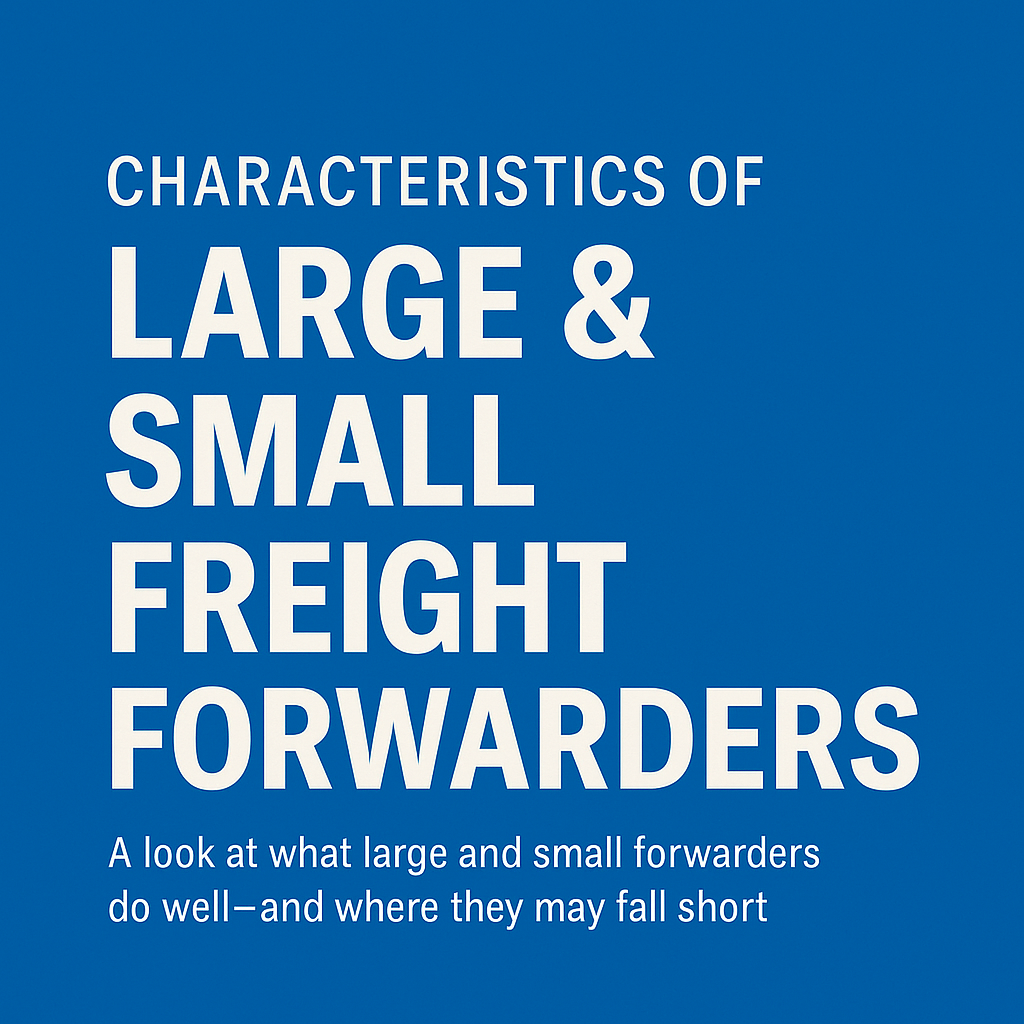
    Post 1/7: Characteristics of Large Freight Forwarders

    Large forwarders (USD 2B+ revenue) are built for scale.
    They operate global networks, run proprietary systems, and handle end-to-end supply chains. Think compliance, capacity, and cross-border coordination.

    Key traits:

    • Global offices & assets
    • Deep sector specialization
    • Digital platforms & integrations
    • Strong procurement power
    • Focus on large contracts & tenders

    #LogisticsLeadership #FreightForwarding #SupplyChainStrategy #LargeVsSmall #Forwarders #SME #GlobalForwarding #BusinessStrategy #CorporateStructure #FreightForwardingStrategy #ClientFit #ForwarderGrowth #BusinessScaling #CustomerCentricity #LocalExpertise #ForwarderTech #Digitization #mmlogistix

  • 🚢 Large vs. Small Freight Forwarders: What Makes Them Tick?

    Introduction

    In today’s global logistics landscape, both large multinational forwarders and agile regional players play critical roles. But their strengths—and weaknesses—are not created equal.

    Over the next 7 posts, I’ll break down:
    ✅ What large forwarders do well
    ✅ Where small forwarders outperform
    ✅ Where each fall short
    ✅ And what happens when they step into each other’s turf

    Whether you’re a forwarder, shipper, or supply chain leader, this series will help you better understand the strategic choices that shape the forwarding industry.

    Follow along and share your thoughts as we explore both sides of the freight equation.

    #LogisticsLeadership #FreightForwarding #SupplyChainStrategy #LargeVsSmall #Forwarders #SME #GlobalForwarding #BusinessStrategy #CorporateStructure #FreightForwardingStrategy #ClientFit #ForwarderGrowth #BusinessScaling #CustomerCentricity #LocalExpertise #ForwarderTech #Digitization