Artificial intelligence is currently being discussed as the next major transformation in freight forwarding. Some believe it will eliminate large parts of operational work. Others dismiss it as hype.
In reality, the truth lies somewhere in between.
Freight forwarding operations are complex, fragmented, and heavily dependent on accurate data. When that data is wrong or incomplete, the consequences ripple across operations, finance, reporting, and customer service.
AI will not solve these problems on its own. Poor processes, weak discipline, or unclear responsibilities cannot be fixed by algorithms.
However, there are specific areas where AI can significantly reduce data quality problems and improve operational visibility.
Below are three examples where AI can realistically help.
1. Shipment Data Quality
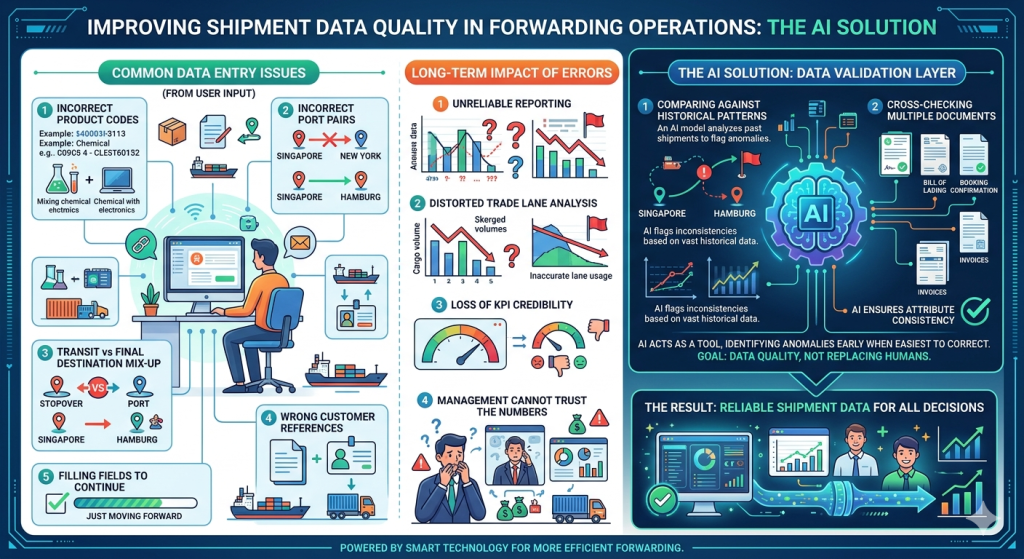
One of the most common issues in forwarding operations is incorrect shipment data.
Users may select the wrong product code, enter incorrect port pairs, mix up transit ports and final destinations, or attach the wrong customer reference. Sometimes the system fields are filled simply to move the shipment forward in the workflow.
The immediate impact may appear small. But over time these errors create larger problems:
- reporting becomes unreliable
- trade lane analysis becomes distorted
- operational KPIs lose credibility
- management cannot trust the numbers they see
AI can help by acting as a data validation layer, rather than replacing the user.
For example, an AI system could compare the shipment data being entered against historical shipment patterns. If a shipment from Singapore to Hamburg suddenly shows a routing through an unusual port or an inconsistent product type, the system can flag the entry before the shipment proceeds.
Similarly, AI can cross-check information across documents such as booking confirmations, bills of lading, and invoices to ensure that the key shipment attributes remain consistent.
The goal is not to automate decisions but to identify anomalies early, when they are easiest to correct.
2. Missing Charges and Revenue Leakage
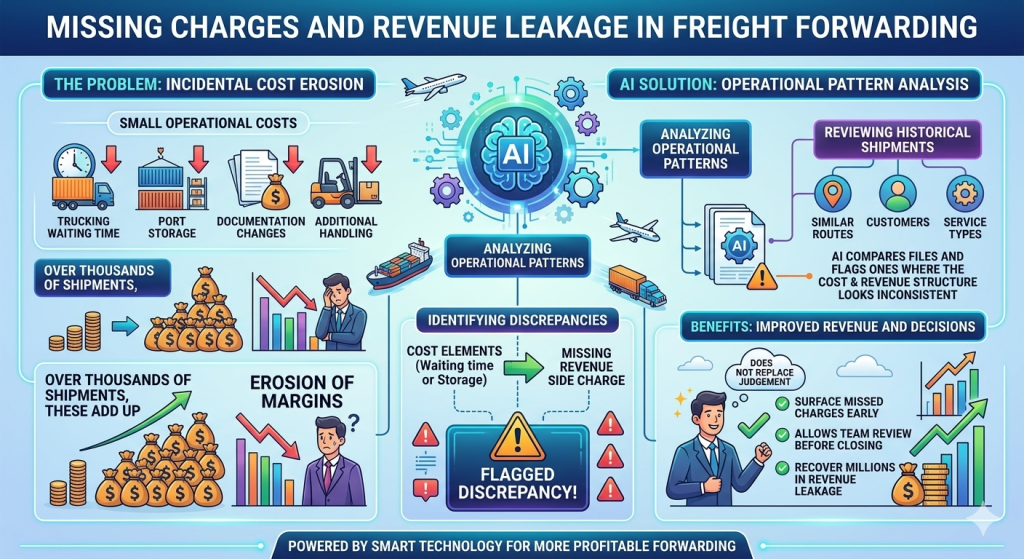
Another recurring problem in forwarding operations is missing incidental charges.
These are typically small operational costs such as waiting time, storage, documentation changes, or additional handling. Because they represent a small percentage of the overall shipment value, they often go unnoticed.
Over thousands of shipments, however, these missed charges can create a measurable erosion of margins.
AI can help identify these situations by analyzing operational patterns.
For example, if certain shipments consistently include specific cost elements — such as trucking waiting time or port storage — but the revenue side of the file does not include the corresponding charge, the system can flag the discrepancy.
Similarly, AI can review historical shipments on similar routes, customers, or service types and highlight files where the cost and revenue structure looks inconsistent.
This does not replace operational judgement. It simply helps surface files where something may have been missed, allowing teams to review them before the job is closed.
3. Inconsistent Customer and Customs Data
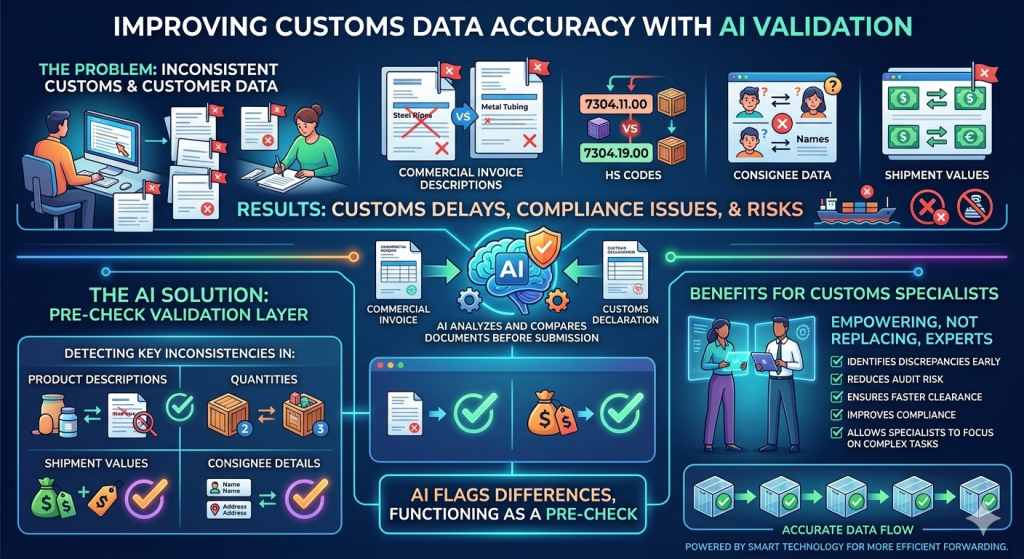
Another area where data quality issues appear frequently is customer documentation and customs information.
Details such as commercial invoice descriptions, HS codes, consignee data, or shipment values are sometimes entered manually across multiple documents. Even small inconsistencies can cause customs delays or compliance issues.
AI tools that analyze documents can help detect inconsistencies between documents before submission.
For instance, the system may compare the commercial invoice, packing list, and customs declaration and flag differences in:
- product descriptions
- quantities
- shipment values
- consignee details
Instead of replacing customs specialists, the AI functions more like a pre-check layer, identifying discrepancies that would otherwise surface later in the process.
AI Is Not a Shortcut
It is important to emphasize that AI cannot compensate for poorly designed operational processes.
If responsibilities are unclear, if data governance is weak, or if users routinely bypass system procedures, AI will simply amplify the confusion.
What AI can do is reduce the operational burden of maintaining data quality by highlighting inconsistencies and anomalies earlier in the process.
Used correctly, it becomes a tool that helps teams maintain discipline rather than replacing the need for it.
The Real Opportunity
Freight forwarding companies generate enormous amounts of operational data every day.
The real opportunity for AI is not replacing operators. It is helping companies trust their own data again.
When shipment data is reliable, billing is consistent, and operational records are accurate, management can move away from explaining numbers and focus on making decisions.
That is where technology begins to create real value.
Leave a Reply
You must be logged in to post a comment.