Introduction
When a multinational manufacturing company reviews its freight forwarding activities, the discussion often starts with freight rates.
How much are we spending? Are our airfreight rates competitive? Should we consolidate volumes with fewer forwarders? Can procurement negotiate another five or ten percent?
Those are valid questions, but they address only a small part of the opportunity.
For a multinational with manufacturing plants across several countries, OEM or contract manufacturing partners, hundreds of component suppliers and customers around the world, freight forwarding is part of a complex network connecting procurement, production, inventory and customers.
A proper freight forwarding analysis therefore shouldn’t simply ask:
“Are we paying the right freight rate?”
It should ask:
“Is our freight network designed, controlled and operated in the most effective way to support the business?”
That is a much bigger question.
Start by understanding the network
Before looking at rates, the physical network needs to be understood.
Where are the manufacturing plants? Where are the OEMs and contract manufacturers? Where are the critical component suppliers? Which consolidation points, gateways and distribution centres are being used?
The next step is mapping the freight flows connecting them.
For each significant lane, the analysis should identify shipment frequency, volume, weight, mode of transport, forwarder, carrier, Incoterm, transit time and cost.
This sounds straightforward. In practice, multinational networks can become surprisingly fragmented.
Different plants may use different forwarders. Suppliers may control transportation under their own Incoterms. Local organizations may purchase spot freight outside global agreements. Several suppliers in the same region may ship separately to the same factory.
Until the network is mapped, management may not have a complete picture of how freight is actually moving.
Follow the money, but look beyond the freight rate
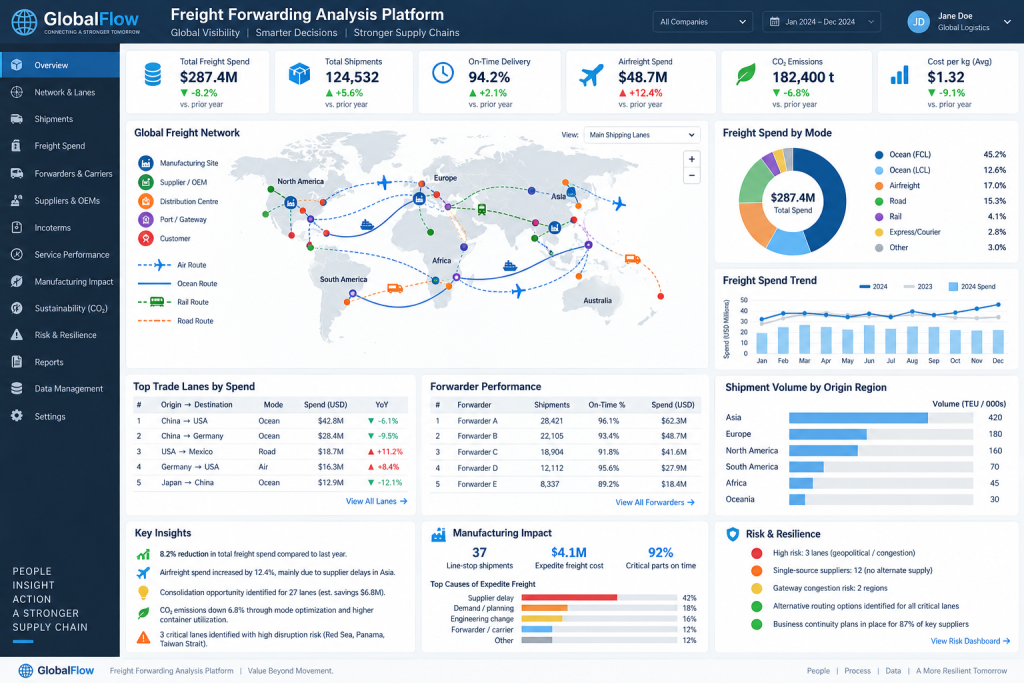
Freight spend should then be analyzed across multiple dimensions.
Spend can be broken down by manufacturing site, supplier, OEM, forwarder, carrier, mode, trade lane, business unit and region.
But base freight is only one part of the picture.
Fuel and security surcharges, terminal handling, customs clearance, pickup and delivery, storage, waiting time, demurrage, detention and other accessorial charges can materially affect the true transportation cost.
There is another important question:
How much freight spend is actually visible?
If suppliers sell components on delivered terms, transportation costs may be embedded in the product price. Procurement may therefore believe the company spends $50 million annually on freight when the real transportation expenditure across the supply chain is considerably higher.
This is where Incoterm analysis becomes important.
Changing the purchasing terms for selected suppliers may allow the manufacturer to take control of transportation, consolidate volumes and use its global purchasing power.
Analyze what is actually being shipped
Shipment-level data can reveal opportunities that rate negotiations never will.
How frequently are shipments moving? What is the average shipment size? How well utilized are containers? How much LCL traffic could potentially become FCL? Are multiple suppliers shipping independently from the same origin region to the same manufacturing facility?
Consider five suppliers around Shenzhen shipping components independently to the same European plant several times each week.
The organization could negotiate better rates for those individual shipments.
Or it could ask a more fundamental question:
Why are we moving five separate shipments in the first place?
Supplier consolidation, buyer’s consolidation, milk runs, regional gateways or consolidation centres may reduce shipment frequency, improve utilization and lower overall logistics cost.
That is network optimization rather than freight procurement.
Understand why premium freight happens
Airfreight and express shipments deserve particular attention in manufacturing environments.
Not all airfreight is bad. Some products genuinely require it because of value, lead time, shelf life or production requirements.
The more interesting question is how much airfreight was planned and how much was an emergency.
A component might have been shipped by air because the supplier produced it late. Another shipment might have resulted from inaccurate forecasting. A factory may have changed its production schedule. Engineering may have changed a specification. A forwarder may have missed a sailing.
These situations all appear in the freight data as expensive transportation.
But transportation isn’t necessarily the cause.
Premium freight should therefore be classified by root cause, for example:
Supplier → OEM → Manufacturing → Planning → Procurement → Forwarder → Carrier → Customer → External event
This changes the management discussion.
Instead of saying, “Airfreight increased by $2 million,” the company can determine why it increased and which function needs to address it.
Measure freight performance against manufacturing requirements
Traditional logistics KPIs remain important.
Pickup reliability, booking confirmation, departure reliability, transit time, arrival reliability, customs clearance, POD availability and exception response should all be measured.
But manufacturing requires another layer.
Which shipments threatened production?
How many expedites occurred?
How much premium freight was incurred?
How many shipments resulted from supplier failure?
How often was production at risk because a critical component wasn’t available?
A $15,000 emergency airfreight shipment looks expensive when viewed by procurement.
If that shipment prevents a production line from stopping and avoids a much larger financial loss, it may have been the correct decision.
The question then becomes why the emergency shipment became necessary.
Analyze the suppliers as well as the forwarders
Forwarders are frequently measured through KPIs. Suppliers often receive less logistics scrutiny.
Yet supplier behavior can have a major impact on transportation performance.
The analysis should examine whether suppliers provide bookings on time, have cargo ready as agreed, provide accurate documentation, comply with packaging requirements and provide reliable shipment information.
The same applies to OEM and contract manufacturing partners.
This makes it possible to distinguish between a forwarder performance problem and an upstream supply-chain problem.
Review the processes behind the shipments
The next layer is process.
How does a purchase order eventually become a shipment?
The process can be mapped from:
PO → supplier readiness → transport order → booking → pickup → export clearance → main carriage → import clearance → delivery → POD → freight invoice → payment
Different factories within the same multinational often handle these processes differently.
One location may automatically transmit transport orders to a nominated forwarder. Another may email spreadsheets. A third may allow suppliers to make bookings directly.
These differences create cost, visibility and control problems.
Standardizing the right processes can therefore produce benefits that have nothing to do with negotiating freight rates.
Determine whether the data can actually support decisions
A sophisticated forwarding strategy cannot compensate for poor data.
The analysis should examine ERP, TMS, supplier portals, forwarder systems and EDI/API connections.
Ideally, the organization should be able to connect:
Purchase Order → Shipment → Transport Order → Forwarder → Freight Invoice → Product/Customer
When those connections don’t exist, answering seemingly simple questions becomes difficult.
Which product generates the highest freight cost?
Which suppliers generate the most premium freight?
Which manufacturing plant has the highest logistics cost relative to production?
Which forwarder is creating the most exceptions?
Which lanes have the greatest consolidation potential?
Data quality is therefore part of freight optimization.
Examine risk and resilience
Cost and performance aren’t the only considerations.
A global manufacturing network may depend on a single supplier, gateway, carrier, airport, port or transportation mode.
Critical lanes should therefore be examined for alternative routings, carriers, forwarders and modes.
The cheapest solution isn’t necessarily the right solution if a disruption can stop production.
The objective is to understand where resilience is required and where redundancy simply adds unnecessary cost.
Finally, look at governance
Perhaps the most revealing question in a multinational freight analysis is:
Who actually controls transportation?
The answer may be global procurement.
Or regional logistics.
Or individual factories.
Or suppliers.
Or OEMs.
Frequently, it is some combination of all of them.
The company may have global forwarding agreements while individual sites continue purchasing transportation locally. Suppliers may ignore nominated forwarders. Spot shipments may bypass contracted rates. Business units may maintain their own processes.
A forwarding strategy only works when governance supports it.
Clear ownership, tender processes, allocation rules, escalation procedures, KPI reviews and compliance monitoring are therefore as important as the freight contracts themselves.
Summary
A comprehensive freight forwarding analysis should ultimately provide management with visibility across four areas:
Cost: Are we buying freight efficiently?
Network: Are we moving freight efficiently?
Performance: Is transportation reliably supporting manufacturing and customers?
Control: Do we actually understand and control the freight network?
The analysis should connect suppliers, OEMs, factories, gateways, distribution centres and customers and attach meaningful information to each major freight flow:
Volume + frequency + mode + forwarder + carrier + Incoterm + transit time + performance + cost + risk
Most importantly, it should establish root causes.
If premium freight is increasing, why?
If freight costs at one plant are significantly higher, why?
If delivery performance is poor, is the problem the forwarder, carrier, supplier, planning process or manufacturing operation?
This is where freight forwarding analysis becomes much more valuable than a rate exercise.
A freight tender may tell a company whether it can buy transportation more cheaply.
A proper freight forwarding analysis tells management whether the company should be moving the freight that way in the first place.
Leave a Reply
You must be logged in to post a comment.