Tag: BusinessStrategy

  • Why Freight Forwarding Struggles with Automation

    There’s a growing frustration around how slowly the freight forwarding and logistics industry is adopting automation. Many IT vendors have entered the space with strong expectations, only to step back after struggling to gain traction. From the outside, it often looks like resistance to change. From the inside, the reality is more complicated.

    At first glance, freight forwarding appears highly repetitive. Emails, documents, shipment updates, billing. It feels like an ideal candidate for automation. But once you look closer, the process is not just a sequence of tasks. It’s a web of decisions, exceptions, and dependencies.

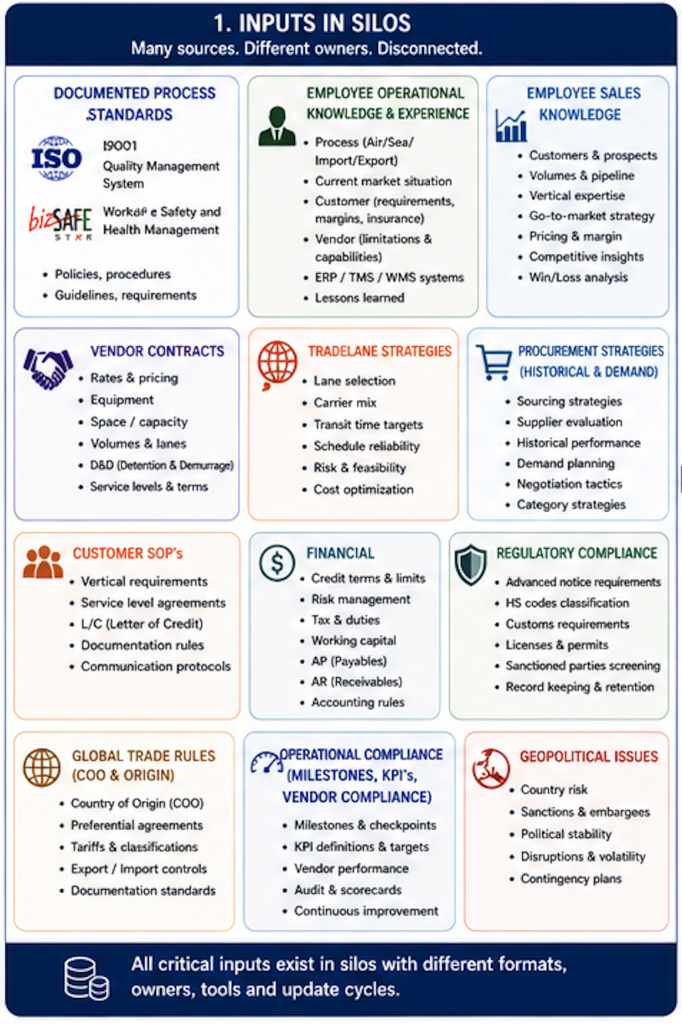
    A single shipment can involve:

    • Customer-specific SOPs and service expectations
    • Vendor constraints on space, equipment, and routing
    • Rapidly changing market conditions
    • Financial considerations such as margins, credit limits, and working capital
    • Regulatory requirements including customs, licenses, and trade compliance
    • System limitations across ERP, TMS, and WMS platforms
    • Geopolitical disruptions affecting routes and costs

    None of this sits in one place.

    The real challenge is not technology. It’s fragmentation.

    Knowledge is spread across:

    • Operations teams who understand how shipments actually move
    • Sales teams who know the customer, volumes, and pricing strategy
    • Procurement teams managing carriers and contracts
    • Finance teams controlling risk and revenue recognition
    • Compliance teams managing regulatory exposure

    Each group holds a piece of the process. Very little of it is fully documented end-to-end.

    This creates two core problems.

    First, processes are often incomplete. What exists in SOPs typically covers the “standard case,” but not the real-world exceptions that happen daily. Automation struggles in environments where exceptions are not clearly defined.

    Second, decision-making is embedded in people, not systems. Experienced operators constantly make judgment calls based on context. Vendor reliability, customer sensitivity, margin pressure, or shipment urgency. These decisions are rarely written down, but they are critical to execution.

    When IT vendors try to automate such environments, they face a moving target. What looks like a simple workflow quickly expands into a complex set of rules, exceptions, and dependencies. Implementation timelines stretch. Scope increases. Confidence drops. Eventually, projects stall or are abandoned.

    This is why many automation initiatives in freight forwarding fail before they even begin. Not because the technology doesn’t work, but because the process is not ready.

    There is a way forward, but it requires a shift in approach.

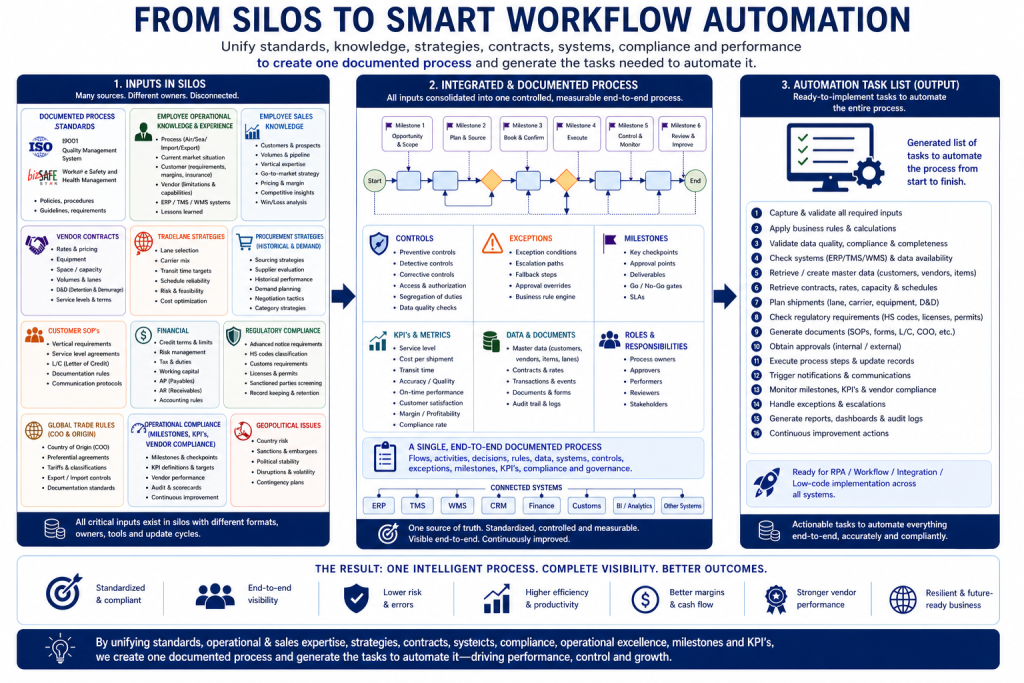
    Automation should not start with tools. It should start with clarity.

    Companies need to:

    • Document processes beyond the standard flow, including exceptions and controls
    • Consolidate knowledge from operations, sales, procurement, finance, and compliance
    • Define decision logic where possible, and clearly separate what remains judgment-based
    • Align data structures across systems
    • Establish milestones, KPIs, and ownership

    Only then does automation become practical.

    When this foundation is in place, something changes. The process becomes visible. Dependencies are understood. Tasks can be broken down. At that point, automation is no longer an abstract concept. It becomes a series of clearly defined steps that can be implemented.

    The industry is not slow because it resists automation. It’s slow because the underlying processes are complex, fragmented, and often undocumented.

    Once that is addressed, automation doesn’t just become possible. It becomes inevitable.

  • Enterprise Value in Freight Forwarding: What Investors Are Really Looking At

    The freight forwarding industry has long been viewed through a transactional lens — margins are thin, volumes fluctuate with trade cycles, and differentiation is notoriously hard to articulate. Yet deal activity in the sector has intensified, with strategic buyers and private equity firms paying increasingly varied multiples for businesses that look, on the surface, remarkably similar. A forwarder turning $100 million in revenue at a 5% EBITDA margin might trade at 5x. Another with comparable financials might fetch 10x. The difference rarely comes down to the numbers themselves. It comes down to what sits behind them.

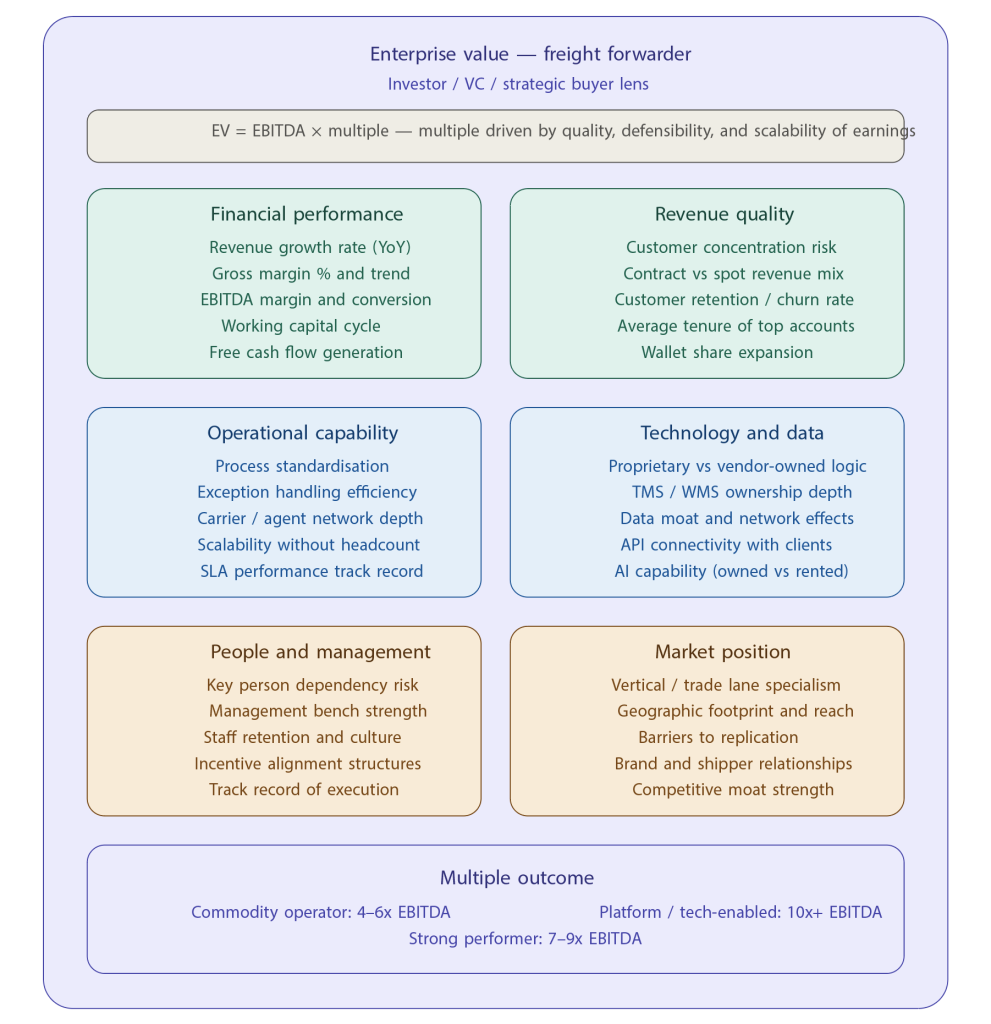
    Enterprise value in freight forwarding is not simply a function of earnings. It is a function of the quality, defensibility, and scalability of those earnings. Investors and acquirers are asking a different set of questions than they did a decade ago — questions about data ownership, technology architecture, customer stickiness, and whether the business can grow without a proportional increase in headcount. Understanding how sophisticated buyers decompose value is no longer just useful for founders preparing for an exit. It is essential for any operator thinking seriously about how to build a business worth owning.

    What Investors Are Actually Measuring

    Financial performance: the starting point, not the conclusion

    Every diligence process begins with the financials, but experienced buyers move through them quickly. Revenue growth rate, gross margin percentage, EBITDA conversion, and free cash flow generation are threshold questions, not differentiators. What matters more is the trajectory and the composition.

    A forwarder growing at 15% annually on contracted revenue is a fundamentally different business from one growing at 20% on spot freight during a rate spike. Working capital management tells a similarly revealing story — a business with a tight cash conversion cycle signals operational discipline and pricing power, while a stretched debtor book often points to customer concentration problems or weak commercial terms. These dynamics are well understood by PE buyers, who will normalise EBITDA, stress-test margins across cycle scenarios, and build a clear picture of sustainable earnings before any multiple conversation begins.

    Revenue quality: the first real differentiator

    Once the financials are understood, attention shifts rapidly to revenue quality — and this is where many freight forwarders are surprised by how deeply buyers probe. Customer concentration is the most immediate concern. A top-ten customer representing more than 20% of gross profit introduces meaningful risk, particularly where that relationship is held personally by a founder or senior operator rather than embedded institutionally.

    Beyond concentration, buyers examine the contract versus spot revenue mix, average customer tenure, churn rates, and evidence of wallet share expansion over time. A portfolio of long-tenured customers across diverse verticals and trade lanes, each deepening their commercial relationship with the forwarder year over year, is the kind of revenue quality that genuinely moves multiples. It suggests the business is providing something customers cannot easily replicate elsewhere — and that is the essence of defensibility.

    Operational capability: scalability is the question

    Operational strength in freight forwarding has historically been measured in execution reliability — on-time performance, exception resolution, carrier relationship depth. These remain important, but the investor lens has sharpened considerably. The question is no longer simply whether the business operates well. It is whether the business can scale its operations without scaling its cost base at the same rate.

    Forwarders with highly standardised processes, documented SOPs, and systematic exception handling demonstrate the kind of operational architecture that supports margin expansion as volume grows. Those relying on tribal knowledge, individual expertise, and manual intervention at every inflection point face a structural ceiling. Buyers can see this ceiling clearly in the data — it shows up in headcount-to-revenue ratios, in SLA variance across customer accounts, and in the time and cost required to onboard new business. Process maturity is, in this sense, a form of leverage.

    Technology and data: the emerging valuation frontier

    No component of freight forwarder valuation has shifted more dramatically in the past five years than technology and data. What was once assessed as a hygiene factor — does the business have a functioning TMS? — has become a primary lens through which differentiation and defensibility are evaluated.

    The critical distinction investors now draw is between forwarders that use technology and those that own it. A business running on vendor-provided platforms, with decision logic residing in external systems, has outsourced a meaningful portion of its operational intelligence. It may be efficient, but it is not differentiated — and its dependency on third-party tools creates both margin risk and switching cost vulnerability in the wrong direction. Conversely, a forwarder that has built proprietary workflows, owns its pricing and rating logic, has deep API connectivity with key customers, and generates data that compounds in value over time is building something qualitatively different. That compound data effect — where every shipment makes the next decision slightly better — is one of the few genuine moats available in this industry, and sophisticated buyers price it accordingly.

    The rise of AI has added a further dimension to this assessment. Investors are now asking not just whether a forwarder has adopted AI, but where the AI capability resides. An AI tool licensed from a vendor improves efficiency but transfers value upstream. An AI capability built on proprietary data and embedded in internal workflows is a genuine asset. The distinction matters enormously to valuation.

    People and management: the risk layer

    However strong the financials and however impressive the technology architecture, people risk remains one of the most common reasons deal processes stall or multiples compress at the final stage. Key person dependency is endemic in freight forwarding, where customer relationships and carrier networks are frequently held by individuals rather than institutions. A business where the departure of one or two senior operators would materially affect revenue is a business with a structural fragility that no amount of EBITDA normalisation can fully address.

    Buyers look for management bench strength, evidence of deliberate succession planning, incentive structures that align the leadership team with long-term outcomes, and a culture of accountability that extends beyond the founder. Track record matters too — not just revenue growth, but evidence that the management team has navigated difficult trading conditions, integrated acquisitions, or built new capability from a standing start. These are the signals that a business can continue to perform under new ownership.

    Market position: the moat assessment

    The final layer of investor analysis focuses on the structural position of the business within its market. Generalist freight forwarders operating across all modes, trade lanes, and verticals without particular depth in any of them face the most difficult valuation conversations. Specialism commands a premium — whether that is vertical expertise in a high-complexity sector such as pharmaceuticals, aerospace, or project cargo, or dominant positioning on specific trade corridors where relationships with carriers and agents are genuinely hard to replicate.

    Geographic footprint is assessed both for its revenue contribution and for its strategic value to a potential acquirer. A regional forwarder with exceptional depth in Southeast Asian trade lanes may be worth considerably more to a global integrator than its standalone earnings would suggest. Brand reputation and the quality of long-standing shipper relationships round out this assessment — in an industry where trust is built slowly and lost quickly, reputation is a tangible asset.

    Summary

    Enterprise value in freight forwarding is not a mystery, but it is frequently misunderstood. The businesses that achieve the highest multiples are not necessarily the largest or the most profitable in absolute terms. They are the ones that have built earnings which are sticky, scalable, and defensible — revenue that does not walk out the door when a senior salesperson leaves, operations that do not require proportional headcount growth to expand, and technology that compounds in value rather than depreciates through dependency.

    For operators building toward an exit — or simply building toward a better business — the framework is consistent. Revenue quality matters more than revenue size. Operational architecture matters more than operational reputation. Technology ownership matters more than technology adoption. And management depth matters more than management talent at the top.

    The multiple a freight forwarder commands in the market is, ultimately, a verdict on the confidence an investor has that the earnings of today will persist and grow under their stewardship. Building that confidence is not a pre-sale exercise. It is the work of running the business well, from the inside out, over a long period of time.

  • The Leaky Funnel – Freight Forwarding Margins. Where the Money Is Really Made (and Lost)

    Freight forwarding is often misunderstood from the outside. On paper, it looks like a high-revenue business moving large volumes of cargo across the globe. In reality, it operates on tight margins, complex processes, and constant pressure on cost and pricing.

    Many forwarders focus heavily on growing revenue. Fewer take a hard look at what actually remains at the bottom line. The uncomfortable truth is this: in a low-margin industry, small inefficiencies can quietly erode a large portion of profit.

    To understand where the opportunity lies, we need to look at three things:

    • What the industry actually earns
    • Where profit is lost
    • How technology, particularly AI, can help recover it

    A) Average Net Margins in Freight Forwarding

    Across the industry, net margins are consistently low.

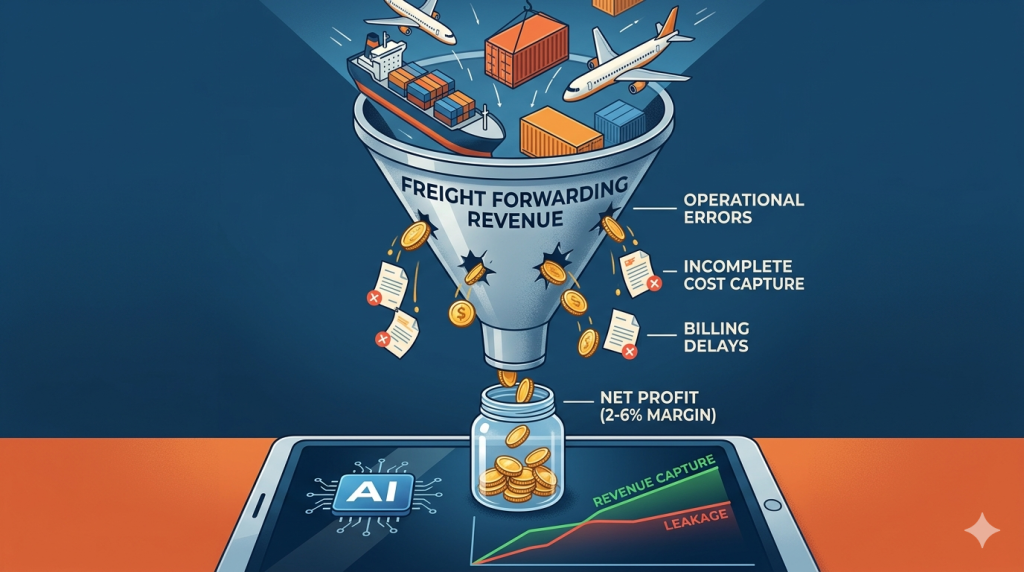
    Large global players such as Kuehne+Nagel, DSV and DHL Global Forwarding typically operate within a 3% to 6% net margin range under normal market conditions.

    Mid-sized and regional forwarders generally fall between 2% and 5%, while smaller forwarders often operate at 0% to 3%, with many hovering around break-even.

    Margins can temporarily expand during strong market cycles, as seen during the pandemic, but structurally the business remains tight.

    This leads to a simple but critical conclusion:

    Freight forwarding is not a margin expansion game. It is a margin protection game.

    B) Revenue Leakage: Where Profit Disappears

    Revenue leakage is rarely the result of one major failure. It is the accumulation of small, everyday issues across the shipment lifecycle.

    1. Operational Data Inaccuracies

    • Incorrect weights or volumes
    • Wrong chargeable calculations
    • Misaligned shipment details (POL, POD, Incoterms)

    These errors often result in underbilling or missed billing entirely.

    2. Incomplete Cost Capture

    • Missing surcharges (PSS, GRI, congestion fees)
    • Accessorial charges not recorded
    • Vendor invoices not matched properly

    In many systems, especially when automation is enabled, small discrepancies can pass through unnoticed.

    3. Delayed or Incorrect Billing

    • Jobs closed late
    • Revenue posted in the wrong period
    • Manual corrections leading to credit notes

    This affects not only revenue accuracy but also financial reporting and forecasting.

    4. Sales–Operations–Finance Misalignment

    • Quotes not fully aligned with execution
    • Costs incurred outside of quoted scope
    • Poor handover between teams

    This creates gaps where services are delivered but not fully monetized.

    5. Process Gaps and Manual Workflows

    • Reliance on spreadsheets or email instructions
    • Lack of validation checks
    • High dependency on individual experience

    These environments are prone to inconsistency, especially when workload increases.

    The Financial Impact

    Industry experience and internal assessments across forwarders consistently point to 1% to 3% of revenue lost through leakage.

    That may sound small. It is not.

    If a company operates at a 3% net margin:

    • 2% revenue leakage effectively reduces profit by up to two-thirds

    In some cases, it can eliminate profit entirely.

    Most forwarders are not losing money because of pricing. They are losing money because they are not capturing what they already earned.

    C) How AI Can Reduce Revenue Leakage

    This is where AI starts to shift the conversation. Not as a replacement for people, but as a control layer that continuously monitors and validates operations.

    1. Data Validation in Real Time

    AI can check shipment data against historical patterns and business rules:

    • Flag unusual weight-to-volume ratios
    • Detect incorrect routing or missing fields
    • Identify inconsistencies between booking, execution, and billing

    Instead of relying on periodic audits, issues are identified as they occur.

    2. Automated Charge Verification

    AI can compare:

    • Quoted charges vs. executed services
    • Vendor invoices vs. expected costs
    • Applied surcharges vs. applicable conditions

    This ensures that all billable items are captured before invoicing.

    3. Exception-Based Management

    Rather than reviewing every shipment, AI highlights:

    • Missing charges
    • Margin deviations
    • Late job closures

    Teams focus only on exceptions, improving both efficiency and accuracy.

    4. Pattern Recognition and Learning

    Over time, AI learns:

    • Typical customer behaviors
    • Common operational errors
    • Seasonal or trade lane variations

    This allows the system to proactively flag risks before they become financial issues.

    5. Continuous Monitoring Without Fatigue

    Unlike manual processes:

    • AI does not overlook small values
    • AI does not slow down during peak periods
    • AI does not depend on staffing levels

    It provides a consistent control mechanism across the business.

    Summary

    Freight forwarding operates on thin margins, typically between 2% and 6%, depending on scale and market conditions. In such an environment, even small inefficiencies can have a disproportionate impact on profitability.

    Revenue leakage, often in the range of 1% to 3% of revenue, is one of the most overlooked challenges in the industry. It stems from everyday operational gaps, data inaccuracies, and misalignment between teams.

    The real opportunity is not just to grow revenue, but to protect it.

    AI offers a practical way forward by introducing real-time validation, automated checks, and exception-based management. It allows forwarders to move away from reactive auditing and toward proactive control.

    In a business where margins are tight and competition is high, the companies that succeed will not necessarily be the ones that sell more.

    They will be the ones that capture what they already earn.

  • Aligning Strategy and Technology in Freight Forwarding: Why Execution Matters More Than Software

    Introduction

    Freight forwarding is at an inflection point.

    On one side, digital-native players have shown that technology alone does not guarantee success. On the other, traditional forwarders that resist modernization risk gradual erosion of competitiveness.

    The real challenge is not choosing between “digital” or “traditional.”
    It is aligning business economics with the right technology — in the right sequence.

    Many forwarders fail not because they lack software, but because their strategy, processes, and systems are misaligned. This is where structured business alignment becomes critical.

    The Core Problem: Strategy and IT Often Move Separately

    In many organizations:

    • The management team defines commercial targets.
    • Operations focus on service execution.
    • IT implements tools in isolation.

    The result is fragmented transformation.

    Systems are installed without redesigning processes.
    Automation is introduced without cleaning master data.
    AI tools are layered onto inconsistent workflows.

    Technology becomes an expense instead of a performance lever.

    True digitization begins with business alignment — not software selection.

    What Business Alignment Really Means

    Business alignment in freight forwarding involves answering fundamental questions:

    • Which customer segments are truly profitable?
    • Which trade lanes generate consistent margin?
    • Where does operational cost leak?
    • Which processes create bottlenecks?
    • How exposed is the company to rate cycles and working capital strain?

    Without clarity on these fundamentals, digitization becomes cosmetic.

    Alignment means defining:

    1. A clear commercial strategy
    2. A disciplined pricing and procurement model
    3. Standardized operational workflows
    4. Measurable performance indicators
    5. A realistic digital roadmap

    Only then should technology be layered in.

    The Role of Modern IT Partners

    Forwarders do not need to build technology internally.
    They need to integrate the right capabilities.

    Modern IT providers in the logistics sector offer solutions such as:

    • AI-driven data extraction from emails and documents
    • Automated rate management systems
    • Digital booking interfaces
    • Carrier integration tools
    • Compliance automation
    • Visibility and control tower platforms

    But tools must serve a defined objective.

    For example:

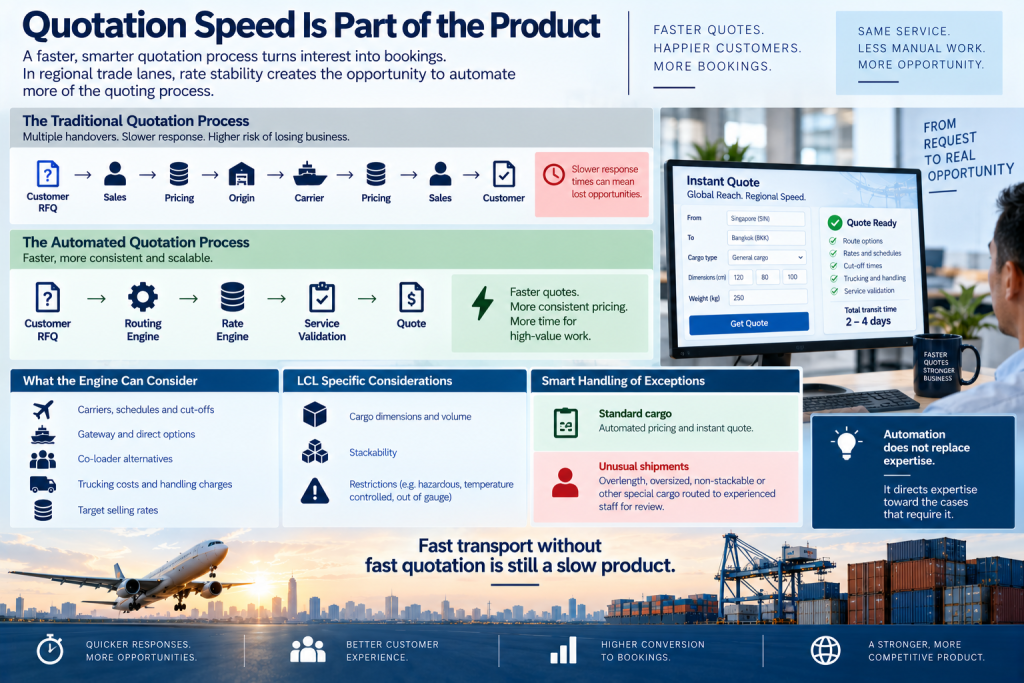
    If quoting speed is the issue, implement structured rate databases and automated comparison engines.

    If margin leakage is the issue, implement profitability dashboards and financial controls.

    If operational errors are frequent, automate document validation and milestone tracking.

    The mistake is adopting tools without linking them to measurable business outcomes.

    A Structured Transformation Approach

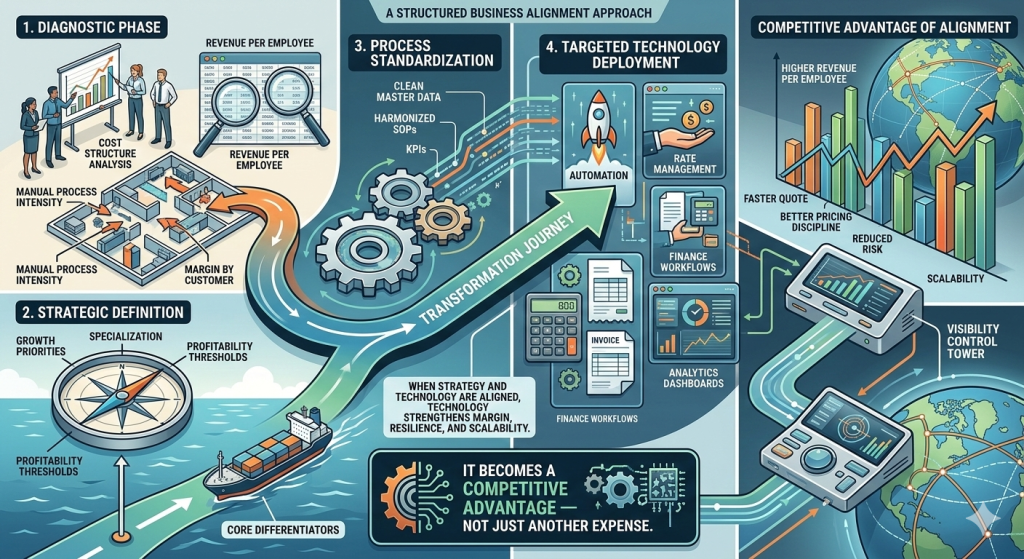
    Effective transformation follows a clear sequence:

    1. Diagnostic Phase

    • Analyze cost structure
    • Review revenue per employee
    • Identify manual process intensity
    • Map margin by customer and trade

    2. Strategic Definition

    • Define growth priorities
    • Clarify specialization areas
    • Set profitability thresholds
    • Identify core differentiators

    3. Process Standardization

    • Clean master data
    • Harmonize SOPs
    • Define escalation logic
    • Create measurable KPIs

    4. Targeted Technology Deployment

    • Introduce automation in repetitive tasks
    • Implement rate management tools
    • Integrate finance workflows
    • Deploy analytics dashboards

    This ensures that technology enhances economics rather than obscuring weaknesses.

    The Competitive Advantage of Alignment

    When strategy and technology are aligned, forwarders gain:

    • Higher revenue per employee
    • Faster quote turnaround
    • Better pricing discipline
    • Reduced operational risk
    • Stronger capital control
    • Scalability without proportional headcount growth

    Digitization becomes a profit amplifier — not a branding exercise.

    Why External Guidance Matters

    Internal teams often struggle with transformation because:

    • Operational teams are absorbed in daily execution
    • IT teams focus on implementation, not strategy
    • Leadership lacks neutral benchmarking

    An external advisory partner can bridge commercial strategy and technical execution, ensuring that:

    • Business objectives drive system selection
    • IT investments are prioritized based on economic impact
    • Implementation avoids unnecessary complexity
    • Change management is structured and realistic

    This prevents both under-digitization and over-investment.

    Summary

    Freight forwarding is not saved by technology alone, nor protected by tradition alone.

    The companies that will lead the next decade are those that:

    • Understand freight economics deeply
    • Define clear commercial priorities
    • Standardize and discipline operations
    • Deploy targeted, well-integrated technology

    Digital transformation is not about replacing people with software.

    It is about aligning strategy, process, and systems so that technology strengthens margin, resilience, and scalability.

    When business alignment comes first, IT becomes a competitive advantage — not just another expense line.

  • The Hidden Risks of Staying Analog: What Happens If Freight Forwarders Fail to Digitize

    Introduction

    For many traditional freight forwarders, the business case for digitization can feel overstated. If margins are stable, customers are loyal, and operations run “well enough,” the urgency to modernize may appear low.

    After all, freight forwarding has survived decades of change.

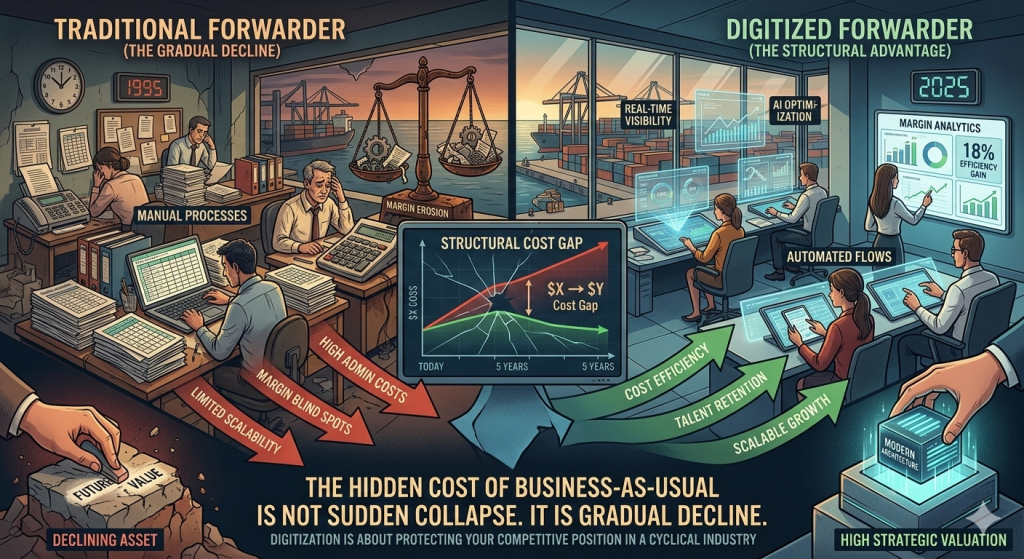
    But the real risk of failing to digitize is not sudden collapse. It is gradual competitive erosion. Forwarders that continue operating under a business-as-usual model may remain profitable in the short term — yet steadily lose structural advantage in the long term.

    The danger is not disruption. It is decline.

    1. Structural Cost Disadvantage

    Digitized competitors operate with:

    • Fewer people per shipment
    • Lower error rates
    • Automated billing cycles
    • Faster quote turnaround
    • Better margin visibility

    Over time, this creates higher revenue per employee and stronger cost efficiency.

    Traditional forwarders that rely on manual processes carry higher administrative costs. Initially, this may not be visible. But as automation spreads, cost gaps widen.

    Eventually, competitors can either:

    • Undercut pricing while maintaining margin, or
    • Reinvest efficiency gains into sales and growth

    The non-digitized forwarder becomes structurally less competitive.

    2. Margin Blind Spots

    Manual systems often mean:

    • Fragmented rate data
    • Limited real-time profitability tracking
    • Inconsistent branch-level reporting
    • Delayed financial visibility

    Without integrated data, pricing discipline weakens. It becomes harder to:

    • Identify unprofitable customers
    • Track margin erosion by trade lane
    • React quickly to carrier rate changes

    Digitization does not guarantee higher margins — but it enables transparency. Without that visibility, forwarders risk making decisions based on incomplete information.

    3. Increasing Customer Expectations

    Large shippers increasingly expect:

    • API connectivity
    • Automated document exchange
    • Real-time milestone visibility
    • Data reporting dashboards
    • Integration with ERP systems

    Even if customers tolerate manual processes today, procurement standards evolve.

    Forwarders unable to meet digital interface requirements may find themselves excluded from tenders — not because of poor service, but because of integration limitations.

    Gradually, they are pushed toward smaller accounts and more price-sensitive segments.

    4. Talent Drain and Operational Fragility

    Non-digitized operations often rely heavily on individual experience and informal knowledge.

    This creates two risks:

    1. Key-person dependency — when senior staff leave, operational stability weakens.
    2. Talent attraction challenges — younger professionals prefer data-driven environments over manual, spreadsheet-heavy workflows.

    Over time, the organization becomes less scalable and more vulnerable to turnover.

    Digitization distributes knowledge across systems rather than individuals.

    5. Limited Scalability

    Manual operations can handle moderate volume efficiently — but scaling requires proportional headcount increases.

    Digitized forwarders can grow shipment volume faster without linear staff growth.

    Traditional forwarders face a choice:

    • Hire more people to grow
    • Or cap growth to maintain control

    Both limit long-term expansion potential.

    6. M&A and Valuation Pressure

    In consolidation cycles, buyers increasingly value:

    • Standardized systems
    • Clean data architecture
    • Integrated reporting
    • Automated workflows

    Forwarders that fail to digitize may still be profitable — but their valuation multiples may suffer due to modernization costs required post-acquisition.

    In other words, they remain viable businesses but become less attractive strategic assets.

    7. Risk Exposure in a More Complex World

    Trade compliance, sanctions regimes, ESG reporting, and customs regulation are becoming more complex.

    Digitized systems allow:

    • Automated compliance checks
    • Data-driven audit trails
    • Faster regulatory reporting

    Manual models increase exposure to errors, fines, and compliance breaches.

    In a world of tightening regulation, process control becomes a competitive advantage.

    Summary

    Freight forwarders that fail to digitize will not disappear overnight. Strong relationships and disciplined economics can sustain them for years.

    But the risks accumulate gradually:

    • Higher structural costs
    • Reduced margin visibility
    • Exclusion from digital tenders
    • Talent attrition
    • Scalability limits
    • Lower strategic valuation

    Digitization is not about following a trend. It is about protecting competitive position in an industry where margins are thin and cycles are unforgiving.

    In freight, survival depends on economics.
    In the long run, economics depend on efficiency.

    And efficiency increasingly depends on digital capability.

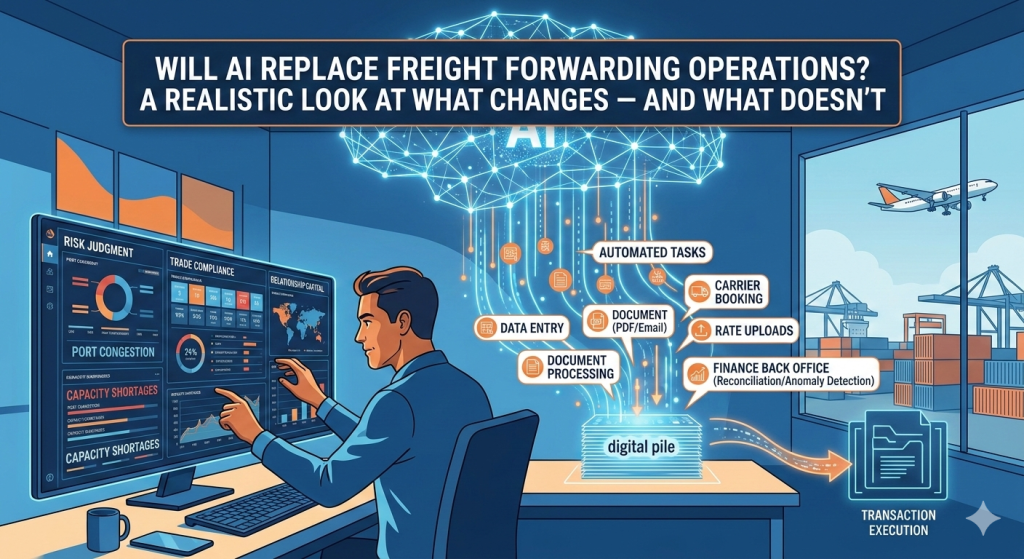
  • Will AI Replace Freight Forwarding Operations? A Realistic Look at What Changes – and What Doesn’t

    Introduction


    There is a growing belief that freight forwarding is on the brink of a major workforce reduction. The logic seems straightforward: if artificial intelligence can handle bookings, customs interfaces, documentation, invoicing, and reporting, then the need for large operational teams should disappear.

    At first glance, this argument is compelling. Much of freight forwarding is process-driven, repetitive, and rule-based. These are precisely the areas where AI performs well.

    But while AI will significantly reshape operations, it will not eliminate the structural complexity of freight. The future will not be “no humans.” It will be fewer transactional roles and more judgment-driven roles.

    Understanding that distinction is critical.

    1. What AI Will Replace

      AI will dramatically reduce manual work in three core areas:

      A. Data Entry and Document Processing

      Shipment creation, milestone updates, draft BL checks, invoice matching, rate uploads, customs documentation formatting — these tasks are structured and repetitive.

      AI systems already extract, validate, and populate structured data from emails, PDFs, and messaging platforms. Over time, these functions will require minimal human intervention.

      B. Transaction Execution

      Carrier booking, routing selection, rate comparison, and service validation can all be automated when rate data is structured and business rules are defined.

      Technically, AI is capable of executing bookings and validating service conditions. The real barrier is not capability — it is data cleanliness and system integration.

      C. Finance Back Office

      Accounts receivable reminders, payables matching, statement reconciliation, margin reporting, and even intercompany netting are highly rules-based.

      AI-driven anomaly detection can flag discrepancies, while automated workflows manage routine processes. Finance teams will shrink in size but become more analytical in focus.

      In short, repetitive operational roles will decline significantly.
    2. What AI Will Not Easily Replace

      Despite these gains, freight forwarding is not purely transactional. Several areas resist full automation.

      A. Risk Judgment Under Uncertainty

      Freight operates in constant ambiguity:

      Port congestion
      Sanctions and trade compliance risk
      Capacity shortages
      Sudden regulatory changes
      Customer credit exposure

      AI can detect patterns, but strategic trade-offs under uncertainty require experience. Deciding whether to prioritize a volatile high-margin customer over a stable long-term client is not just data-driven — it is commercial judgment.

      B. Relationship Capital

      Freight is still relationship-heavy, especially in tight markets.
      Securing space during peak season, negotiating demurrage waivers, extending credit terms, or resolving customs bottlenecks often depend on human trust and networks. AI does not build that capital.

      C. Accountability and Liability

      When shipments fail, delays occur, or claims arise, companies need accountable individuals.

      Contracts are signed by humans. Negotiations are handled by humans. Liability cannot be delegated to an algorithm.
    3. The Likely Future Structure

      The forwarder of the future will not eliminate people. It will reorganize them.

      A plausible structure includes:

      Commercial Core: Strategic sales, pricing specialists, key account managers
      Control Tower / Exception Team: Escalation managers, compliance experts, risk controllers
      Technology & Data Layer: AI oversight, system integration, data governance
      Procurement & Carrier Relations: Contract negotiation and capacity strategy
      Lean Finance: Oversight and financial analytics

      The large middle layer of shipment processing executives will shrink. Revenue per employee will rise. The organization becomes more concentrated around high-value decision-making.
    4. The Hidden Constraint: Data Quality

      All of this depends on clean master data, structured rate databases, standardized SOPs, and integrated systems.
      AI does not fix disorganized processes. It amplifies them.
      Companies that digitize chaotic foundations will not see transformative results. Companies that clean their data and standardize processes first will benefit the most.
    5. Where Differentiation Moves

      As AI absorbs transactional work, competitive advantage shifts.

      It will no longer be about:

      Faster booking input
      Cheaper documentation processing
      Invoice accuracy
      Instead, differentiation will center on:
      Industry specialization
      Risk management capability
      Network strength
      Financial stability
      Advisory capability for customers

      Technology becomes infrastructure. Judgment becomes value.

      Summary

      AI will significantly reduce repetitive operational roles in freight forwarding. Data entry, transaction execution, and back-office processing will become increasingly automated.

      However, freight remains a cyclical, risk-sensitive, relationship-driven industry. Strategic judgment, accountability, and trust cannot be automated away.

      The future is not a human-free forwarder. It is a leaner organization where low-value tasks disappear and high-accountability roles increase in importance.

      In practical terms, AI will compress the middle layer of operations — but elevate the value of leadership, commercial strategy, and risk management.

      Freight will change.

      Its economic DNA will not.
  • The Importance of a Realistic ROI when Implementing Technology in SME Freight Forwarders

    Small and medium-sized freight forwarders operate in one of the most margin-sensitive industries in the world. With razor-thin profits, unpredictable market cycles, and constant pressure from global players, every dollar spent must deliver measurable value. This financial discipline — while commendable — often becomes a barrier when it comes to digital transformation.

    Most SME forwarders are self-financed. They invest only what they earn, rarely turning to banks for funding. Their capital allocation decisions are driven by immediate operational needs: hiring an extra operations clerk when shipment volumes rise, or leasing additional warehouse space for a new customer. Investments that don’t directly contribute to visible revenue growth are often deferred — especially technology projects that promise “efficiency” or “future readiness” without a tangible link to new business.

    The ROI Challenge

    This mindset is understandable. In a business where gross margins often hover between 5–10%, forwarders can’t afford expensive missteps. The problem is that many technology initiatives are pitched in broad, aspirational terms — “digitalisation,” “automation,” “AI-driven insights” — without clear, quantifiable outcomes. For SME decision-makers, such projects can feel abstract, risky, and detached from daily operational realities.

    That’s why defining a realistic and specific ROI is crucial. Technology investments must be backed by solid use cases that directly address operational pain points:

    • Reducing invoice errors by automating billing and EDI exchanges
    • Shortening quote turnaround times through rate management tools
    • Improving shipment visibility with integrated tracking systems
    • Enhancing compliance accuracy via automated document checks

    When the ROI is defined in measurable terms — such as saving 3 man-hours per file, reducing invoice disputes by 50%, or winning additional RFQs through faster response times — the investment conversation becomes grounded and credible.

    Why ROI Drives Adoption

    The lack of clear ROI has long contributed to the industry’s status as a digital laggard. Many forwarders still rely on email, spreadsheets, and legacy systems because “the old way works.” However, as the logistics ecosystem evolves, the baseline for participation is changing.

    Technology is no longer a competitive advantage — it’s a minimum requirement. Shippers and global 3PLs now expect forwarders to submit electronic bids, provide online visibility, and exchange data seamlessly through APIs or digital platforms. Without these capabilities, even the most reliable forwarder risks being excluded from major RFQs.

    Making Digital Investments Work

    The path forward isn’t about adopting every new tool. It’s about strategic prioritisation — identifying where digital investments align with business outcomes. For SME forwarders, this means:

    1. Start with process pain points. Focus on bottlenecks that consume time or cause customer dissatisfaction.
    2. Quantify the benefit. Translate improvements into financial or capacity gains — e.g., freeing staff hours that can support more shipments.
    3. Validate through pilots. Begin small, measure the impact, and scale what works.
    4. Track ROI continuously. Treat technology as an ongoing business initiative, not a one-off project.

    The Bottom Line

    For SME freight forwarders, digitalisation isn’t a luxury — it’s the ticket to staying relevant. But survival depends not on buzzwords, but on realistic ROI. Forwarders who approach technology with the same financial discipline they apply to every other aspect of their business will find that well-planned digital investments can strengthen both margins and competitiveness — not by replacing people, but by enabling them to do more with less.

  • A2A: The Future of Corporate Agents

    In the emerging age of agentic AI, the next revolution in enterprise technology will not be about connecting systems — it will be about connecting agents.

    For years, corporations have relied on APIs, middleware, and data pipelines to integrate their business applications. These mechanisms, while powerful, are rigid and costly to maintain. The next wave — Agent-to-Agent (A2A) architecture — replaces technical integration with cognitive collaboration.


    From Automation to Autonomy

    Leading enterprise platforms are already embedding intelligent agents within their ecosystems:

    • Salesforce has introduced Agentforce, capable of interpreting user prompts and generating contextual CRM actions.
    • Workday integrates BP Optimize Agents to streamline workforce and process efficiency and Contingent sourcing platforms now use AI agents to autonomously match talent to projects based on skill and availability.
    • Cargowise, long known for logistics automation, is now advancing into agentic AI functions that reason across workflows rather than merely execute them.

    The difference is profound. Automation follows instructions; autonomy understands purpose. Each of these systems now hosts specialized agents capable of perception, reasoning, and communication — forming the foundation for true A2A ecosystems.


    Role-Based Agents: The Next Layer of Intelligence

    The natural evolution of this trend is the rise of role-based agents — AI entities designed to perform specialized corporate functions within defined boundaries.
    A few early examples illustrate the concept:

    • Financial Audit Agent for Workday Adaptive: constantly monitors ledgers, forecasts, and anomaly reports, ensuring compliance with internal controls and external standards. It flags inconsistencies, queries variances, and even drafts summary notes for CFO review.
    • Procurement Compliance Agent: embedded within ERP systems to ensure all supplier actions adhere to sustainability, ESG, and cost policies.
    • Sales Forecast Agent: within CRM systems, dynamically adjusting pipeline projections based on market sentiment and customer behaviour.
    • Logistics Coordination Agent: in platforms like Cargowise, continuously assessing shipment milestones, carrier reliability, and exception risks.

    Each of these agents operates within its system domain — interpreting local data, reasoning over role-specific goals, and interfacing with others via A2A orchestration.


    A2A: Agents That Talk to Agents

    In the coming landscape, there won’t be a single universal communication protocol connecting all corporate software. Instead, A2A agents will emerge as intelligent intermediaries that interpret intent, select the relevant domain agent, and coordinate the exchange.

    Consider a scenario:

    A regional operations director asks, “Provide a profitability forecast for next quarter.”

    The A2A layer springs into action:

    • The Financial Audit Agent in Workday Adaptive analyzes revenue and cost projections.
    • The Sales Forecast Agent in Salesforce Agentforce provides order pipeline probabilities.
    • The Logistics Coordination Agent in Cargowise estimates capacity utilization and transport cost exposure.
    • The A2A Orchestrator Agent interprets the results, reconciles inconsistencies, and generates a unified executive summary — without any human needing to manually transfer data or align formats.

    This is cross-agent reasoning, not just cross-system integration.


    Security and Risk Management by Design

    Traditional integrations expose multiple endpoints to external networks. Every connection is a potential vulnerability.
    A2A architecture simplifies and secures this: only one orchestrator agent — the “frontline negotiator” — is accessible via the internet.

    All role-based agents (finance, HR, operations, logistics, etc.) remain behind internal firewalls, accessible only through the orchestrator’s verified handshake.

    This model minimizes the attack surface, enhances auditability, and satisfies zero-trust policies by enforcing compartmentalized access. In effect, the enterprise becomes a network of trusted agents rather than a web of exposed APIs.


    Why It Matters for Operations and Supply Chain

    For logistics and supply chain operations, where multiple applications coexist — from TMS and WMS to ERP and CRM — A2A unlocks enormous potential.

    Agents within each system can perform their own reasoning: forecasting volume trends, identifying bottlenecks, or validating customs documentation. The A2A orchestrator then synchronizes the insights across departments.

    This architecture enables modular transformation — companies can evolve system by system, replacing or upgrading individual applications without disrupting the overall intelligence network.


    The Road Ahead

    Over the next five years, we will see enterprises deploy layered agent frameworks:

    1. System-native agents (Salesforce, Workday, Cargowise, SAP, etc.) performing role-based functions.
    2. A2A orchestrators interpreting intent, delegating tasks, and consolidating outputs.
    3. Governance agents ensuring traceability, security, and compliance across all interactions.

    This is not just the future of automation — it’s the future of enterprise cognition.

    Just as APIs defined the last decade of digital transformation, A2A will define the next: a world where intelligent, role-based agents collaborate seamlessly, securely, and autonomously to deliver real business outcomes.

  • The Freight Forwarding Industry

    Is it interesting to work in the freight forwarding industry? From a Senior Managers perspective.

    We need to be aware of global trade and supply chain issues affecting the movement of goods. We need to be aware of free trade agreements, customs requirements and documentation, port handling requirements pertaining to hazmat and cold chain, and understand trade financing for customers complying with letter of credits.

    On the sales side, there is high pressure to increase revenue, volume and profits in a market that is saturated and highly competitive with few USP’s. There are demanding customers who don’t always know what they want, don’t always understand freight forwarding, and constantly try to reduce cost. Customers often demand a high level of service at low rates, however tend to pay late for this service. And the odd customer will call you at 11pm at night to understand where their shipment is. Sales need to work with regional and global teams to manage key accounts, and work with other subsidiaries or agents to grow specific tradelanes. The tender management teams needs to fill out endless lines in RFQ excel sheets and legal/risk/insurance needs to be consulted on contractual clauses. Every customer is unique, but at the end of the day they use the same container, on the same ship, sailing on the same water.

    Operations bargain with the trucker to be at the customers warehouse at a very specific time, chase the ocean freight carrier for the bill of lading, haggle with the airline to ensure cargo is uplifted – even at late hours on a weekend, and they coordinate with overseas offices to ensure suppliers’ shipments are consolidated into the same container. Sometime we need to arrange an off-shore delivery during a public holiday when no one is around. Operations often chases sales for a copy of the customer quotation and any handling details mentioned by the customer. Occasionally they need to be insurance experts when customer claims arise. Operationally the pressure is high to complete milestones and do so within the specified KPI’s. Productivity relies on their proficiency using ERP’s and Microsoft office tools. 

    Procurement needs to bargain to reduce cost while maintaining a specific service level. They need to be well connected to operations to understand current demand, and be connected to sales to understand future demand. They need to be connected to the market to understand trends and carrier strategies.

    Financially there is constant pressure to ensure a healthy cashflow. Sales need to be chased to ensure AR’s look healthy, AP’s need to be settled on time to ensure the vendor doesn’t stop working with us, operations needs to be chased to bill accurately on time, to generate mid-month revenue and GP forecasts, and perform month end closing. When there appears to be revenue leakage operations needs to be chased to perform deep dives. There needs to always be sufficient cash in the account to settle sudden large customs outlays for duties and taxes, or the occasional charter shipment. Besides the day-to-day accounting which includes netting, there’s the financial forecasting, monthly reporting, budgeting, monitoring OPEX and coordination with treasury. Occasionally Finance will help management with an investment request that includes CAPEX, from a new truck, renovation or a new branch office.

    For HR, there is a constant movement in staff. Like any other industry freight forwarders hire people straight out of university up to senior management levels. Low to mid-level staff tend to move regularly, especially in high stress environments. While working in the freight forwarding industry is very rewarding in terms of gaining knowledge about different industries, global trade, different cultures, the pay often doesn’t seem to commensurate with the working stress level. HR is therefore always busy with the usual comings and goings, but also with strategic initiatives trying to attract new staff. And sometimes HR has to assist staff that want to relocate to the other side of the planet. For staff motivation HR arranges parties, gatherings and events around health and sustainability.

    On the compliance side there is financial compliance where we need to comply with rules on transfer pricing and anti-corruption. Operationally we need to comply with customs regulations, ensure QMS, schemes and licenses are adhered to and lived, and ensure we adhere to laws regarding sanctioned parties and countries. In terms of QC, compliance will chase operations to capture those NC’s, perform the RCA and issue and close out CAR’s – all before the customer gets frustrated.

    On the management side we need to ensure all these components are aligned and work together smoothly, implement regional/global plans, guidelines and budgets, provide short/mid/long term direction and goals, give staff the tools they need to complete their jobs, hold townhall gatherings answering any questions the staff has, troubleshoot and engage when issues arise – internally or externally, ensure a healthy working relationship with regional and global teams, as well as the global network of branch offices, be the main marketing officer of the company and the branch/subsidiary, and ensure all regulatory requirements are complied with. At times we need to roll up our sleeves and read customer SOP’s, tackle alignment issues between operations and sales, or operate the forklift. Occasionally we work with legal to sue a customer that doesn’t pay, sign a block space agreement with an airlines, approve payments to vendors and the payroll or create a business case for the setup of a new branch or department. All in all, as senior management we are expected to know everything and always be encouraging, motivational, positive and accessible.

    FreightForwarding #SupplyChainLeadership #LogisticsLife

    GlobalTrade #OperationsManagement #B2BSales

    ProcurementStrategy #CashFlowMatters #ComplianceInFocus

    HRChallenges #SeniorLeadership #ConsultingLife

    FromOperationsToConsulting #LogisticsConsultant

    BusinessStrategy #CrossFunctionalLeadership

  • 🚢 Large vs. Small Freight Forwarders: What Makes Them Tick?

    Post 7/7: What Happens When They Compete Outside Their Sweet Spot

    When small forwarders pursue large global clients:

    • They may underprice or overcommit.
    • Risk reputational damage if execution fails.
    • Lose focus on their core SME base.

    When large forwarders pursue small clients:

    • Clients may feel neglected or priced out.
    • Service personalization often suffers.
    • Internal processes may not suit transactional needs.

    Bottom line:
    The winners understand their lane—and stay in it or grow with clarity.

    #LogisticsLeadership #FreightForwarding #SupplyChainStrategy #LargeVsSmall #Forwarders #SME #GlobalForwarding #BusinessStrategy #CorporateStructure #FreightForwardingStrategy #ClientFit #ForwarderGrowth #BusinessScaling #CustomerCentricity #LocalExpertise #ForwarderTech #Digitization