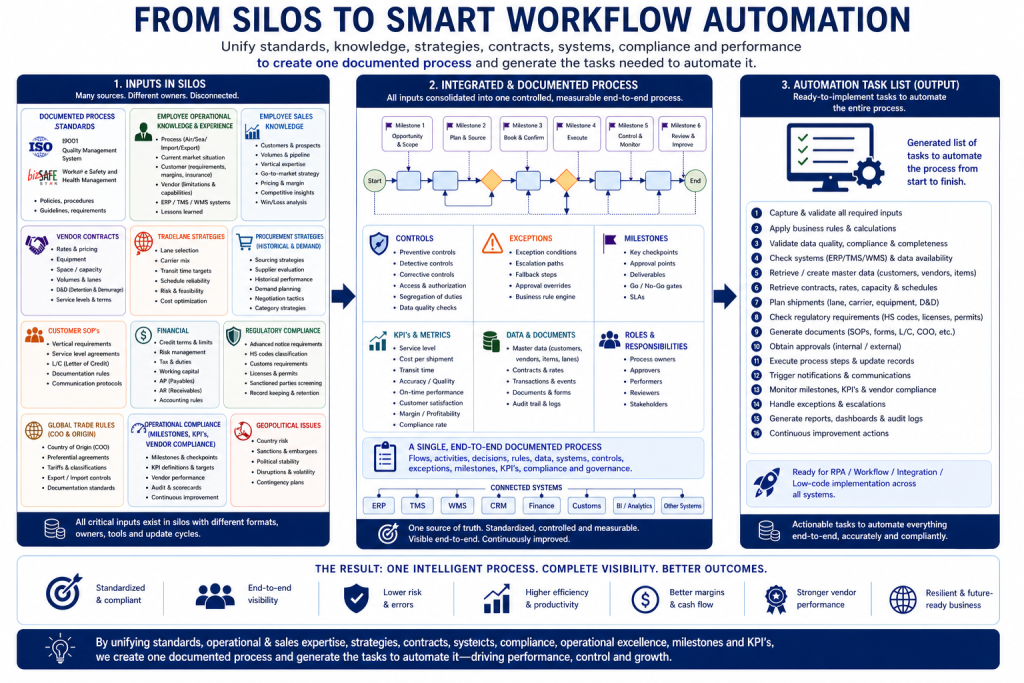
There’s a growing frustration around how slowly the freight forwarding and logistics industry is adopting automation. Many IT vendors have entered the space with strong expectations, only to step back after struggling to gain traction. From the outside, it often looks like resistance to change. From the inside, the reality is more complicated.
At first glance, freight forwarding appears highly repetitive. Emails, documents, shipment updates, billing. It feels like an ideal candidate for automation. But once you look closer, the process is not just a sequence of tasks. It’s a web of decisions, exceptions, and dependencies.
A single shipment can involve:
- Customer-specific SOPs and service expectations
- Vendor constraints on space, equipment, and routing
- Rapidly changing market conditions
- Financial considerations such as margins, credit limits, and working capital
- Regulatory requirements including customs, licenses, and trade compliance
- System limitations across ERP, TMS, and WMS platforms
- Geopolitical disruptions affecting routes and costs
None of this sits in one place.
The real challenge is not technology. It’s fragmentation.
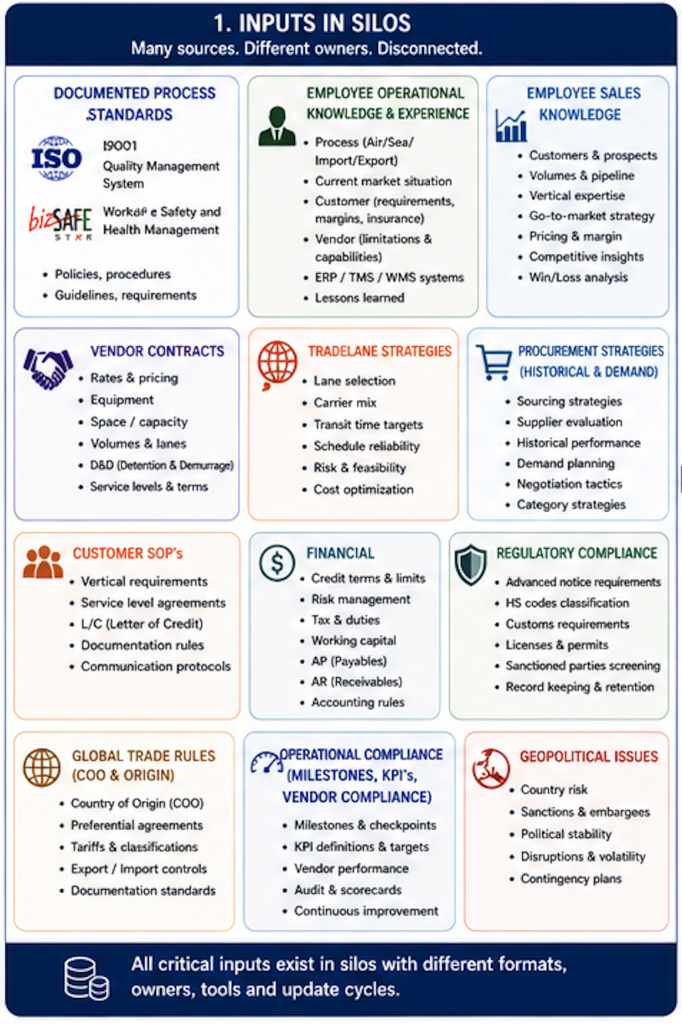
Knowledge is spread across:
- Operations teams who understand how shipments actually move
- Sales teams who know the customer, volumes, and pricing strategy
- Procurement teams managing carriers and contracts
- Finance teams controlling risk and revenue recognition
- Compliance teams managing regulatory exposure
Each group holds a piece of the process. Very little of it is fully documented end-to-end.
This creates two core problems.
First, processes are often incomplete. What exists in SOPs typically covers the “standard case,” but not the real-world exceptions that happen daily. Automation struggles in environments where exceptions are not clearly defined.
Second, decision-making is embedded in people, not systems. Experienced operators constantly make judgment calls based on context. Vendor reliability, customer sensitivity, margin pressure, or shipment urgency. These decisions are rarely written down, but they are critical to execution.
When IT vendors try to automate such environments, they face a moving target. What looks like a simple workflow quickly expands into a complex set of rules, exceptions, and dependencies. Implementation timelines stretch. Scope increases. Confidence drops. Eventually, projects stall or are abandoned.
This is why many automation initiatives in freight forwarding fail before they even begin. Not because the technology doesn’t work, but because the process is not ready.
There is a way forward, but it requires a shift in approach.
Automation should not start with tools. It should start with clarity.
Companies need to:
- Document processes beyond the standard flow, including exceptions and controls
- Consolidate knowledge from operations, sales, procurement, finance, and compliance
- Define decision logic where possible, and clearly separate what remains judgment-based
- Align data structures across systems
- Establish milestones, KPIs, and ownership
Only then does automation become practical.
When this foundation is in place, something changes. The process becomes visible. Dependencies are understood. Tasks can be broken down. At that point, automation is no longer an abstract concept. It becomes a series of clearly defined steps that can be implemented.
The industry is not slow because it resists automation. It’s slow because the underlying processes are complex, fragmented, and often undocumented.
Once that is addressed, automation doesn’t just become possible. It becomes inevitable.
Leave a Reply
You must be logged in to post a comment.