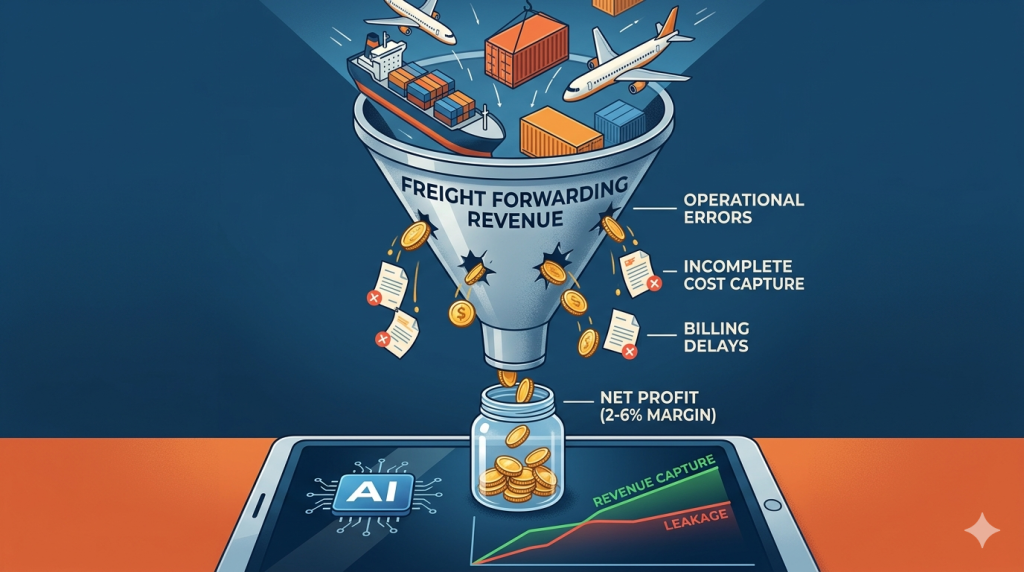
Freight forwarding is often misunderstood from the outside. On paper, it looks like a high-revenue business moving large volumes of cargo across the globe. In reality, it operates on tight margins, complex processes, and constant pressure on cost and pricing.
Many forwarders focus heavily on growing revenue. Fewer take a hard look at what actually remains at the bottom line. The uncomfortable truth is this: in a low-margin industry, small inefficiencies can quietly erode a large portion of profit.
To understand where the opportunity lies, we need to look at three things:
- What the industry actually earns
- Where profit is lost
- How technology, particularly AI, can help recover it
A) Average Net Margins in Freight Forwarding
Across the industry, net margins are consistently low.
Large global players such as Kuehne+Nagel, DSV and DHL Global Forwarding typically operate within a 3% to 6% net margin range under normal market conditions.
Mid-sized and regional forwarders generally fall between 2% and 5%, while smaller forwarders often operate at 0% to 3%, with many hovering around break-even.
Margins can temporarily expand during strong market cycles, as seen during the pandemic, but structurally the business remains tight.
This leads to a simple but critical conclusion:
Freight forwarding is not a margin expansion game. It is a margin protection game.
B) Revenue Leakage: Where Profit Disappears
Revenue leakage is rarely the result of one major failure. It is the accumulation of small, everyday issues across the shipment lifecycle.
1. Operational Data Inaccuracies
- Incorrect weights or volumes
- Wrong chargeable calculations
- Misaligned shipment details (POL, POD, Incoterms)
These errors often result in underbilling or missed billing entirely.
2. Incomplete Cost Capture
- Missing surcharges (PSS, GRI, congestion fees)
- Accessorial charges not recorded
- Vendor invoices not matched properly
In many systems, especially when automation is enabled, small discrepancies can pass through unnoticed.
3. Delayed or Incorrect Billing
- Jobs closed late
- Revenue posted in the wrong period
- Manual corrections leading to credit notes
This affects not only revenue accuracy but also financial reporting and forecasting.
4. Sales–Operations–Finance Misalignment
- Quotes not fully aligned with execution
- Costs incurred outside of quoted scope
- Poor handover between teams
This creates gaps where services are delivered but not fully monetized.
5. Process Gaps and Manual Workflows
- Reliance on spreadsheets or email instructions
- Lack of validation checks
- High dependency on individual experience
These environments are prone to inconsistency, especially when workload increases.
The Financial Impact
Industry experience and internal assessments across forwarders consistently point to 1% to 3% of revenue lost through leakage.
That may sound small. It is not.
If a company operates at a 3% net margin:
- A 2% revenue leakage effectively reduces profit by up to two-thirds
In some cases, it can eliminate profit entirely.
Most forwarders are not losing money because of pricing. They are losing money because they are not capturing what they already earned.
C) How AI Can Reduce Revenue Leakage
This is where AI starts to shift the conversation. Not as a replacement for people, but as a control layer that continuously monitors and validates operations.
1. Data Validation in Real Time
AI can check shipment data against historical patterns and business rules:
- Flag unusual weight-to-volume ratios
- Detect incorrect routing or missing fields
- Identify inconsistencies between booking, execution, and billing
Instead of relying on periodic audits, issues are identified as they occur.
2. Automated Charge Verification
AI can compare:
- Quoted charges vs. executed services
- Vendor invoices vs. expected costs
- Applied surcharges vs. applicable conditions
This ensures that all billable items are captured before invoicing.
3. Exception-Based Management
Rather than reviewing every shipment, AI highlights:
- Missing charges
- Margin deviations
- Late job closures
Teams focus only on exceptions, improving both efficiency and accuracy.
4. Pattern Recognition and Learning
Over time, AI learns:
- Typical customer behaviors
- Common operational errors
- Seasonal or trade lane variations
This allows the system to proactively flag risks before they become financial issues.
5. Continuous Monitoring Without Fatigue
Unlike manual processes:
- AI does not overlook small values
- AI does not slow down during peak periods
- AI does not depend on staffing levels
It provides a consistent control mechanism across the business.
Summary
Freight forwarding operates on thin margins, typically between 2% and 6%, depending on scale and market conditions. In such an environment, even small inefficiencies can have a disproportionate impact on profitability.
Revenue leakage, often in the range of 1% to 3% of revenue, is one of the most overlooked challenges in the industry. It stems from everyday operational gaps, data inaccuracies, and misalignment between teams.
The real opportunity is not just to grow revenue, but to protect it.
AI offers a practical way forward by introducing real-time validation, automated checks, and exception-based management. It allows forwarders to move away from reactive auditing and toward proactive control.
In a business where margins are tight and competition is high, the companies that succeed will not necessarily be the ones that sell more.
They will be the ones that capture what they already earn.
Leave a Reply
You must be logged in to post a comment.