Tag: CorporateStructure

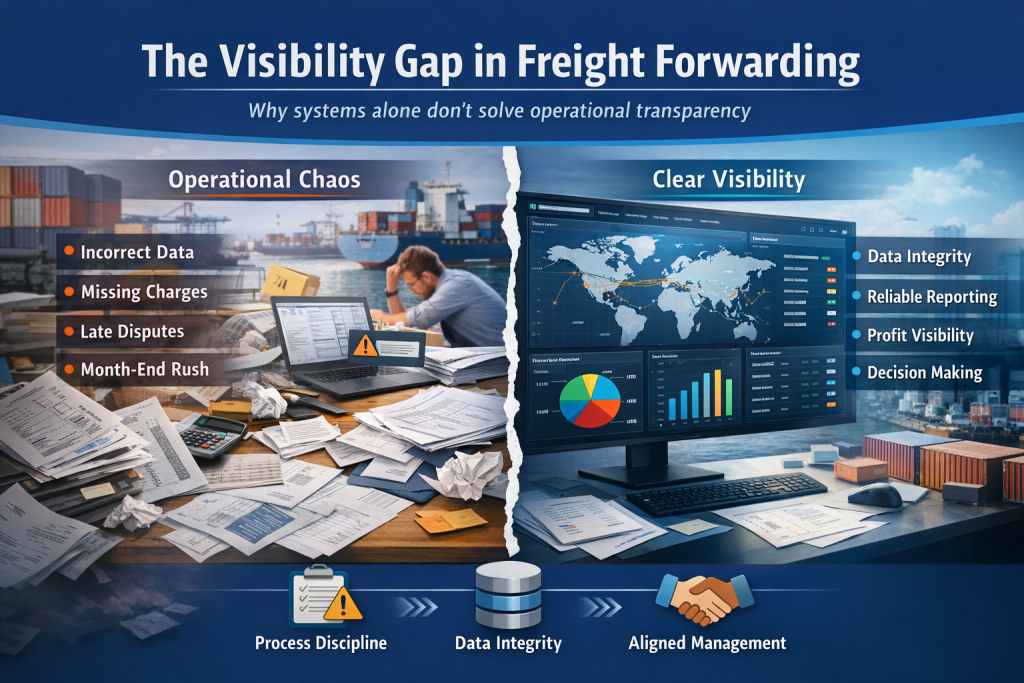
  • Why Many Freight Forwarders Struggle With Visibility

    Freight forwarding companies invest heavily in systems, processes, and certifications. Most run complex operating platforms, accounting tools, and quality systems designed to keep operations under control.

    Yet despite these investments, many management teams still struggle with a basic problem: they lack clear operational visibility.

    Monthly reporting takes too long. Forecasts are unreliable. Disputes appear weeks after shipments are completed. And management meetings often revolve around explaining numbers rather than making decisions.

    In my experience, this is rarely a technology problem. It is usually a combination of process discipline, data integrity, and operational alignment.

    Below are some of the recurring issues that quietly undermine visibility in freight forwarding operations.

    The Data Integrity Problem

    Operational systems are only as good as the data entered into them. When shipment details such as products, volumes, client names, or port pairs are entered incorrectly, the consequences cascade throughout the organization.

    Reports become unreliable. Trade lane analysis becomes distorted. And management ends up questioning the numbers rather than acting on them.

    Small inconsistencies in operational data can ultimately make strategic planning difficult.

    Revenue Leakage and Billing Friction

    Revenue leakage is rarely the result of large errors. More often it is caused by small operational gaps:

    • incidental costs that were never billed
    • disputes that are resolved months after the shipment moved
    • incorrect invoice dates or missing accruals
    • supplier invoices arriving long after the job should have been closed

    Individually these issues may seem minor. Across thousands of shipments they can significantly impact margins, cash flow, and financial reporting.

    In many organizations, these problems are amplified when operational processes rely heavily on automation without sufficient control points.

    The Month-End Chaos Cycle In some companies, the end of every month looks the same.

    Operations rush to close shipment files to ensure revenue is recognized in the current period. Finance scrambles to reconcile missing costs and issue corrections. Forecasts become difficult because the timing of billing is inconsistent.

    Instead of focusing on analysis and decision making, finance teams spend valuable time correcting operational data.

    When this pattern repeats month after month, reporting becomes reactive rather than strategic.

    Sales, Operations, and Finance Misalignment

    Freight forwarding is highly dependent on coordination between departments.

    When sales teams fail to pass complete information to operations, billing problems arise. When operational details are not documented properly, clients become frustrated. When disputes and credit notes increase, payment cycles slow down.

    These issues often appear operational on the surface but are ultimately symptoms of misalignment between commercial and operational processes.

    Limited Visibility Into Performance

    Many companies believe they have strong visibility into their business until they start asking deeper questions:

    • Which clients are actually profitable?
    • Which carriers consistently underperform?
    • Where are billing disputes originating?
    • Which trade lanes are truly growing?

    Without reliable data capture across quoting, operations, billing, and carrier performance, these questions become difficult to answer with confidence.

    Strategic discussions about trade lane development or network performance then become largely speculative.

    Process Discipline vs. Process Documentation

    Most freight forwarders have documented processes. Many hold certifications such as ISO 9001. Yet documentation alone does not guarantee operational discipline.

    Audits are often prepared at the last minute. Process errors are corrected informally rather than systematically. Training gaps appear as experienced staff compensate for weaker system users.

    Over time this creates a situation where key individuals become indispensable simply because they are holding the operational structure together.

    The Hidden Complexity of Freight Operations

    Freight forwarding is inherently complex.

    Rates vary by routing, carrier, and equipment. Charges are structured differently across countries. Networks apply different markups and charge codes. Clients increasingly require digital integrations such as e-invoicing.

    Trying to automate quoting, billing, and reporting within this environment is not straightforward. Without strong governance around data, processes, and responsibilities, systems alone cannot solve the problem.

    A Management Challenge, Not a Technology Challenge

    When companies struggle with operational visibility, the first instinct is often to look for a new system or additional automation.

    In reality, the root causes are usually much more fundamental:

    • inconsistent operational discipline
    • incomplete data capture
    • weak process ownership
    • lack of alignment between departments

    Until these foundations are addressed, additional technology often adds complexity rather than clarity.

    Final Thoughts

    Freight forwarding companies operate in a demanding environment where margins are thin and operational complexity is high. Achieving true visibility requires more than just systems and reports.

    It requires a clear understanding of where operational data originates, how processes interact across departments, and where control points are needed to prevent small issues from becoming systemic problems.

    For leadership teams, improving visibility is not about adding more dashboards. It is about ensuring that the underlying operational structure produces reliable information in the first place.
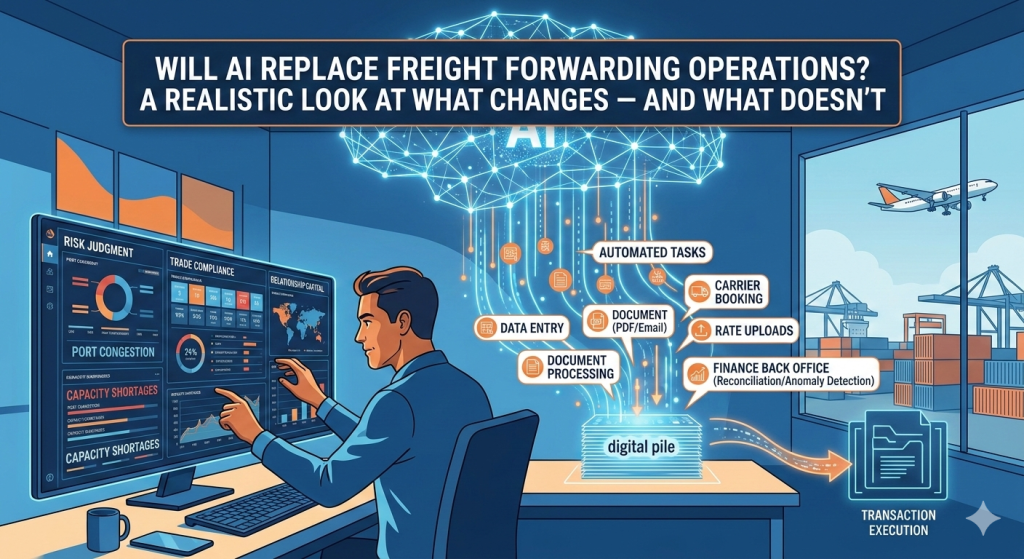
  • Will AI Replace Freight Forwarding Operations? A Realistic Look at What Changes – and What Doesn’t

    Introduction


    There is a growing belief that freight forwarding is on the brink of a major workforce reduction. The logic seems straightforward: if artificial intelligence can handle bookings, customs interfaces, documentation, invoicing, and reporting, then the need for large operational teams should disappear.

    At first glance, this argument is compelling. Much of freight forwarding is process-driven, repetitive, and rule-based. These are precisely the areas where AI performs well.

    But while AI will significantly reshape operations, it will not eliminate the structural complexity of freight. The future will not be “no humans.” It will be fewer transactional roles and more judgment-driven roles.

    Understanding that distinction is critical.

    1. What AI Will Replace

      AI will dramatically reduce manual work in three core areas:

      A. Data Entry and Document Processing

      Shipment creation, milestone updates, draft BL checks, invoice matching, rate uploads, customs documentation formatting — these tasks are structured and repetitive.

      AI systems already extract, validate, and populate structured data from emails, PDFs, and messaging platforms. Over time, these functions will require minimal human intervention.

      B. Transaction Execution

      Carrier booking, routing selection, rate comparison, and service validation can all be automated when rate data is structured and business rules are defined.

      Technically, AI is capable of executing bookings and validating service conditions. The real barrier is not capability — it is data cleanliness and system integration.

      C. Finance Back Office

      Accounts receivable reminders, payables matching, statement reconciliation, margin reporting, and even intercompany netting are highly rules-based.

      AI-driven anomaly detection can flag discrepancies, while automated workflows manage routine processes. Finance teams will shrink in size but become more analytical in focus.

      In short, repetitive operational roles will decline significantly.
    2. What AI Will Not Easily Replace

      Despite these gains, freight forwarding is not purely transactional. Several areas resist full automation.

      A. Risk Judgment Under Uncertainty

      Freight operates in constant ambiguity:

      Port congestion
      Sanctions and trade compliance risk
      Capacity shortages
      Sudden regulatory changes
      Customer credit exposure

      AI can detect patterns, but strategic trade-offs under uncertainty require experience. Deciding whether to prioritize a volatile high-margin customer over a stable long-term client is not just data-driven — it is commercial judgment.

      B. Relationship Capital

      Freight is still relationship-heavy, especially in tight markets.
      Securing space during peak season, negotiating demurrage waivers, extending credit terms, or resolving customs bottlenecks often depend on human trust and networks. AI does not build that capital.

      C. Accountability and Liability

      When shipments fail, delays occur, or claims arise, companies need accountable individuals.

      Contracts are signed by humans. Negotiations are handled by humans. Liability cannot be delegated to an algorithm.
    3. The Likely Future Structure

      The forwarder of the future will not eliminate people. It will reorganize them.

      A plausible structure includes:

      Commercial Core: Strategic sales, pricing specialists, key account managers
      Control Tower / Exception Team: Escalation managers, compliance experts, risk controllers
      Technology & Data Layer: AI oversight, system integration, data governance
      Procurement & Carrier Relations: Contract negotiation and capacity strategy
      Lean Finance: Oversight and financial analytics

      The large middle layer of shipment processing executives will shrink. Revenue per employee will rise. The organization becomes more concentrated around high-value decision-making.
    4. The Hidden Constraint: Data Quality

      All of this depends on clean master data, structured rate databases, standardized SOPs, and integrated systems.
      AI does not fix disorganized processes. It amplifies them.
      Companies that digitize chaotic foundations will not see transformative results. Companies that clean their data and standardize processes first will benefit the most.
    5. Where Differentiation Moves

      As AI absorbs transactional work, competitive advantage shifts.

      It will no longer be about:

      Faster booking input
      Cheaper documentation processing
      Invoice accuracy
      Instead, differentiation will center on:
      Industry specialization
      Risk management capability
      Network strength
      Financial stability
      Advisory capability for customers

      Technology becomes infrastructure. Judgment becomes value.

      Summary

      AI will significantly reduce repetitive operational roles in freight forwarding. Data entry, transaction execution, and back-office processing will become increasingly automated.

      However, freight remains a cyclical, risk-sensitive, relationship-driven industry. Strategic judgment, accountability, and trust cannot be automated away.

      The future is not a human-free forwarder. It is a leaner organization where low-value tasks disappear and high-accountability roles increase in importance.

      In practical terms, AI will compress the middle layer of operations — but elevate the value of leadership, commercial strategy, and risk management.

      Freight will change.

      Its economic DNA will not.
  • 🚢 Large vs. Small Freight Forwarders: What Makes Them Tick?

    Post 7/7: What Happens When They Compete Outside Their Sweet Spot

    When small forwarders pursue large global clients:

    • They may underprice or overcommit.
    • Risk reputational damage if execution fails.
    • Lose focus on their core SME base.

    When large forwarders pursue small clients:

    • Clients may feel neglected or priced out.
    • Service personalization often suffers.
    • Internal processes may not suit transactional needs.

    Bottom line:
    The winners understand their lane—and stay in it or grow with clarity.

    #LogisticsLeadership #FreightForwarding #SupplyChainStrategy #LargeVsSmall #Forwarders #SME #GlobalForwarding #BusinessStrategy #CorporateStructure #FreightForwardingStrategy #ClientFit #ForwarderGrowth #BusinessScaling #CustomerCentricity #LocalExpertise #ForwarderTech #Digitization

  • 🚢 Large vs. Small Freight Forwarders: What Makes Them Tick?

    Post 6/7: What Small Forwarders Struggle With

    Trying to do everything often backfires.

    Common pitfalls:

    • Limited rate leverage
    • Overstretching into services beyond core strength
    • Fragmented tech stack
    • Dependency on key staff or clients
    • Difficulty competing in global tenders

    #LogisticsLeadership #FreightForwarding #SupplyChainStrategy #LargeVsSmall #Forwarders #SME #GlobalForwarding #BusinessStrategy #CorporateStructure #FreightForwardingStrategy #ClientFit #ForwarderGrowth #BusinessScaling #CustomerCentricity #LocalExpertise #ForwarderTech #Digitization

  • 🚢 Large vs. Small Freight Forwarders: What Makes Them Tick?

    Post 5/7: What Small Forwarders Do Well

    Small forwarders build trust through agility.

    Strengths include:

    • Tailored service delivery
    • Personal client relationships
    • Speed in quoting & execution
    • Success in underserved or emerging markets
    • Entrepreneurial problem solving

    #LogisticsLeadership #FreightForwarding #SupplyChainStrategy #LargeVsSmall #Forwarders #SME #GlobalForwarding #BusinessStrategy #CorporateStructure #FreightForwardingStrategy #ClientFit #ForwarderGrowth #BusinessScaling #CustomerCentricity #LocalExpertise #ForwarderTech #Digitization

  • 🚢 Large vs. Small Freight Forwarders: What Makes Them Tick?

    Post 4/7: What Large Forwarders Struggle With

    Size comes with trade-offs.

    Challenges include:

    • Inflexibility in service customizations
    • Slower response time for smaller clients
    • Complexity in internal processes
    • Less personal account management
    • Struggles in niche, low-volume lanes

    #LogisticsLeadership #FreightForwarding #SupplyChainStrategy #LargeVsSmall #Forwarders #SME #GlobalForwarding #BusinessStrategy #CorporateStructure #FreightForwardingStrategy #ClientFit #ForwarderGrowth #BusinessScaling #CustomerCentricity #LocalExpertise #ForwarderTech #Digitization

  • 🚢 Large vs. Small Freight Forwarders: What Makes Them Tick?

    Post 3/7: What Large Forwarders Do Well

    Large forwarders excel when the task is complex, global, or regulated.

    They shine in:

    • Serving multinational clients
    • Managing high-volume, multi-lane shipments
    • Delivering standardized SOPs
    • Investing in automation, ESG, and innovation
    • Winning and running RFQs

    #LogisticsLeadership #FreightForwarding #SupplyChainStrategy #LargeVsSmall #Forwarders #SME #GlobalForwarding #BusinessStrategy #CorporateStructure #FreightForwardingStrategy #ClientFit #ForwarderGrowth #BusinessScaling #CustomerCentricity #LocalExpertise #ForwarderTech #Digitization

  • 🚢 Large vs. Small Freight Forwarders: What Makes Them Tick?

    Post 2/7: Characteristics of Small Freight Forwarders

    Small forwarders are agile, customer-centric, and often locally dominant.
    They thrive in flexibility, service quality, and personal relationships.

    Key traits:

    • Niche market expertise
    • Hands-on customer service
    • Quick decisions, no red tape
    • Customizable solutions
    • Strong regional agent networks

    #LogisticsLeadership #FreightForwarding #SupplyChainStrategy #LargeVsSmall #Forwarders #SME #GlobalForwarding #BusinessStrategy #CorporateStructure #FreightForwardingStrategy #ClientFit #ForwarderGrowth #BusinessScaling #CustomerCentricity #LocalExpertise #ForwarderTech #Digitization #mmlogistix

  • 🚢 Large vs. Small Freight Forwarders: What Makes Them Tick?

    Post 1/7: Characteristics of Large Freight Forwarders

    Large forwarders (USD 2B+ revenue) are built for scale.
    They operate global networks, run proprietary systems, and handle end-to-end supply chains. Think compliance, capacity, and cross-border coordination.

    Key traits:

    • Global offices & assets
    • Deep sector specialization
    • Digital platforms & integrations
    • Strong procurement power
    • Focus on large contracts & tenders

    #LogisticsLeadership #FreightForwarding #SupplyChainStrategy #LargeVsSmall #Forwarders #SME #GlobalForwarding #BusinessStrategy #CorporateStructure #FreightForwardingStrategy #ClientFit #ForwarderGrowth #BusinessScaling #CustomerCentricity #LocalExpertise #ForwarderTech #Digitization #mmlogistix

  • 🚢 Large vs. Small Freight Forwarders: What Makes Them Tick?

    Introduction

    In today’s global logistics landscape, both large multinational forwarders and agile regional players play critical roles. But their strengths—and weaknesses—are not created equal.

    Over the next 7 posts, I’ll break down:
    ✅ What large forwarders do well
    ✅ Where small forwarders outperform
    ✅ Where each fall short
    ✅ And what happens when they step into each other’s turf

    Whether you’re a forwarder, shipper, or supply chain leader, this series will help you better understand the strategic choices that shape the forwarding industry.

    Follow along and share your thoughts as we explore both sides of the freight equation.

    #LogisticsLeadership #FreightForwarding #SupplyChainStrategy #LargeVsSmall #Forwarders #SME #GlobalForwarding #BusinessStrategy #CorporateStructure #FreightForwardingStrategy #ClientFit #ForwarderGrowth #BusinessScaling #CustomerCentricity #LocalExpertise #ForwarderTech #Digitization