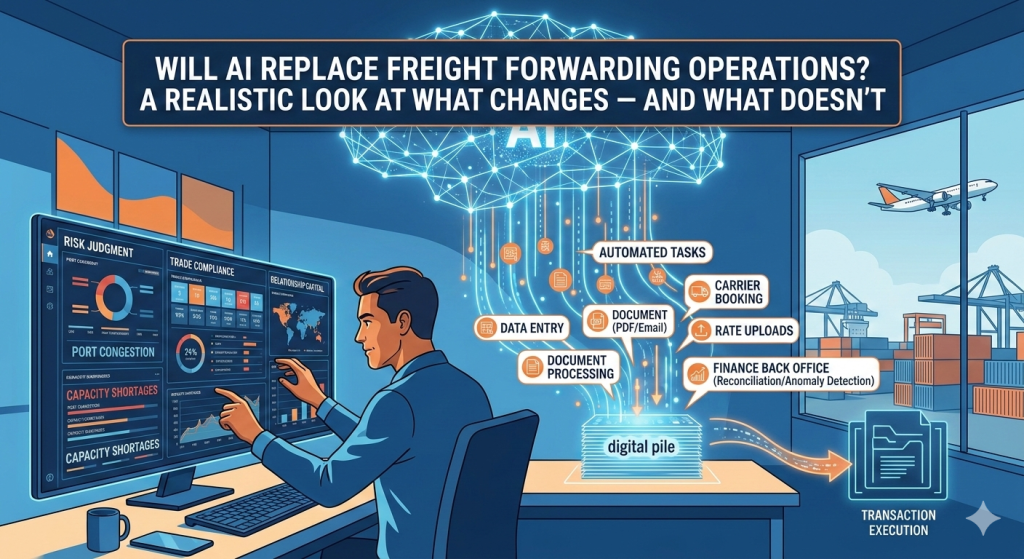
Tag: Digitization

  • Where AI Can Actually Help Freight Forwarders: Fixing the Data Problem

    Artificial intelligence is currently being discussed as the next major transformation in freight forwarding. Some believe it will eliminate large parts of operational work. Others dismiss it as hype.

    In reality, the truth lies somewhere in between.

    Freight forwarding operations are complex, fragmented, and heavily dependent on accurate data. When that data is wrong or incomplete, the consequences ripple across operations, finance, reporting, and customer service.

    AI will not solve these problems on its own. Poor processes, weak discipline, or unclear responsibilities cannot be fixed by algorithms.

    However, there are specific areas where AI can significantly reduce data quality problems and improve operational visibility.

    Below are three examples where AI can realistically help.

    1. Shipment Data Quality
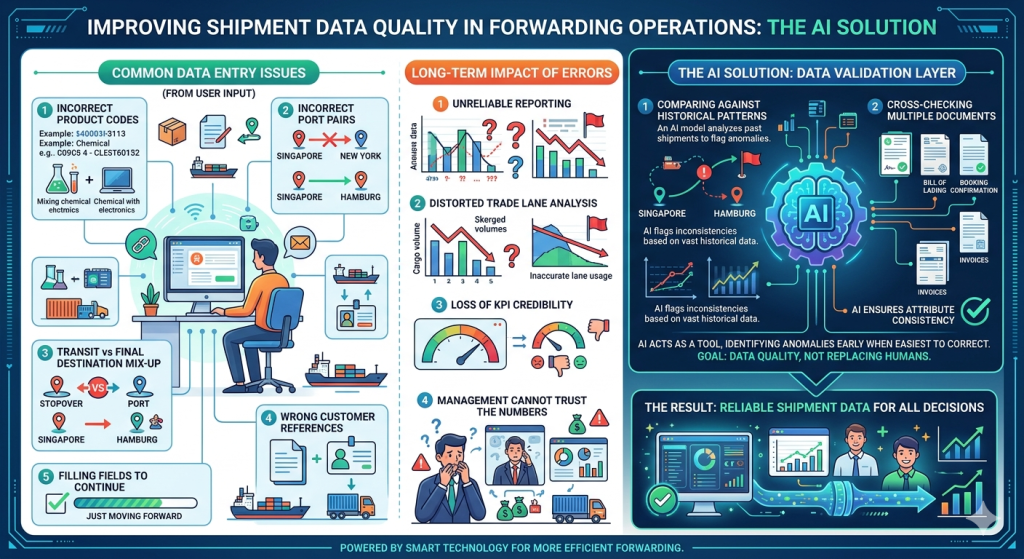
    One of the most common issues in forwarding operations is incorrect shipment data.

    Users may select the wrong product code, enter incorrect port pairs, mix up transit ports and final destinations, or attach the wrong customer reference. Sometimes the system fields are filled simply to move the shipment forward in the workflow.

    The immediate impact may appear small. But over time these errors create larger problems:

    • reporting becomes unreliable
    • trade lane analysis becomes distorted
    • operational KPIs lose credibility
    • management cannot trust the numbers they see

    AI can help by acting as a data validation layer, rather than replacing the user.

    For example, an AI system could compare the shipment data being entered against historical shipment patterns. If a shipment from Singapore to Hamburg suddenly shows a routing through an unusual port or an inconsistent product type, the system can flag the entry before the shipment proceeds.

    Similarly, AI can cross-check information across documents such as booking confirmations, bills of lading, and invoices to ensure that the key shipment attributes remain consistent.

    The goal is not to automate decisions but to identify anomalies early, when they are easiest to correct.

    2. Missing Charges and Revenue Leakage
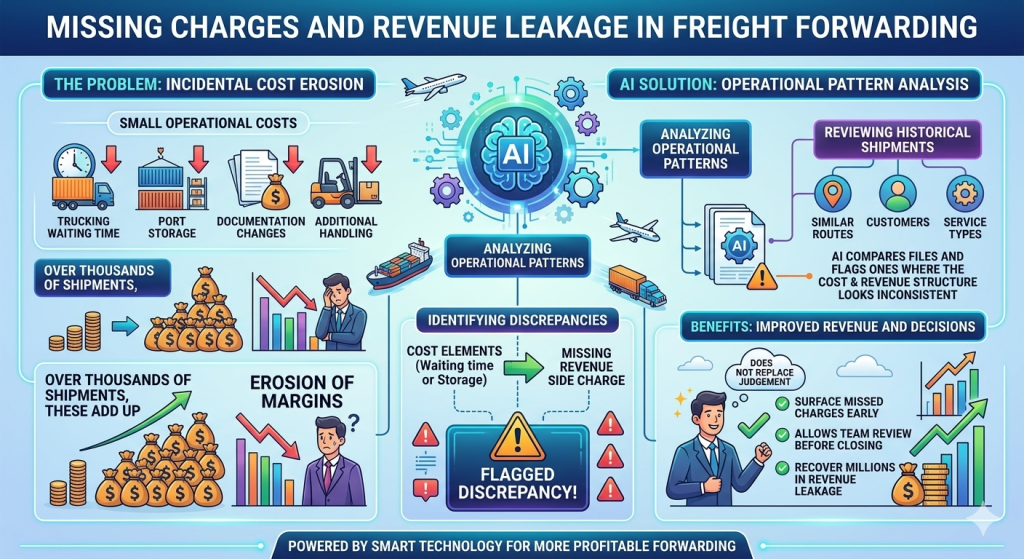
    Another recurring problem in forwarding operations is missing incidental charges.

    These are typically small operational costs such as waiting time, storage, documentation changes, or additional handling. Because they represent a small percentage of the overall shipment value, they often go unnoticed.

    Over thousands of shipments, however, these missed charges can create a measurable erosion of margins.

    AI can help identify these situations by analyzing operational patterns.

    For example, if certain shipments consistently include specific cost elements — such as trucking waiting time or port storage — but the revenue side of the file does not include the corresponding charge, the system can flag the discrepancy.

    Similarly, AI can review historical shipments on similar routes, customers, or service types and highlight files where the cost and revenue structure looks inconsistent.

    This does not replace operational judgement. It simply helps surface files where something may have been missed, allowing teams to review them before the job is closed.

    3. Inconsistent Customer and Customs Data
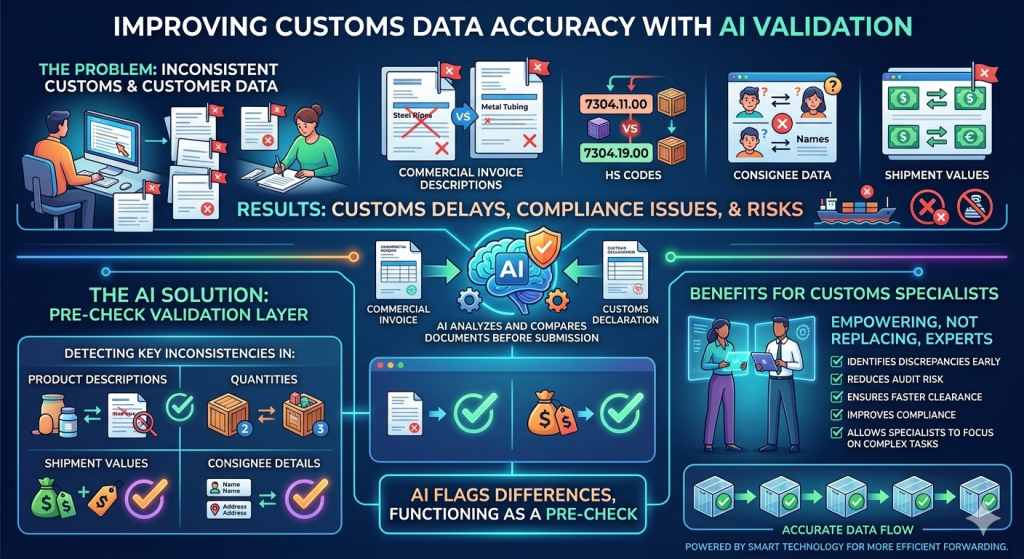
    Another area where data quality issues appear frequently is customer documentation and customs information.

    Details such as commercial invoice descriptions, HS codes, consignee data, or shipment values are sometimes entered manually across multiple documents. Even small inconsistencies can cause customs delays or compliance issues.

    AI tools that analyze documents can help detect inconsistencies between documents before submission.

    For instance, the system may compare the commercial invoice, packing list, and customs declaration and flag differences in:

    • product descriptions
    • quantities
    • shipment values
    • consignee details

    Instead of replacing customs specialists, the AI functions more like a pre-check layer, identifying discrepancies that would otherwise surface later in the process.


    AI Is Not a Shortcut

    It is important to emphasize that AI cannot compensate for poorly designed operational processes.

    If responsibilities are unclear, if data governance is weak, or if users routinely bypass system procedures, AI will simply amplify the confusion.

    What AI can do is reduce the operational burden of maintaining data quality by highlighting inconsistencies and anomalies earlier in the process.

    Used correctly, it becomes a tool that helps teams maintain discipline rather than replacing the need for it.


    The Real Opportunity

    Freight forwarding companies generate enormous amounts of operational data every day.

    The real opportunity for AI is not replacing operators. It is helping companies trust their own data again.

    When shipment data is reliable, billing is consistent, and operational records are accurate, management can move away from explaining numbers and focus on making decisions.

    That is where technology begins to create real value.
  • Why Many Freight Forwarders Struggle With Visibility

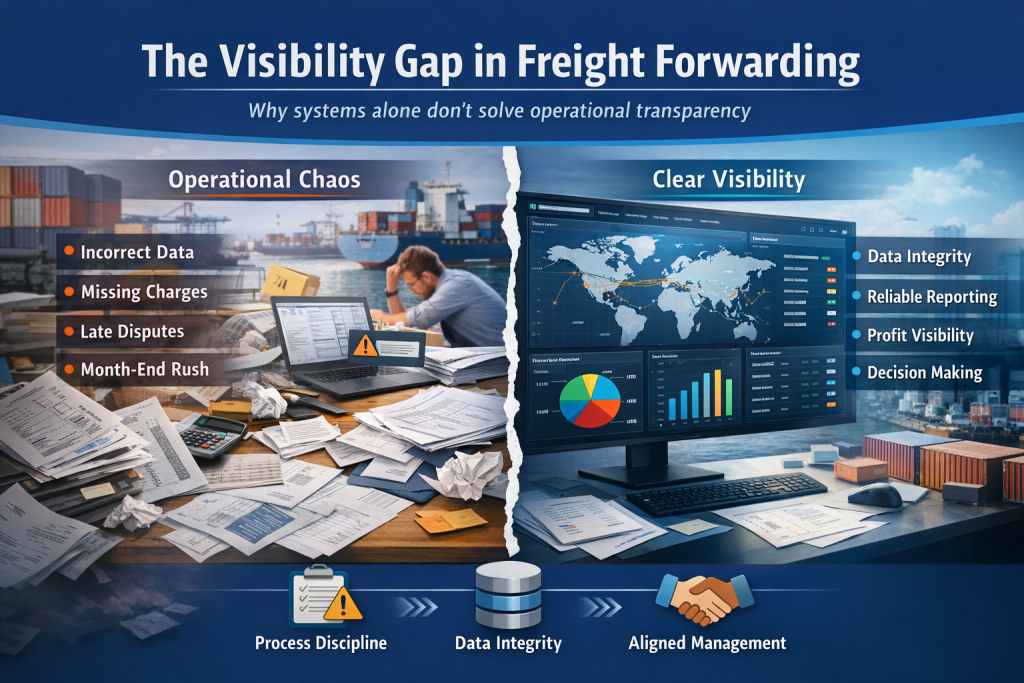
    Freight forwarding companies invest heavily in systems, processes, and certifications. Most run complex operating platforms, accounting tools, and quality systems designed to keep operations under control.

    Yet despite these investments, many management teams still struggle with a basic problem: they lack clear operational visibility.

    Monthly reporting takes too long. Forecasts are unreliable. Disputes appear weeks after shipments are completed. And management meetings often revolve around explaining numbers rather than making decisions.

    In my experience, this is rarely a technology problem. It is usually a combination of process discipline, data integrity, and operational alignment.

    Below are some of the recurring issues that quietly undermine visibility in freight forwarding operations.

    The Data Integrity Problem

    Operational systems are only as good as the data entered into them. When shipment details such as products, volumes, client names, or port pairs are entered incorrectly, the consequences cascade throughout the organization.

    Reports become unreliable. Trade lane analysis becomes distorted. And management ends up questioning the numbers rather than acting on them.

    Small inconsistencies in operational data can ultimately make strategic planning difficult.

    Revenue Leakage and Billing Friction

    Revenue leakage is rarely the result of large errors. More often it is caused by small operational gaps:

    • incidental costs that were never billed
    • disputes that are resolved months after the shipment moved
    • incorrect invoice dates or missing accruals
    • supplier invoices arriving long after the job should have been closed

    Individually these issues may seem minor. Across thousands of shipments they can significantly impact margins, cash flow, and financial reporting.

    In many organizations, these problems are amplified when operational processes rely heavily on automation without sufficient control points.

    The Month-End Chaos Cycle In some companies, the end of every month looks the same.

    Operations rush to close shipment files to ensure revenue is recognized in the current period. Finance scrambles to reconcile missing costs and issue corrections. Forecasts become difficult because the timing of billing is inconsistent.

    Instead of focusing on analysis and decision making, finance teams spend valuable time correcting operational data.

    When this pattern repeats month after month, reporting becomes reactive rather than strategic.

    Sales, Operations, and Finance Misalignment

    Freight forwarding is highly dependent on coordination between departments.

    When sales teams fail to pass complete information to operations, billing problems arise. When operational details are not documented properly, clients become frustrated. When disputes and credit notes increase, payment cycles slow down.

    These issues often appear operational on the surface but are ultimately symptoms of misalignment between commercial and operational processes.

    Limited Visibility Into Performance

    Many companies believe they have strong visibility into their business until they start asking deeper questions:

    • Which clients are actually profitable?
    • Which carriers consistently underperform?
    • Where are billing disputes originating?
    • Which trade lanes are truly growing?

    Without reliable data capture across quoting, operations, billing, and carrier performance, these questions become difficult to answer with confidence.

    Strategic discussions about trade lane development or network performance then become largely speculative.

    Process Discipline vs. Process Documentation

    Most freight forwarders have documented processes. Many hold certifications such as ISO 9001. Yet documentation alone does not guarantee operational discipline.

    Audits are often prepared at the last minute. Process errors are corrected informally rather than systematically. Training gaps appear as experienced staff compensate for weaker system users.

    Over time this creates a situation where key individuals become indispensable simply because they are holding the operational structure together.

    The Hidden Complexity of Freight Operations

    Freight forwarding is inherently complex.

    Rates vary by routing, carrier, and equipment. Charges are structured differently across countries. Networks apply different markups and charge codes. Clients increasingly require digital integrations such as e-invoicing.

    Trying to automate quoting, billing, and reporting within this environment is not straightforward. Without strong governance around data, processes, and responsibilities, systems alone cannot solve the problem.

    A Management Challenge, Not a Technology Challenge

    When companies struggle with operational visibility, the first instinct is often to look for a new system or additional automation.

    In reality, the root causes are usually much more fundamental:

    • inconsistent operational discipline
    • incomplete data capture
    • weak process ownership
    • lack of alignment between departments

    Until these foundations are addressed, additional technology often adds complexity rather than clarity.

    Final Thoughts

    Freight forwarding companies operate in a demanding environment where margins are thin and operational complexity is high. Achieving true visibility requires more than just systems and reports.

    It requires a clear understanding of where operational data originates, how processes interact across departments, and where control points are needed to prevent small issues from becoming systemic problems.

    For leadership teams, improving visibility is not about adding more dashboards. It is about ensuring that the underlying operational structure produces reliable information in the first place.

  • The Jobs of Tomorrow: Where Employment Is Actually Growing in the Age of AI.

    Many recent European and global labour market studies concluded: automation and AI will eliminate some jobs, but they will also create many new ones. For example, the World Economic Forum estimates that around 170 million new jobs could be created by 2030 while about 92 million disappear, resulting in a net increase of roughly 78 million jobs globally.

    However, the key point is this: the new jobs are very different from the old ones. Most of them appear in five broad areas.


    1. AI, Data, and Technology Jobs

    These are the most obvious new roles created by AI and digitalization.

    Examples

    • AI / machine-learning engineers
    • Data scientists and big-data specialists
    • AI trainers (people who teach AI systems how to respond)
    • Prompt engineers
    • Robotics engineers
    • Cloud infrastructure engineers
    • Cybersecurity specialists

    Reports consistently show that AI and machine-learning specialists, big-data analysts, and fintech engineers are among the fastest-growing professions.

    Why these jobs exist:
    Someone must design, train, maintain, audit, and secure the AI systems that replace routine work.


    2. AI Oversight, Ethics, and Governance

    As AI becomes more powerful, organizations need people to monitor and control it.

    Examples

    • AI ethics officers
    • Algorithm auditors
    • AI risk managers
    • Responsible AI compliance specialists
    • Data privacy officers

    These roles exist because governments and companies must ensure that AI systems do not discriminate, break regulations, or make unsafe decisions.


    3. Human-AI Collaboration Roles

    Many jobs won’t disappear—they will change.

    Instead of doing the work themselves, people will manage AI systems that do the work.

    Examples

    • AI workflow supervisors
    • Automation process designers
    • AI operations managers
    • Digital twin operators (virtual factory or supply chain simulation managers)
    • Human-machine interaction specialists

    Think of it like a pilot with autopilot: the human supervises and intervenes.


    4. Green Economy and Energy Transition Jobs

    Another major area of job creation is the climate and energy transition.

    Examples

    • Renewable energy engineers
    • Battery technology specialists
    • Carbon accounting experts
    • Sustainability analysts
    • Circular economy supply chain managers
    • Climate risk analysts

    Many governments expect millions of jobs here because energy systems and supply chains must be redesigned.


    5. High-Human-Skill Jobs

    Ironically, the more technology advances, the more valuable uniquely human skills become.

    These include roles requiring:

    • empathy
    • judgment
    • creativity
    • leadership

    Examples

    • therapists and mental-health professionals
    • healthcare specialists
    • teachers and learning designers
    • creative professionals (design, storytelling, content)
    • strategic advisors

    Jobs that require creativity, critical thinking, and emotional intelligence are hardest to automate.


    6. Entirely New Industries

    Historically, technology creates industries that didn’t exist before.

    Examples already emerging:

    • autonomous vehicle fleet managers
    • drone traffic controllers
    • digital identity managers
    • metaverse architects
    • bioinformatics and genetic data specialists

    These jobs simply did not exist 10–15 years ago.


    The Important Pattern

    Most disappearing jobs share three characteristics:

    • repetitive
    • rule-based
    • predictable

    Examples:

    • data entry
    • administrative processing
    • basic accounting
    • simple customer support

    The new jobs tend to be the opposite:

    • analytical
    • supervisory
    • creative
    • interdisciplinary

    One Interesting Observation

    Many economists believe the biggest growth won’t be in pure tech jobs.

    It will be in traditional industries enhanced by technology, such as:

    • AI-assisted doctors
    • AI-supported lawyers
    • AI-enhanced logistics planners
    • AI-supported engineers

    In other words:
    AI will create “augmented professionals,” not just programmers.

  • Aligning Strategy and Technology in Freight Forwarding: Why Execution Matters More Than Software

    Introduction

    Freight forwarding is at an inflection point.

    On one side, digital-native players have shown that technology alone does not guarantee success. On the other, traditional forwarders that resist modernization risk gradual erosion of competitiveness.

    The real challenge is not choosing between “digital” or “traditional.”
    It is aligning business economics with the right technology — in the right sequence.

    Many forwarders fail not because they lack software, but because their strategy, processes, and systems are misaligned. This is where structured business alignment becomes critical.

    The Core Problem: Strategy and IT Often Move Separately

    In many organizations:

    • The management team defines commercial targets.
    • Operations focus on service execution.
    • IT implements tools in isolation.

    The result is fragmented transformation.

    Systems are installed without redesigning processes.
    Automation is introduced without cleaning master data.
    AI tools are layered onto inconsistent workflows.

    Technology becomes an expense instead of a performance lever.

    True digitization begins with business alignment — not software selection.

    What Business Alignment Really Means

    Business alignment in freight forwarding involves answering fundamental questions:

    • Which customer segments are truly profitable?
    • Which trade lanes generate consistent margin?
    • Where does operational cost leak?
    • Which processes create bottlenecks?
    • How exposed is the company to rate cycles and working capital strain?

    Without clarity on these fundamentals, digitization becomes cosmetic.

    Alignment means defining:

    1. A clear commercial strategy
    2. A disciplined pricing and procurement model
    3. Standardized operational workflows
    4. Measurable performance indicators
    5. A realistic digital roadmap

    Only then should technology be layered in.

    The Role of Modern IT Partners

    Forwarders do not need to build technology internally.
    They need to integrate the right capabilities.

    Modern IT providers in the logistics sector offer solutions such as:

    • AI-driven data extraction from emails and documents
    • Automated rate management systems
    • Digital booking interfaces
    • Carrier integration tools
    • Compliance automation
    • Visibility and control tower platforms

    But tools must serve a defined objective.

    For example:

    If quoting speed is the issue, implement structured rate databases and automated comparison engines.

    If margin leakage is the issue, implement profitability dashboards and financial controls.

    If operational errors are frequent, automate document validation and milestone tracking.

    The mistake is adopting tools without linking them to measurable business outcomes.

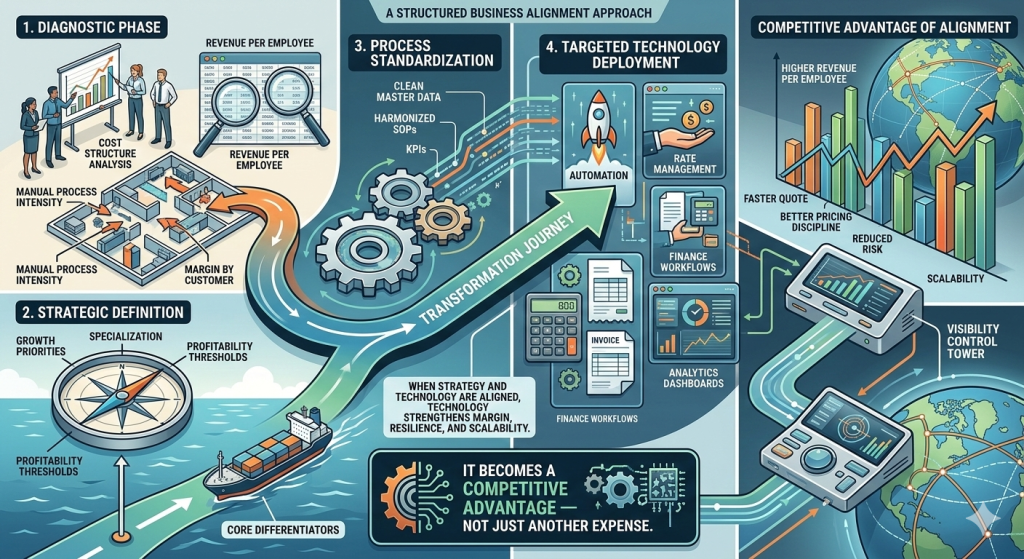
    A Structured Transformation Approach

    Effective transformation follows a clear sequence:

    1. Diagnostic Phase

    • Analyze cost structure
    • Review revenue per employee
    • Identify manual process intensity
    • Map margin by customer and trade

    2. Strategic Definition

    • Define growth priorities
    • Clarify specialization areas
    • Set profitability thresholds
    • Identify core differentiators

    3. Process Standardization

    • Clean master data
    • Harmonize SOPs
    • Define escalation logic
    • Create measurable KPIs

    4. Targeted Technology Deployment

    • Introduce automation in repetitive tasks
    • Implement rate management tools
    • Integrate finance workflows
    • Deploy analytics dashboards

    This ensures that technology enhances economics rather than obscuring weaknesses.

    The Competitive Advantage of Alignment

    When strategy and technology are aligned, forwarders gain:

    • Higher revenue per employee
    • Faster quote turnaround
    • Better pricing discipline
    • Reduced operational risk
    • Stronger capital control
    • Scalability without proportional headcount growth

    Digitization becomes a profit amplifier — not a branding exercise.

    Why External Guidance Matters

    Internal teams often struggle with transformation because:

    • Operational teams are absorbed in daily execution
    • IT teams focus on implementation, not strategy
    • Leadership lacks neutral benchmarking

    An external advisory partner can bridge commercial strategy and technical execution, ensuring that:

    • Business objectives drive system selection
    • IT investments are prioritized based on economic impact
    • Implementation avoids unnecessary complexity
    • Change management is structured and realistic

    This prevents both under-digitization and over-investment.

    Summary

    Freight forwarding is not saved by technology alone, nor protected by tradition alone.

    The companies that will lead the next decade are those that:

    • Understand freight economics deeply
    • Define clear commercial priorities
    • Standardize and discipline operations
    • Deploy targeted, well-integrated technology

    Digital transformation is not about replacing people with software.

    It is about aligning strategy, process, and systems so that technology strengthens margin, resilience, and scalability.

    When business alignment comes first, IT becomes a competitive advantage — not just another expense line.

  • The Hidden Risks of Staying Analog: What Happens If Freight Forwarders Fail to Digitize

    Introduction

    For many traditional freight forwarders, the business case for digitization can feel overstated. If margins are stable, customers are loyal, and operations run “well enough,” the urgency to modernize may appear low.

    After all, freight forwarding has survived decades of change.

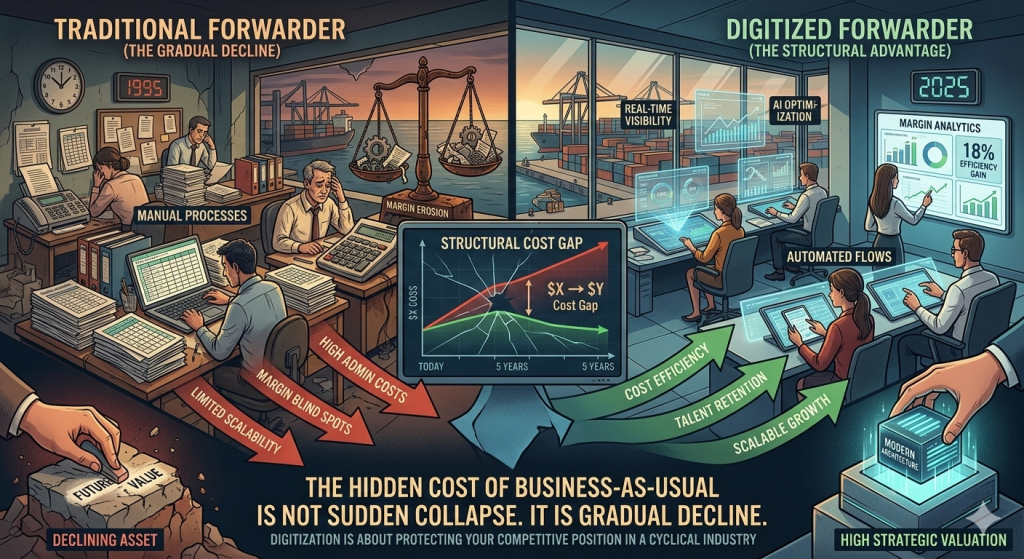
    But the real risk of failing to digitize is not sudden collapse. It is gradual competitive erosion. Forwarders that continue operating under a business-as-usual model may remain profitable in the short term — yet steadily lose structural advantage in the long term.

    The danger is not disruption. It is decline.

    1. Structural Cost Disadvantage

    Digitized competitors operate with:

    • Fewer people per shipment
    • Lower error rates
    • Automated billing cycles
    • Faster quote turnaround
    • Better margin visibility

    Over time, this creates higher revenue per employee and stronger cost efficiency.

    Traditional forwarders that rely on manual processes carry higher administrative costs. Initially, this may not be visible. But as automation spreads, cost gaps widen.

    Eventually, competitors can either:

    • Undercut pricing while maintaining margin, or
    • Reinvest efficiency gains into sales and growth

    The non-digitized forwarder becomes structurally less competitive.

    2. Margin Blind Spots

    Manual systems often mean:

    • Fragmented rate data
    • Limited real-time profitability tracking
    • Inconsistent branch-level reporting
    • Delayed financial visibility

    Without integrated data, pricing discipline weakens. It becomes harder to:

    • Identify unprofitable customers
    • Track margin erosion by trade lane
    • React quickly to carrier rate changes

    Digitization does not guarantee higher margins — but it enables transparency. Without that visibility, forwarders risk making decisions based on incomplete information.

    3. Increasing Customer Expectations

    Large shippers increasingly expect:

    • API connectivity
    • Automated document exchange
    • Real-time milestone visibility
    • Data reporting dashboards
    • Integration with ERP systems

    Even if customers tolerate manual processes today, procurement standards evolve.

    Forwarders unable to meet digital interface requirements may find themselves excluded from tenders — not because of poor service, but because of integration limitations.

    Gradually, they are pushed toward smaller accounts and more price-sensitive segments.

    4. Talent Drain and Operational Fragility

    Non-digitized operations often rely heavily on individual experience and informal knowledge.

    This creates two risks:

    1. Key-person dependency — when senior staff leave, operational stability weakens.
    2. Talent attraction challenges — younger professionals prefer data-driven environments over manual, spreadsheet-heavy workflows.

    Over time, the organization becomes less scalable and more vulnerable to turnover.

    Digitization distributes knowledge across systems rather than individuals.

    5. Limited Scalability

    Manual operations can handle moderate volume efficiently — but scaling requires proportional headcount increases.

    Digitized forwarders can grow shipment volume faster without linear staff growth.

    Traditional forwarders face a choice:

    • Hire more people to grow
    • Or cap growth to maintain control

    Both limit long-term expansion potential.

    6. M&A and Valuation Pressure

    In consolidation cycles, buyers increasingly value:

    • Standardized systems
    • Clean data architecture
    • Integrated reporting
    • Automated workflows

    Forwarders that fail to digitize may still be profitable — but their valuation multiples may suffer due to modernization costs required post-acquisition.

    In other words, they remain viable businesses but become less attractive strategic assets.

    7. Risk Exposure in a More Complex World

    Trade compliance, sanctions regimes, ESG reporting, and customs regulation are becoming more complex.

    Digitized systems allow:

    • Automated compliance checks
    • Data-driven audit trails
    • Faster regulatory reporting

    Manual models increase exposure to errors, fines, and compliance breaches.

    In a world of tightening regulation, process control becomes a competitive advantage.

    Summary

    Freight forwarders that fail to digitize will not disappear overnight. Strong relationships and disciplined economics can sustain them for years.

    But the risks accumulate gradually:

    • Higher structural costs
    • Reduced margin visibility
    • Exclusion from digital tenders
    • Talent attrition
    • Scalability limits
    • Lower strategic valuation

    Digitization is not about following a trend. It is about protecting competitive position in an industry where margins are thin and cycles are unforgiving.

    In freight, survival depends on economics.
    In the long run, economics depend on efficiency.

    And efficiency increasingly depends on digital capability.

  • Digital Freight Forwarders: Why Technology Alone Doesn’t Fix Freight Economics

    Introduction

    Over the past decade, a new generation of “digital freight forwarders” promised to reinvent logistics. With modern interfaces, automated booking flows, real-time dashboards, and AI-driven rate comparisons, they positioned themselves as technology companies operating in freight.

    The assumption was clear: digitize the process, remove inefficiencies, scale rapidly — and profitability would follow.

    Yet several high-profile digital players have faced layoffs, valuation cuts, strategic pivots, or closures. The problem was not a lack of technology. The problem was forgetting the economics of freight.

    The Illusion: If It’s Digital, It Must Be Better

    Companies such as Flexport, Forto (formerly Freighthub), Xeneta, and Haven built models centered around:

    • Automation
    • Platform visibility
    • Data-driven rate comparisons
    • Reduced manual intervention

    Technologically, these models were impressive. Operationally, they improved transparency and efficiency.

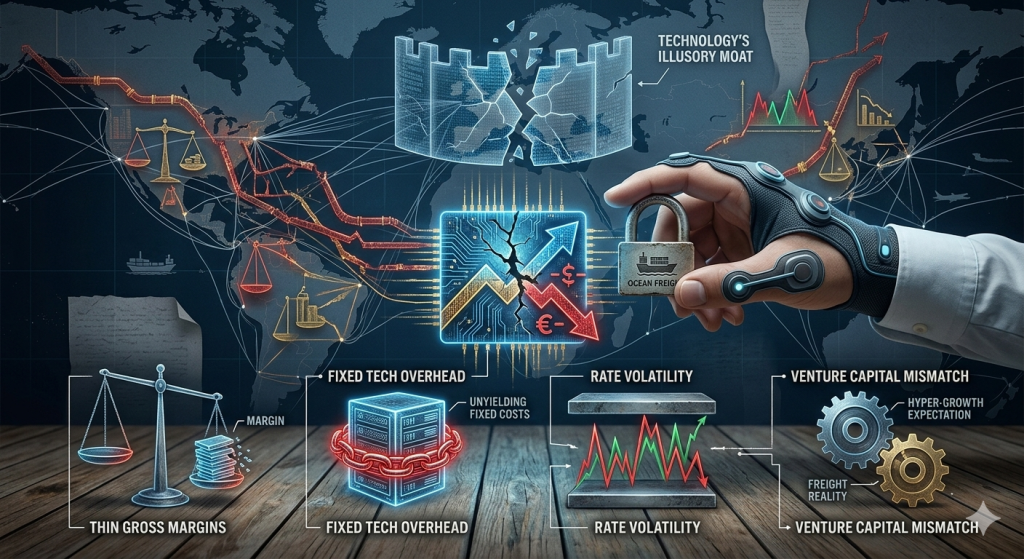
    But freight forwarding is not a software business. It is a cyclical, capital-intensive, low-margin industry.

    Digitization improves execution. It does not rewrite industry structure.

    Freight Has Structural Realities

    Freight forwarding operates under constraints that technology alone cannot eliminate:

    • Thin gross margins
    • High working capital requirements
    • Exposure to volatile carrier rates
    • Customer price sensitivity
    • Credit risk
    • Relationship-driven procurement

    When ocean and air rates surged during the pandemic, digital forwarders scaled aggressively. Revenue rose rapidly. Valuations expanded.

    When rates normalized, the underlying economics reappeared.

    Gross profit per shipment fell. Volume growth slowed. Fixed tech overhead remained.

    Technology did not protect them from rate cycles.

    The Venture Capital Mismatch

    Many digital forwarders were venture-backed.

    Venture capital expects:

    • Rapid market capture
    • High growth multiples
    • Network effects
    • Strong operating leverage

    Freight forwarding, however, delivers:

    • 5–10% margins in good years
    • Enterprise sales cycles
    • Conservative switching behavior
    • Volatile earnings

    This mismatch creates tension. To meet growth targets, digital forwarders often prioritize volume expansion over margin discipline. In freight, volume without pricing power can destroy profitability.

    Traditional forwarders, by contrast, often grow slower but guard margins more carefully.

    Technology Adds Cost Before It Adds Advantage

    Another misconception is that digital means lean.

    In reality, digital forwarders carry:

    • Large engineering teams
    • Product and UX staff
    • Data infrastructure expenses
    • Marketing and brand spend

    These are fixed costs.

    When margins compress, high fixed costs become dangerous. Traditional forwarders can reduce operational staff quickly in downturns. Tech-heavy models have less flexibility.

    Digitization reduces manual labor, but if the tech overhead is too high relative to freight margins, the cost structure becomes unstable.

    Freight Is Not Purely Transactional

    Freight is full of exceptions:

    • Port congestion
    • Sanctions and compliance issues
    • Space allocation politics
    • Disputes over demurrage and detention
    • Credit and liability negotiations

    Shippers still value escalation handling, commercial judgment, and relationships with carriers and authorities.

    Digital interfaces may simplify booking, but when complexity arises — and it always does — the real value lies in operational depth and risk management.

    If technology replaces too much of the relationship layer without strengthening the control layer, the model becomes fragile.

    What Was Overestimated

    Digital forwarders often assumed:

    • Shippers would switch primarily for better UI
    • Carriers would fully expose rates digitally
    • Automation would dramatically increase margins
    • Freight could scale like software

    In practice:

    • Switching costs in freight are operationally high
    • Carrier relationships remain strategic
    • Margin gains from automation are incremental, not transformative
    • Freight cycles compress profitability regardless of platform quality

    Technology is necessary infrastructure. It is not a structural moat.

    The Core Problem: Ignoring Economics

    The central issue is not digitization failure. It is economic misalignment.

    Freight profitability depends on:

    • Pricing discipline
    • Procurement leverage
    • Customer mix
    • Working capital control
    • Risk management
    • Cost flexibility

    If these fundamentals are weak, digitization simply accelerates volume through an unprofitable engine.

    You can build the most elegant booking interface in the industry.
    If you misprice risk or overextend working capital, the model breaks.

    The Real Lesson

    Digital freight forwarders are not failing because they are digital.

    They struggle when they assume digitization replaces freight fundamentals.

    The sustainable model likely lies in combining:

    • Strong economic discipline
    • Lean but effective digitization
    • Careful cost control
    • Operational depth
    • Capital resilience

    Technology should strengthen margins, not mask them.

    Freight remains what it has always been:
    A cyclical, risk-sensitive, relationship-heavy industry.

    Digitization changes how it is executed.

    It does not change what drives profit.

  • What Does It Actually Look Like When AI Runs Freight Operations? A Simple Explanation

    Introduction

    When people hear that AI will “automate shipment creation” or “handle finance workflows,” it sounds abstract. It feels technical. Hard to visualize.

    A simpler way to understand it is this:

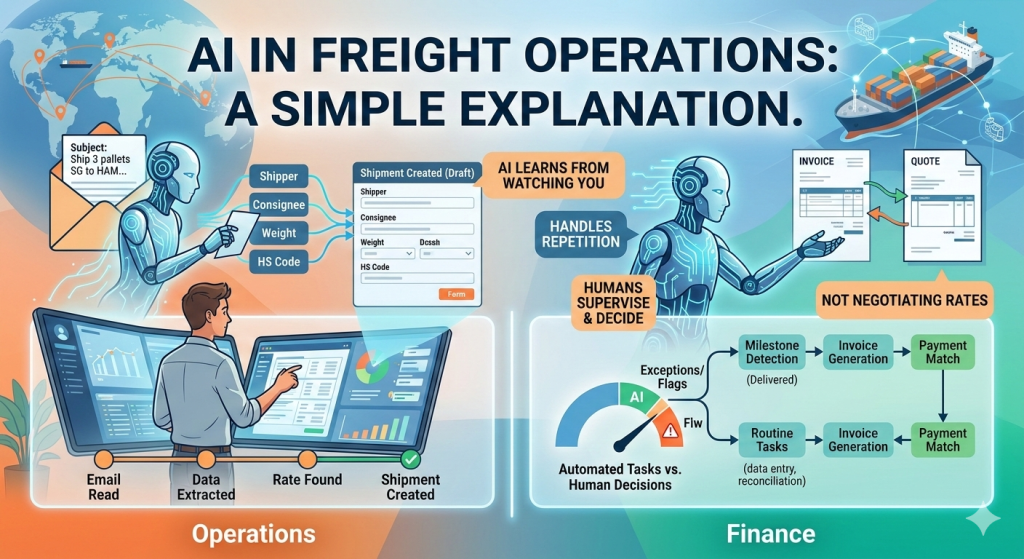
    Imagine you hire a personal assistant. For months, this assistant sits next to you and watches everything you do – every click, every email you read, every field you fill in, every document you check.

    At first, the assistant just observes.
    Over time, the assistant understands the steps.
    Eventually, the assistant can perform the task independently – and only calls you when something unusual happens.

    That is what operational AI in freight forwarding looks like.

    Let’s make this concrete with two examples — one from operations, one from finance.

    Example 1: Shipment Creation in Operations

    The Traditional Way

    A customer sends an email:

    “Please ship 3 pallets from Singapore to Hamburg. Cargo ready Friday. HS code attached.”

    An operations executive typically:

    1. Opens the email
    2. Downloads the attachment
    3. Checks weight and volume
    4. Looks up the rate
    5. Enters shipment details into the system
    6. Selects carrier and service
    7. Creates booking request
    8. Updates internal reference
    9. Sends booking confirmation to the customer

    This can take 15–30 minutes per shipment, sometimes longer if documents are incomplete.

    What AI Looks Like in Practice

    Now imagine the personal assistant has been watching this process for months.

    When the email arrives, AI:

    1. Reads the email automatically
    2. Extracts shipper, consignee, weight, volume, HS code
    3. Validates whether the customer is approved
    4. Pulls contracted rates from the database
    5. Suggests the most suitable service
    6. Creates the shipment file in the system
    7. Prepares the booking draft
    8. Generates a confirmation email

    By the time the operations manager opens the system, the shipment is already created — waiting for approval.

    If something unusual appears (missing HS code, unusual weight, expired rate), the AI flags it and asks for review.

    Instead of doing the work, the human supervises it.

    The assistant now handles the repetition.
    The human handles judgment.

    Example 2: Milestone Updates and Finance Reconciliation

    Let’s move to finance.

    The Traditional Way

    After shipment completion:

    1. Operations updates delivery milestone manually
    2. Finance checks proof of delivery
    3. An invoice is generated
    4. Accounts receivable tracks payment due date
    5. If payment is late, reminders are sent
    6. Statement reconciliation is done monthly

    Each step often involves checking multiple systems and emails.


    What AI Looks Like in Practice

    Now imagine the assistant again.

    The moment delivery is confirmed:

    • AI detects the delivery milestone automatically (from carrier API or document upload).
    • It triggers invoice generation immediately.
    • It matches the invoice amount against the original quote.
    • It checks whether margin is within expected range.
    • It schedules payment reminders based on customer credit terms.

    If payment is not received by the due date:

    • The assistant drafts a reminder email.
    • It flags high-risk accounts.
    • It updates cash flow forecasts.

    If payment arrives:

    • AI matches the bank transaction to the correct invoice.
    • It clears the outstanding balance.
    • It updates the financial dashboard.

    The finance manager no longer spends time chasing routine payments.

    They focus on credit risk and strategic cash management.


    The Key Difference: Doing vs. Monitoring

    In both examples, the important shift is this:

    Humans move from typing and copying
    to supervising and deciding.

    AI does not “think” like a human. It executes structured steps extremely consistently.

    If the process is:

    • Repetitive
    • Rule-based
    • Data-driven
    • Predictable

    AI can learn it.

    When something falls outside the rule set, it escalates.

    Just like a well-trained assistant.


    What AI Is Not Doing

    It is not:

    • Negotiating carrier space during a tight market
    • Deciding whether to extend risky credit
    • Managing claim disputes
    • Making strategic pricing decisions

    Those remain human responsibilities.

    AI handles the predictable.

    Humans handle the unpredictable.


    Summary

    The easiest way to understand AI in freight forwarding is to imagine a personal assistant that:

    • Watches every operational and finance step
    • Learns the sequence
    • Executes routine tasks automatically
    • Flags exceptions for human review

    In operations, it can create shipments and manage milestone updates.

    In finance, it can generate invoices, reconcile payments, and monitor receivables.

    The result is not fewer responsibilities — it is different responsibilities.

    Less typing.
    Less copying.
    Less manual checking.

    More supervision.
    More analysis.
    More decision-making.

    That is what AI looks like when it actually works inside a freight forwarder.

  • Will AI Replace Freight Forwarding Operations? A Realistic Look at What Changes – and What Doesn’t

    Introduction


    There is a growing belief that freight forwarding is on the brink of a major workforce reduction. The logic seems straightforward: if artificial intelligence can handle bookings, customs interfaces, documentation, invoicing, and reporting, then the need for large operational teams should disappear.

    At first glance, this argument is compelling. Much of freight forwarding is process-driven, repetitive, and rule-based. These are precisely the areas where AI performs well.

    But while AI will significantly reshape operations, it will not eliminate the structural complexity of freight. The future will not be “no humans.” It will be fewer transactional roles and more judgment-driven roles.

    Understanding that distinction is critical.

    1. What AI Will Replace

      AI will dramatically reduce manual work in three core areas:

      A. Data Entry and Document Processing

      Shipment creation, milestone updates, draft BL checks, invoice matching, rate uploads, customs documentation formatting — these tasks are structured and repetitive.

      AI systems already extract, validate, and populate structured data from emails, PDFs, and messaging platforms. Over time, these functions will require minimal human intervention.

      B. Transaction Execution

      Carrier booking, routing selection, rate comparison, and service validation can all be automated when rate data is structured and business rules are defined.

      Technically, AI is capable of executing bookings and validating service conditions. The real barrier is not capability — it is data cleanliness and system integration.

      C. Finance Back Office

      Accounts receivable reminders, payables matching, statement reconciliation, margin reporting, and even intercompany netting are highly rules-based.

      AI-driven anomaly detection can flag discrepancies, while automated workflows manage routine processes. Finance teams will shrink in size but become more analytical in focus.

      In short, repetitive operational roles will decline significantly.
    2. What AI Will Not Easily Replace

      Despite these gains, freight forwarding is not purely transactional. Several areas resist full automation.

      A. Risk Judgment Under Uncertainty

      Freight operates in constant ambiguity:

      Port congestion
      Sanctions and trade compliance risk
      Capacity shortages
      Sudden regulatory changes
      Customer credit exposure

      AI can detect patterns, but strategic trade-offs under uncertainty require experience. Deciding whether to prioritize a volatile high-margin customer over a stable long-term client is not just data-driven — it is commercial judgment.

      B. Relationship Capital

      Freight is still relationship-heavy, especially in tight markets.
      Securing space during peak season, negotiating demurrage waivers, extending credit terms, or resolving customs bottlenecks often depend on human trust and networks. AI does not build that capital.

      C. Accountability and Liability

      When shipments fail, delays occur, or claims arise, companies need accountable individuals.

      Contracts are signed by humans. Negotiations are handled by humans. Liability cannot be delegated to an algorithm.
    3. The Likely Future Structure

      The forwarder of the future will not eliminate people. It will reorganize them.

      A plausible structure includes:

      Commercial Core: Strategic sales, pricing specialists, key account managers
      Control Tower / Exception Team: Escalation managers, compliance experts, risk controllers
      Technology & Data Layer: AI oversight, system integration, data governance
      Procurement & Carrier Relations: Contract negotiation and capacity strategy
      Lean Finance: Oversight and financial analytics

      The large middle layer of shipment processing executives will shrink. Revenue per employee will rise. The organization becomes more concentrated around high-value decision-making.
    4. The Hidden Constraint: Data Quality

      All of this depends on clean master data, structured rate databases, standardized SOPs, and integrated systems.
      AI does not fix disorganized processes. It amplifies them.
      Companies that digitize chaotic foundations will not see transformative results. Companies that clean their data and standardize processes first will benefit the most.
    5. Where Differentiation Moves

      As AI absorbs transactional work, competitive advantage shifts.

      It will no longer be about:

      Faster booking input
      Cheaper documentation processing
      Invoice accuracy
      Instead, differentiation will center on:
      Industry specialization
      Risk management capability
      Network strength
      Financial stability
      Advisory capability for customers

      Technology becomes infrastructure. Judgment becomes value.

      Summary

      AI will significantly reduce repetitive operational roles in freight forwarding. Data entry, transaction execution, and back-office processing will become increasingly automated.

      However, freight remains a cyclical, risk-sensitive, relationship-driven industry. Strategic judgment, accountability, and trust cannot be automated away.

      The future is not a human-free forwarder. It is a leaner organization where low-value tasks disappear and high-accountability roles increase in importance.

      In practical terms, AI will compress the middle layer of operations — but elevate the value of leadership, commercial strategy, and risk management.

      Freight will change.

      Its economic DNA will not.
  • The Importance of a Realistic ROI when Implementing Technology in SME Freight Forwarders

    Small and medium-sized freight forwarders operate in one of the most margin-sensitive industries in the world. With razor-thin profits, unpredictable market cycles, and constant pressure from global players, every dollar spent must deliver measurable value. This financial discipline — while commendable — often becomes a barrier when it comes to digital transformation.

    Most SME forwarders are self-financed. They invest only what they earn, rarely turning to banks for funding. Their capital allocation decisions are driven by immediate operational needs: hiring an extra operations clerk when shipment volumes rise, or leasing additional warehouse space for a new customer. Investments that don’t directly contribute to visible revenue growth are often deferred — especially technology projects that promise “efficiency” or “future readiness” without a tangible link to new business.

    The ROI Challenge

    This mindset is understandable. In a business where gross margins often hover between 5–10%, forwarders can’t afford expensive missteps. The problem is that many technology initiatives are pitched in broad, aspirational terms — “digitalisation,” “automation,” “AI-driven insights” — without clear, quantifiable outcomes. For SME decision-makers, such projects can feel abstract, risky, and detached from daily operational realities.

    That’s why defining a realistic and specific ROI is crucial. Technology investments must be backed by solid use cases that directly address operational pain points:

    • Reducing invoice errors by automating billing and EDI exchanges
    • Shortening quote turnaround times through rate management tools
    • Improving shipment visibility with integrated tracking systems
    • Enhancing compliance accuracy via automated document checks

    When the ROI is defined in measurable terms — such as saving 3 man-hours per file, reducing invoice disputes by 50%, or winning additional RFQs through faster response times — the investment conversation becomes grounded and credible.

    Why ROI Drives Adoption

    The lack of clear ROI has long contributed to the industry’s status as a digital laggard. Many forwarders still rely on email, spreadsheets, and legacy systems because “the old way works.” However, as the logistics ecosystem evolves, the baseline for participation is changing.

    Technology is no longer a competitive advantage — it’s a minimum requirement. Shippers and global 3PLs now expect forwarders to submit electronic bids, provide online visibility, and exchange data seamlessly through APIs or digital platforms. Without these capabilities, even the most reliable forwarder risks being excluded from major RFQs.

    Making Digital Investments Work

    The path forward isn’t about adopting every new tool. It’s about strategic prioritisation — identifying where digital investments align with business outcomes. For SME forwarders, this means:

    1. Start with process pain points. Focus on bottlenecks that consume time or cause customer dissatisfaction.
    2. Quantify the benefit. Translate improvements into financial or capacity gains — e.g., freeing staff hours that can support more shipments.
    3. Validate through pilots. Begin small, measure the impact, and scale what works.
    4. Track ROI continuously. Treat technology as an ongoing business initiative, not a one-off project.

    The Bottom Line

    For SME freight forwarders, digitalisation isn’t a luxury — it’s the ticket to staying relevant. But survival depends not on buzzwords, but on realistic ROI. Forwarders who approach technology with the same financial discipline they apply to every other aspect of their business will find that well-planned digital investments can strengthen both margins and competitiveness — not by replacing people, but by enabling them to do more with less.

  • A2A: The Future of Corporate Agents

    In the emerging age of agentic AI, the next revolution in enterprise technology will not be about connecting systems — it will be about connecting agents.

    For years, corporations have relied on APIs, middleware, and data pipelines to integrate their business applications. These mechanisms, while powerful, are rigid and costly to maintain. The next wave — Agent-to-Agent (A2A) architecture — replaces technical integration with cognitive collaboration.


    From Automation to Autonomy

    Leading enterprise platforms are already embedding intelligent agents within their ecosystems:

    • Salesforce has introduced Agentforce, capable of interpreting user prompts and generating contextual CRM actions.
    • Workday integrates BP Optimize Agents to streamline workforce and process efficiency and Contingent sourcing platforms now use AI agents to autonomously match talent to projects based on skill and availability.
    • Cargowise, long known for logistics automation, is now advancing into agentic AI functions that reason across workflows rather than merely execute them.

    The difference is profound. Automation follows instructions; autonomy understands purpose. Each of these systems now hosts specialized agents capable of perception, reasoning, and communication — forming the foundation for true A2A ecosystems.


    Role-Based Agents: The Next Layer of Intelligence

    The natural evolution of this trend is the rise of role-based agents — AI entities designed to perform specialized corporate functions within defined boundaries.
    A few early examples illustrate the concept:

    • Financial Audit Agent for Workday Adaptive: constantly monitors ledgers, forecasts, and anomaly reports, ensuring compliance with internal controls and external standards. It flags inconsistencies, queries variances, and even drafts summary notes for CFO review.
    • Procurement Compliance Agent: embedded within ERP systems to ensure all supplier actions adhere to sustainability, ESG, and cost policies.
    • Sales Forecast Agent: within CRM systems, dynamically adjusting pipeline projections based on market sentiment and customer behaviour.
    • Logistics Coordination Agent: in platforms like Cargowise, continuously assessing shipment milestones, carrier reliability, and exception risks.

    Each of these agents operates within its system domain — interpreting local data, reasoning over role-specific goals, and interfacing with others via A2A orchestration.


    A2A: Agents That Talk to Agents

    In the coming landscape, there won’t be a single universal communication protocol connecting all corporate software. Instead, A2A agents will emerge as intelligent intermediaries that interpret intent, select the relevant domain agent, and coordinate the exchange.

    Consider a scenario:

    A regional operations director asks, “Provide a profitability forecast for next quarter.”

    The A2A layer springs into action:

    • The Financial Audit Agent in Workday Adaptive analyzes revenue and cost projections.
    • The Sales Forecast Agent in Salesforce Agentforce provides order pipeline probabilities.
    • The Logistics Coordination Agent in Cargowise estimates capacity utilization and transport cost exposure.
    • The A2A Orchestrator Agent interprets the results, reconciles inconsistencies, and generates a unified executive summary — without any human needing to manually transfer data or align formats.

    This is cross-agent reasoning, not just cross-system integration.


    Security and Risk Management by Design

    Traditional integrations expose multiple endpoints to external networks. Every connection is a potential vulnerability.
    A2A architecture simplifies and secures this: only one orchestrator agent — the “frontline negotiator” — is accessible via the internet.

    All role-based agents (finance, HR, operations, logistics, etc.) remain behind internal firewalls, accessible only through the orchestrator’s verified handshake.

    This model minimizes the attack surface, enhances auditability, and satisfies zero-trust policies by enforcing compartmentalized access. In effect, the enterprise becomes a network of trusted agents rather than a web of exposed APIs.


    Why It Matters for Operations and Supply Chain

    For logistics and supply chain operations, where multiple applications coexist — from TMS and WMS to ERP and CRM — A2A unlocks enormous potential.

    Agents within each system can perform their own reasoning: forecasting volume trends, identifying bottlenecks, or validating customs documentation. The A2A orchestrator then synchronizes the insights across departments.

    This architecture enables modular transformation — companies can evolve system by system, replacing or upgrading individual applications without disrupting the overall intelligence network.


    The Road Ahead

    Over the next five years, we will see enterprises deploy layered agent frameworks:

    1. System-native agents (Salesforce, Workday, Cargowise, SAP, etc.) performing role-based functions.
    2. A2A orchestrators interpreting intent, delegating tasks, and consolidating outputs.
    3. Governance agents ensuring traceability, security, and compliance across all interactions.

    This is not just the future of automation — it’s the future of enterprise cognition.

    Just as APIs defined the last decade of digital transformation, A2A will define the next: a world where intelligent, role-based agents collaborate seamlessly, securely, and autonomously to deliver real business outcomes.