Tag: ForwarderGrowth

  • From Good to Great: How Freight Forwarders Build, Scale and Transform

    Part 1: From Zero to Good: Building a Freight Forwarding Company
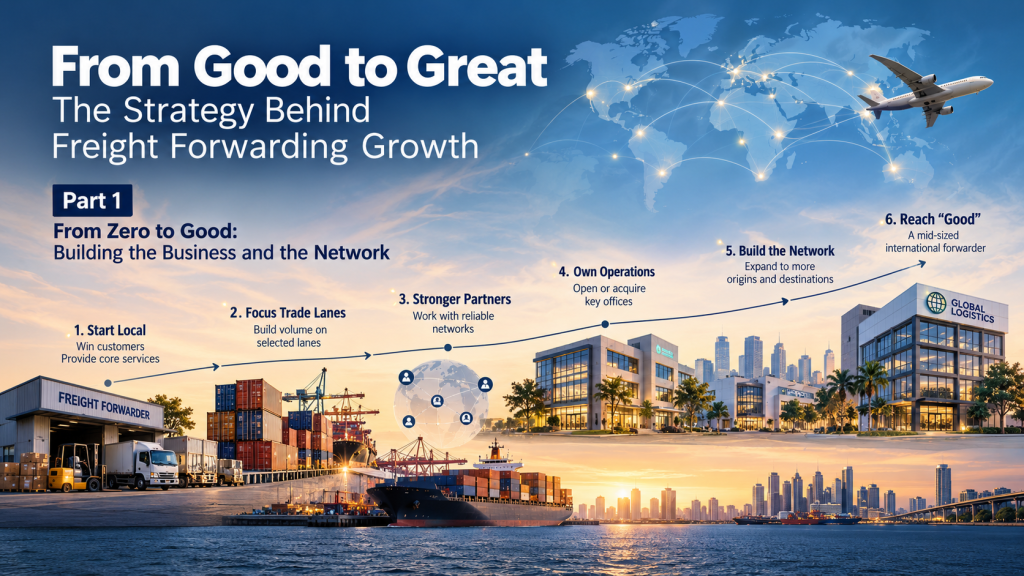
    A proven model of building a freight forwarding company:

    Start locally. Win customers. Develop relationships with overseas forwarders. Concentrate on trade lanes where the business grows. Replace partners with your own operations when sufficient volume justifies the investment. Then repeat the process.

    Over time, a small local forwarder can become a substantial international company.

    Two characteristics make this model particularly interesting.

    The first is that freight forwarding can be operated as an asset-light business. The company makes little to no investment in capital-intensive logistics assets such as warehouses, CFS facilities, large truck fleets or other physical logistics infrastructure. It may own selected assets, such as office premises, individual trucks or equipment, where there is a practical or economic reason to do so, but physical asset ownership is not central to the business model.

    The second is the way growth can be financed.

    Instead of relying heavily on debt or external investors, expansion can be financed primarily from the profits generated by the existing business.

    Together, these principles create a disciplined growth model:

    Build the business first. Let the business justify the investment. Use the investment to strengthen the network. Then allow the stronger network to create more business.

    This is the journey from zero to good.

    Stage 1: Start as a Local Forwarder

    The company begins with the fundamental forwarding services:

    Pickup/delivery + handling + customs clearance + air/ocean freight

    It can control the local side of the shipment but cannot independently provide the same service overseas.

    So it joins or develops relationships with a network of other independent forwarders that provide equivalent capabilities at origin and destination.

    That creates the first viable international product:

    Local capability + overseas partner = door-to-door forwarding

    Very little fixed network investment is required.

    The company does not need its own operation in Germany to offer a Singapore-Germany service. A German forwarding partner can provide the pickup, customs clearance, handling or delivery required at the other end.

    The same model can be repeated across multiple countries.

    The company’s primary assets at this stage are therefore not warehouses or CFS facilities. They are its people, customer relationships, forwarding expertise, carrier relationships and overseas partner network.

    Capital requirements remain relatively modest, allowing management to concentrate its available resources on generating and managing business.

    Stage 2: Develop Focused Trade Lanes

    As the company grows, certain trade lanes naturally become more important.

    Perhaps Singapore-Germany becomes significant, or China-Singapore, or Singapore-US.

    This matters because volume becomes concentrated rather than simply increasing in aggregate.

    The company develops deeper relationships with selected overseas partners on those lanes. Business begins flowing in both directions:

    Locally controlled business → overseas partner

    and

    Partner-controlled/routed business → local company

    This creates a reinforcing cycle:

    More local business → stronger overseas relationship → more routed business → more volume → greater relevance to the partner → more routed business

    The relationship becomes increasingly valuable to both companies.

    This is an important stage in the development of the forwarder because it begins creating trade-lane density.

    Instead of trying to become equally strong everywhere, the company develops greater strength on selected origin-destination combinations where its customer base and partner relationships are producing meaningful volume.

    At this stage, partner selection becomes strategically important.

    Stage 3: Move Toward Stronger Network Partners

    As the business becomes larger, the limitations of a loose collection of small independent agents eventually become visible.

    Service levels vary. Systems differ. Communication standards differ. Financial strength differs. Management priorities differ.

    And when something goes wrong, accountability can become difficult.

    This creates a problem for the growing forwarder.

    The customer does not particularly care that several independent companies are involved in moving the shipment.

    The customer bought a door-to-door service.

    One solution is therefore to develop a closer relationship with a larger independent or medium-sized forwarding network.

    This may reduce some flexibility in choosing individual agents, but it can improve:

    coverage, consistency, reliability, systems, buying power and accountability.

    The company is beginning to sell more than transportation between two points.

    It is developing a more dependable network product.

    Importantly, this remains a capital-efficient way of improving international capability.

    Rather than opening dozens of overseas offices, the company uses stronger partnerships to extend its reach while concentrating its own resources on the markets where it already has meaningful business.

    Stage 4: Replace Partners With Owned Operations

    Eventually, a particular trade lane becomes sufficiently important that using an agent is no longer the optimal solution.

    This creates the first major critical-mass decision.

    The question becomes:

    At what level of existing and expected business does owning the overseas operation produce better economics, control and service than continuing to use an agent?

    The company may establish its own office or acquire an existing local forwarder. That changes both the economics and the product. The company gains control over both ends of the shipment.

    It can retain more of the forwarding margin, improve accountability, introduce common processes and service standards, and gain direct access to customers in the overseas market.

    But something even more important happens.

    The new office does not only service the shipments that justified opening it.

    It starts generating business itself.

    Salespeople in the new country win local customers. Those customers generate exports and imports. Some of that freight moves to existing offices elsewhere in the network.

    The growth cycle therefore expands:

    Existing volume → own office → improved service and control → local sales → new customers → additional bilateral volume → stronger trade lane

    The investment begins reinforcing the business that originally justified it.

    Stage 5: Build an Owned Network

    The same logic can now be repeated. A second market reaches critical mass. Then another. Some locations are opened organically. Others may be acquired because acquisition provides an established customer base, experienced employees, licenses, relationships and revenue from the first day.

    Gradually, the structure changes:

    Agent network → hybrid network → predominantly owned network

    The company is no longer simply a local forwarder with overseas agents.

    It has become a multinational forwarding company.

    And every additional location potentially increases the value of the existing network.

    A new office does not simply create one additional market. It creates new commercial relationships with multiple existing locations.

    An office in Singapore can generate business with Germany. Germany can generate business with China. China can generate business with the United States. The United States can generate business with Singapore. The number of potential trade relationships grows as the network expands.

    This is where the network itself starts becoming an increasingly important competitive capability.

    Stage 6: Reach “Good”

    Continue this process for 10, 20 or 30 years and the result can be a substantial mid-sized international freight forwarder.

    Yet the organizational structure can remain surprisingly close to the model from which the company developed.

    Most employees still contribute directly to generating, executing or managing business:

    Sales → customer service → operations → customs → finance → local management

    Corporate functions remain relatively lean.

    There may be regional management, procurement, IT, finance, HR and product functions, but the company has not developed the extensive central structures associated with the largest global forwarding organizations.

    The physical asset base can also remain relatively small compared with the revenue generated.

    Warehouses, CFS facilities, large truck fleets and other capital-intensive infrastructure are generally provided by external specialists unless there is a specific strategic or economic reason for ownership.

    Capital is instead concentrated primarily on people, offices, systems and network development.

    The result can be an economically efficient forwarding organization with relatively low fixed-asset requirements.

    It has become good at freight forwarding. It has experienced people. It has customers. It has reliable basic air and ocean freight capabilities. It has an international network. It has increasing purchasing power. And it has a business model capable of generating sustainable profits.

    The Zero-to-Good Flywheel

    The entire development model can be summarized as a freight-forwarding flywheel:

    Win local customers

    → Generate export/import volume

    → Strengthen selected trade lanes

    → Develop stronger overseas partnerships

    → Receive routed business

    → Increase trade-lane density

    → Reach critical mass

    → Open or acquire an own office

    → Improve service, control and margin retention

    → Generate local business in the new market

    → Increase network volume and profitability

    → Reinvest profits into the next market

    ↺


    Each turn of the flywheel strengthens the organization.

    More customers create more freight.

    More freight creates greater trade-lane density.

    Greater density justifies greater network control.

    Greater network control improves the product and creates new commercial opportunities.

    Those opportunities generate additional profits that can finance the next stage.

    There is therefore an important principle underlying the entire Zero-to-Good model:

    Build the network behind the freight.

    The company does not first construct an expensive international network and then hope enough freight arrives to support it.

    The freight comes first.

    The network follows.

    Financing Growth From the Business

    The financing model is an essential part of this strategy.

    The company can choose to finance expansion primarily through profits generated by the existing business.

    The logic is straightforward:

    Business → profit → investment → additional capability → more business → more profit

    The asset-light operating model makes this possible.

    Because relatively little capital needs to be committed to warehouses, CFS facilities and other physical logistics assets, a greater proportion of available investment can be directed toward commercial and network development.

    Profits can finance a new office. They can finance additional salespeople. They can finance systems. They can finance regional functions. They can contribute toward acquisitions.

    And as those investments generate additional business and profit, further investments become possible.

    But there is an unavoidable consequence.

    The speed and size of investment are constrained by the profits the company generates.

    A company cannot continuously invest substantially more than it earns without obtaining capital from somewhere else.

    That means investments tend to happen progressively.

    One market is developed. Then another. One capability is added. Then another.

    The company grows within the financial capacity created by the existing organization.

    A Constraint That Creates Discipline

    At first glance, limiting investment to internally generated funds may appear to be a disadvantage.

    And in one sense it is.

    A company with access to substantial external capital could potentially expand faster.

    It could acquire several companies simultaneously, enter multiple countries, build infrastructure or invest heavily in technology and organizational capabilities ahead of existing demand.

    A self-financed company has fewer options.

    But that constraint also creates discipline.

    Every significant investment has to answer a fundamental question:

    Does the existing or realistically accessible business justify this investment?

    A new office cannot simply be opened because a market looks attractive on a strategy presentation.

    A meaningful commercial case has to exist.

    Expansion therefore tends to follow proven business rather than anticipated business.

    This reduces the risk of building an expensive network that customers never fill.

    Independence Has Value

    There is another side to the financing model.

    By relying primarily on internally generated profits, the company can preserve a high degree of financial and strategic independence.

    It is less dependent on external investors seeking returns within a particular investment horizon.

    It is less dependent on lenders imposing financial conditions on the business.

    Ownership and management can therefore take a longer-term view.

    A trade lane can be developed patiently. A market can take several years to mature. Customer relationships can be built over decades. Profits can be reinvested rather than maximized for short-term distribution.

    The trade-off is therefore not simply:

    More capital versus less capital.

    It is:

    Faster access to investment capital versus greater financial independence and control over the company’s long-term direction.

    For a company moving from zero to good, that trade-off can work remarkably well.

    From Zero to Good

    None of this requires an especially complicated strategy.

    In fact, its strength comes partly from its simplicity.

    Win customers.

    Execute their freight well.

    Concentrate on trade lanes where you develop strength.

    Build strong overseas partnerships.

    Replace partners with owned operations when the business justifies it.

    Remain asset-light where ownership does not create sufficient value.

    Generate profits.

    Reinvest those profits into the next stage of the network.

    Then repeat.

    Over many years, this can transform a small local forwarder into a substantial multinational forwarding company.

    The company has built its network largely behind the freight, allowing proven business to determine where scarce investment capital should go.

    The same discipline that limits the speed of expansion also protects the company from overextending itself and allows it to remain independent.

    For the journey from zero to good, this can be an exceptionally effective model.

    But success eventually creates a new problem.

    The company reaches a size where simply repeating what worked before may no longer be enough.

    Some of the capabilities required to attract larger customers, increase network density and compete at the next level may need to be built before the freight exists to justify them.

    The investments may also become larger than those required during the company’s earlier development.

    And suddenly the principles that helped build a successful, independent forwarder create a new strategic question:

    How do you go from good to great when the next stage of growth requires investing ahead of the business rather than behind it?

    That is the subject of Part 2.
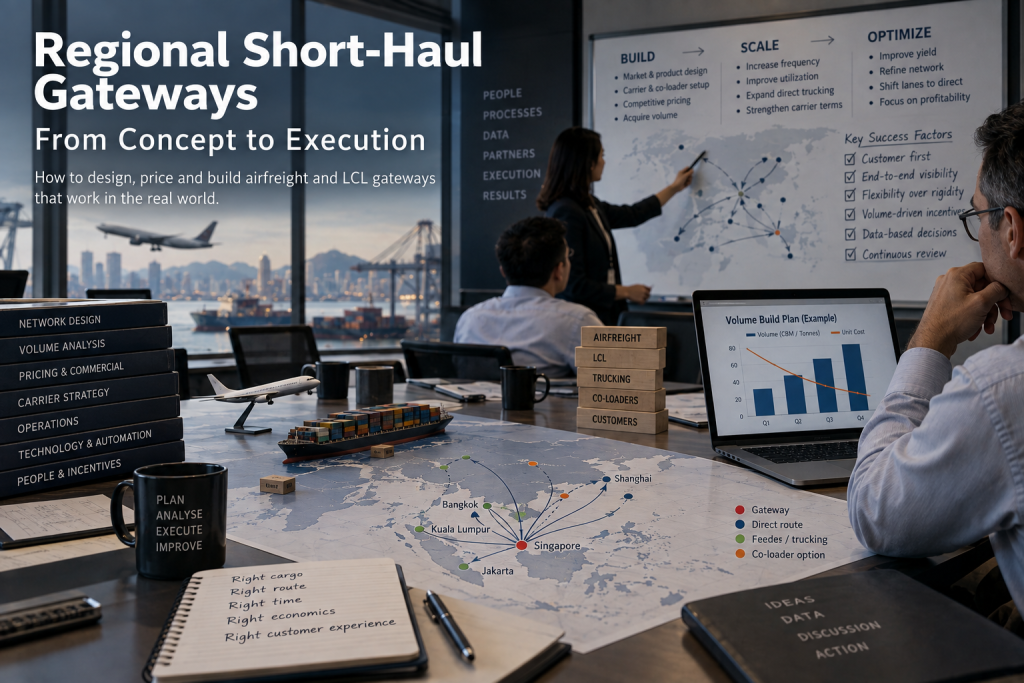
  • Regional Short-Haul Gateways: Why Airfreight and LCL Need a Different Model

    Gateway concepts are well established in freight forwarding.

    Cargo from multiple origins is concentrated at a gateway, consolidated into larger movements and transported to destination. On long-haul trades, the logic is relatively straightforward. Consolidating volume creates buying power, improves capacity utilization and allows forwarders to build controlled products around major intercontinental trunk routes.

    But can the same concept work for regional short-haul airfreight and LCL?

    It can, but simply applying a traditional long-haul gateway model to regional trades is unlikely to produce the desired result.

    Short-haul economics are different. Customers expect fast transit, direct transportation options are plentiful and departures can be frequent. A few hours of unnecessary handling can represent a significant percentage of the total door-to-door journey.

    A successful regional gateway therefore needs to optimize:

    Volume + Frequency + Transit Time + Capacity + Flexibility + Cost

    That requires looking beyond consolidation itself. Physical handling, first-mile trucking, carrier policy, co-loaders, pricing, quotation speed and internal incentives all become part of the design.

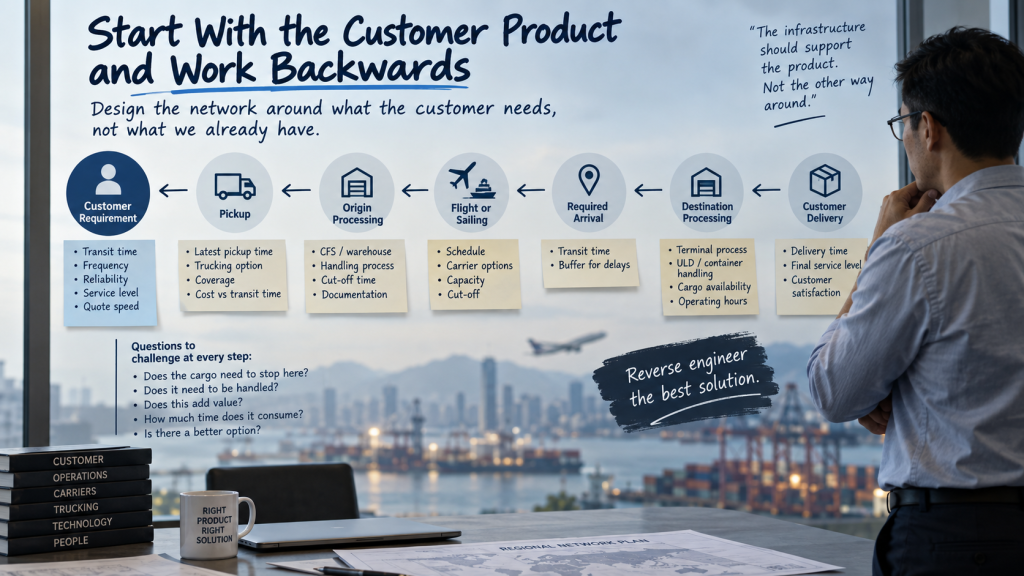
    Most importantly, the starting point should not be the infrastructure the forwarder already has.

    It should be the product the customer needs.

    A common approach to gateway development is to begin with the existing organization.

    We have these warehouses, handling partners, carriers, trucking providers and consolidations. How can we build a gateway around them?

    For short-haul freight, I believe this should be reversed.

    Start with the customer proposition.

    What door-to-door transit time are we promising? How frequently must we depart? What reliability is required? What is the latest acceptable pickup time? How quickly must we quote?

    Then work backwards:

    Customer delivery requirement → Destination processing → Required arrival → Flight or sailing → Origin processing → Cut-off → Pickup

    Only then should the physical and commercial network be designed.

    If an existing warehouse adds six unnecessary hours, question the warehouse. If the carrier policy prevents access to the required departures, change the policy. If the trucking network causes cargo to miss the intended consolidation, reconsider the trucking model.

    The infrastructure should support the product. The product should not be compromised to accommodate the infrastructure.

    Consider Intra-Asia airfreight.

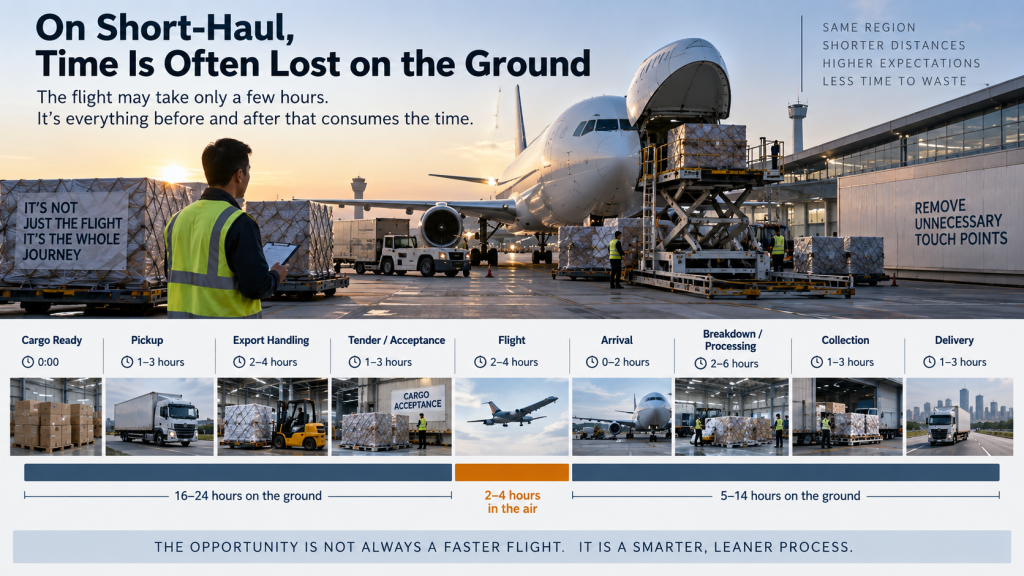
    Customers may expect approximately one day door-to-door, with two days representing the upper end for many standard regional movements. Losing six hours somewhere in the process can therefore consume 25% of an entire 24-hour service window.

    The flight itself may only take a few hours. The larger problem can be everything happening around it.

    I have seen this first-hand on Singapore-Hong Kong airfreight movements. Cargo could arrive at the airport terminal in Hong Kong, be collected and then transported to another warehouse outside the airport for breakdown and processing. That additional movement could easily consume six hours.

    Every physical touch point therefore needs to be challenged.

    Does the cargo actually need to stop there? Does it need to be unloaded? Does it need to move to another warehouse? What value does the process add, and how much time does it consume?

    The relevant measurement cannot simply be airport-to-airport transit. It needs to cover the complete journey:

    Cargo ready → Pickup → Export handling → Tender → Departure → Arrival → Breakdown → Collection → Delivery

    Sometimes eliminating one physical cargo touch creates more customer value than negotiating another few percentage points from the freight rate.

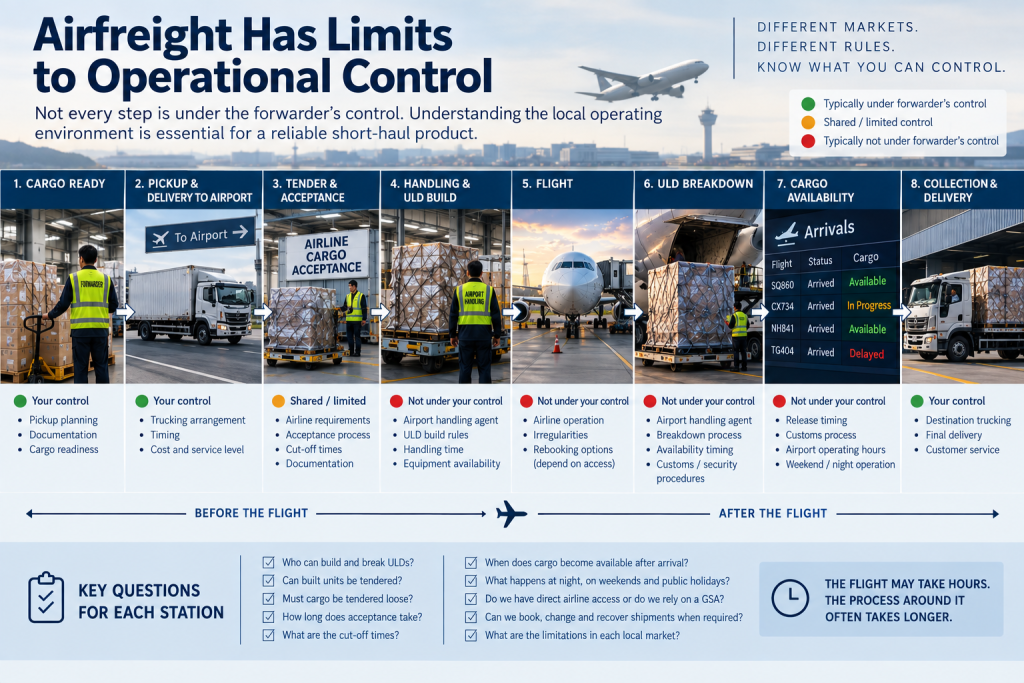
    Not every physical touch can simply be eliminated.

    The ability of a forwarder to control cargo handling varies by market and airport. In some Asian operating environments, forwarders cannot independently build or break airline pallets or ULDs. Cargo may have to be tendered loose and collected loose after arrival.

    The process can therefore become:

    Loose cargo tender → Acceptance → Handling → ULD build → Flight → ULD breakdown → Cargo availability → Collection

    Gateway analysis must consequently understand the actual operating environment at each location.

    Who can build and break ULDs? Can built units be tendered? How long does acceptance take? When does cargo become available after arrival? What happens at night, on weekends and on public holidays?

    Commercial access matters as well.

    Forwarders without an IATA license that depend on GSAs, may have significantly less flexibility outside normal working hours.

    That becomes critical when a shipment misses a Friday evening flight, additional capacity is required on Saturday or cargo needs to be switched to another carrier.

    For short-haul airfreight, there are therefore three different forms of availability:

    Schedule availability: The flight exists.

    Commercial availability: Space and a rate are available.

    Operational availability: The shipment can actually be booked, tendered, changed, recovered and collected within the required timeframe.

    Only when all three are present is the flight genuinely useful to the gateway product.

    A short-haul gateway cannot depend on infrequent consolidations.

    If the underlying transportation takes one or two days but cargo waits three days for the next consolidation, the gateway has defeated the purpose of the product.

    As a starting principle, a regional consolidation should probably offer at least two to three departures per week, with higher connectivity required on important time-sensitive corridors.

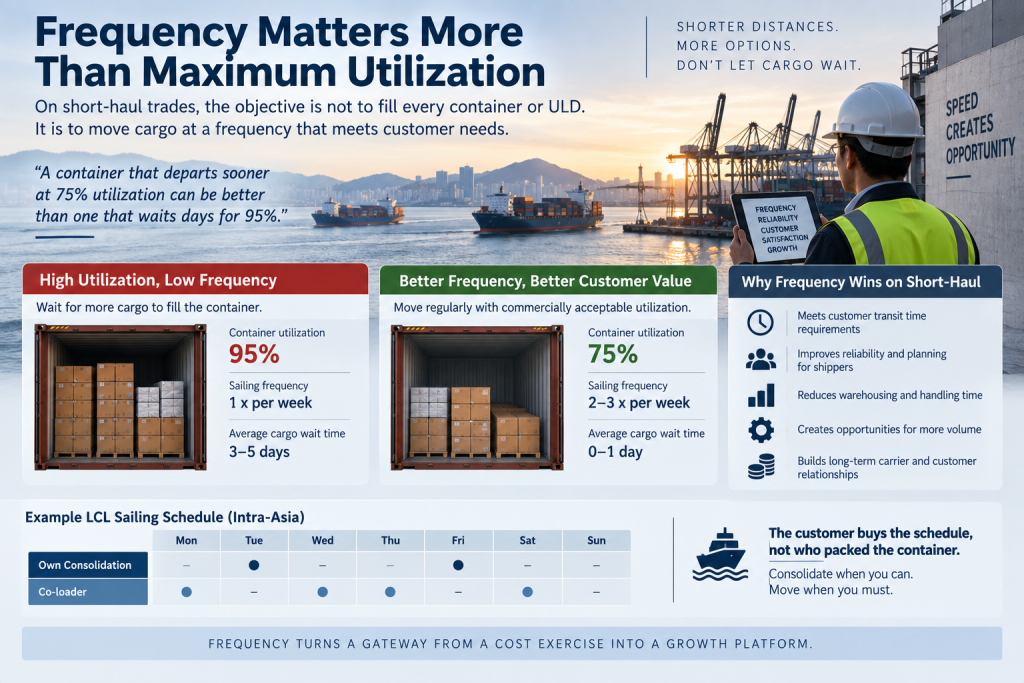
    This creates a fundamental trade-off between utilization and frequency.

    The objective should not be to maximize every ULD or container.

    It should be:

    Commercially acceptable utilization at a competitive frequency.

    This is particularly important for LCL. On some intra-Asia corridors, several vessel sailings can be available within a single day. Holding cargo simply to achieve a fuller own container makes little sense if it damages the customer proposition.

    A container departing at 75% utilization can be better than one departing at 95% if achieving the additional utilization requires holding cargo for several days.

    LCL has an important advantage in solving this frequency problem.

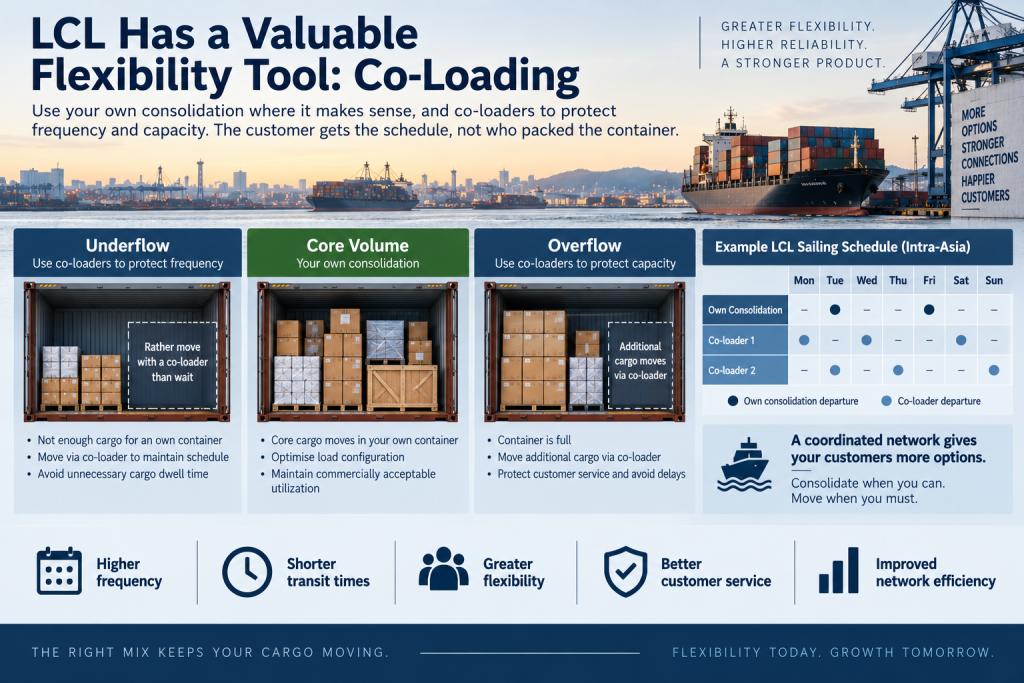
    The forwarder does not need to move every shipment in its own consolidation. Qualified co-loaders can be incorporated into the product to manage both underflow and overflow.

    If insufficient cargo exists to justify the planned own container and waiting would compromise the service, cargo can move through a co-loader.

    If the own container is full, additional cargo can also move through a co-loader rather than waiting for the next consolidation.

    The model becomes:

    Underflow → Co-loader protects frequency

    Core volume → Own consolidation

    Overflow → Co-loader protects capacity

    This should not be treated simply as a temporary arrangement while the gateway develops. Co-loading can remain a permanent flexibility layer around the forwarder’s own consolidation programme.

    The key is to coordinate sailing schedules.

    If own consolidations depart Tuesday and Friday, selected co-loaders should ideally provide useful departures around those sailings rather than simply duplicating them.

    The combined schedule could provide departures across most of the week even though only some are operated as own consolidations.

    From the customer’s perspective, the product is the schedule, not who packed the container.

    This leads to a useful operating principle:

    Consolidate when you can. Move when you must.

    Each shipment effectively has a maximum permissible dwell time. If the next own consolidation falls within that window, use it. If it does not, move the cargo through the best qualified alternative.

    Volume analysis for LCL also needs to consider the physical characteristics of the cargo.

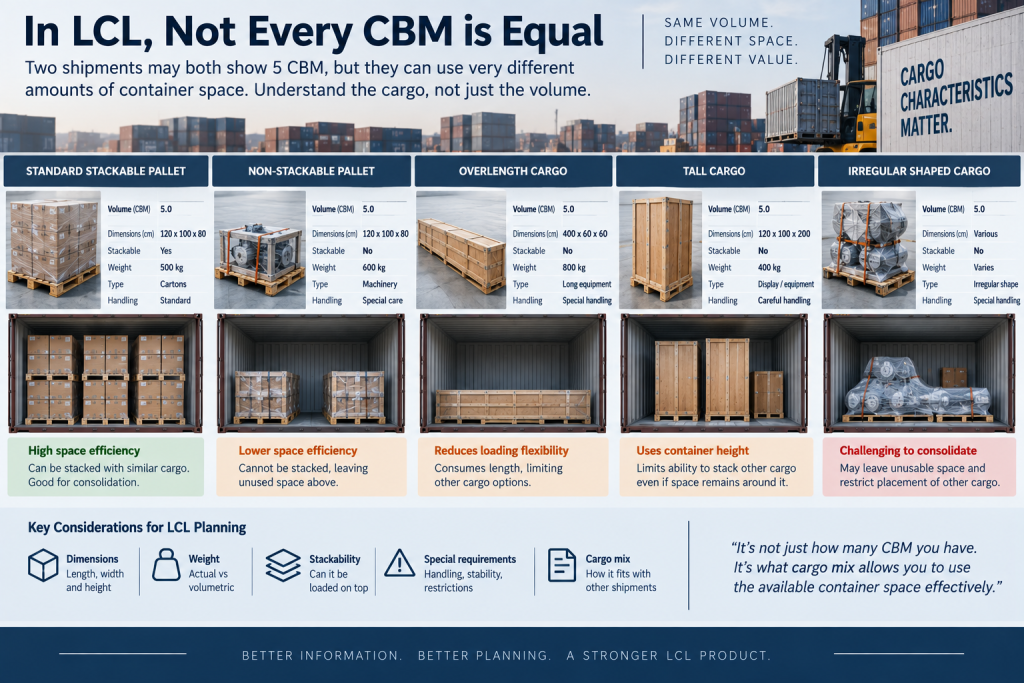
    Cargo on relatively low pallets, for example around 80 cm high and safely stackable, is attractive consolidation cargo because suitable freight can potentially be loaded above it.

    Non-stackable pallets, non-standard skids, overlength pieces, machinery, tall cargo and irregularly shaped freight are very different.

    Two shipments may both show 5 CBM in the forwarding system while consuming completely different amounts of usable container capacity.

    A non-stackable skid can leave substantial unused space above it. An overlength piece may prevent several other shipments from being positioned efficiently.

    The gateway therefore needs to understand effective capacity, not simply booked CBM.

    Dimensions, packaging type, stackability, weight and loading restrictions should form part of the analysis.

    The important question is not simply:

    How many CBM do we have?

    It is:

    What cargo mix allows us to use the available container space effectively?

    The same end-to-end thinking needs to include both first- and last-mile trucking.

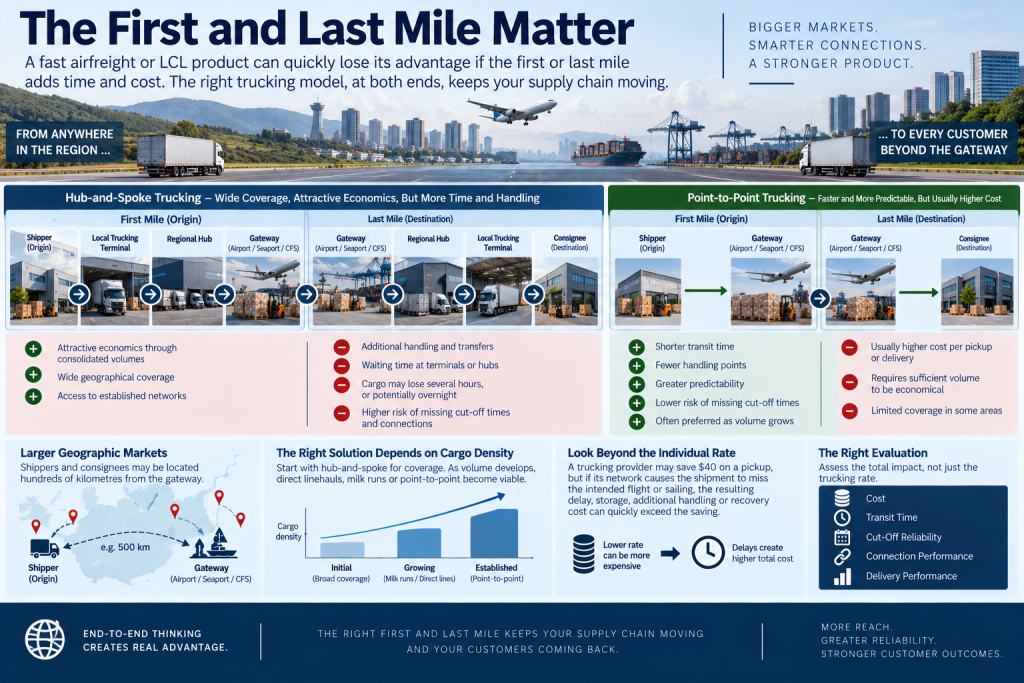
    This becomes particularly important in larger geographic markets where shippers and consignees may be located hundreds of kilometres from the gateway. A fast international airfreight or LCL product can quickly lose its advantage if significant time is added before departure or after arrival.

    Large trucking companies often operate hub-and-spoke networks. On the first mile, the movement may look like:

    Shipper → Local trucking terminal → Regional hub → Gateway

    At destination, the process can effectively operate in reverse:

    Gateway → Regional hub → Local trucking terminal → Consignee

    These networks can provide attractive economics and broad geographical coverage because cargo from many customers is combined. However, every additional terminal introduces another transfer, handling activity and potential waiting period. Cargo may lose several hours, or potentially overnight, at either end of the international movement.

    The alternative is a more direct trucking solution:

    Shipper → Gateway

    and

    Gateway → Consignee

    Point-to-point trucking can reduce handling, improve predictability and shorten door-to-door transit. The trade-off is cost. Without sufficient cargo density, direct trucking can be considerably more expensive than using an established hub-and-spoke network.

    The appropriate solution therefore depends on both geography and volume.

    During the early development of a gateway, hub-and-spoke trucking may provide the most economical way to achieve broad market coverage. As cargo density develops within particular regions, direct linehauls, milk runs or point-to-point trucking can become viable on either the origin or destination side.

    This means first- and last-mile networks should evolve together with the gateway rather than being treated as fixed arrangements.

    It also demonstrates why trucking procurement cannot be evaluated purely on the individual pickup or delivery rate.

    A cheaper first-mile solution may cause cargo to miss the planned flight or sailing. A cheaper last-mile solution may add a day to delivery after the cargo has already reached the destination gateway. In either case, savings on the trucking rate can be outweighed by additional handling, storage, missed connections, recovery costs or deterioration of the customer proposition.

    The relevant comparison is therefore:

    Cost + Transit Time + Cut-Off Reliability + Connection Performance + Delivery Performance

    not simply the cost of the pickup or delivery.

    For a short-haul product, the international movement may only take a few hours or a day. The first and last mile can therefore determine whether the overall product is genuinely fast or merely appears fast on the flight or sailing schedule.

    The same principle applies to carrier procurement.

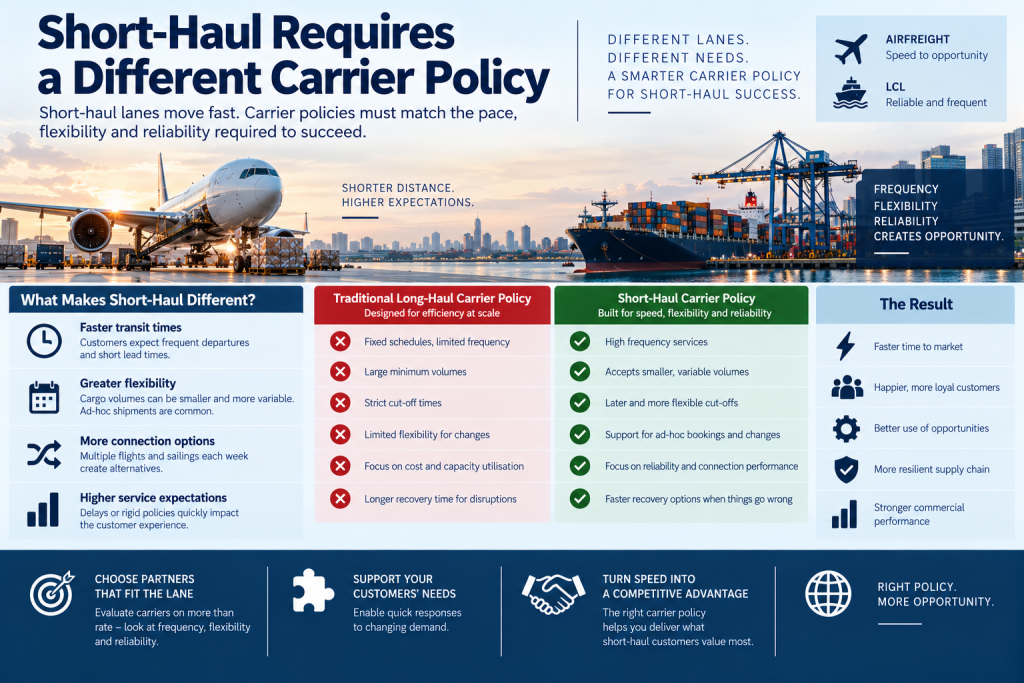
    Carrier concentration can make considerable sense on long-haul trades. Concentrating large volumes with selected carriers can generate attractive rates, capacity commitments and strategic benefits.

    Rigidly applying the same philosophy to short-haul gateways can reduce the frequency and flexibility the product requires.

    If five carriers provide useful departures but procurement policy effectively restricts the operation to one or two, the forwarder has voluntarily reduced the available network.

    For short-haul traffic, the hierarchy should increasingly become:

    Customer requirement → Available departure → Qualified carrier → Commercial selection

    rather than:

    Preferred carrier → Available departure → Customer service

    This does not mean abandoning procurement discipline. It means recognizing that frequency, cut-off, recovery capability and operational flexibility have economic value.

    Carrier interests can also align with this approach because carriers want volume.

    Instead of discussing only today’s rate, procurement can approach carriers with a lane-development proposition based on expected recurring volume.

    As the gateway grows, that volume creates greater buying leverage.

    And this still requires the relationships with key GSA’s that occasionally offer attractive rates on specific flights.

    This leads to perhaps the most difficult gateway question:

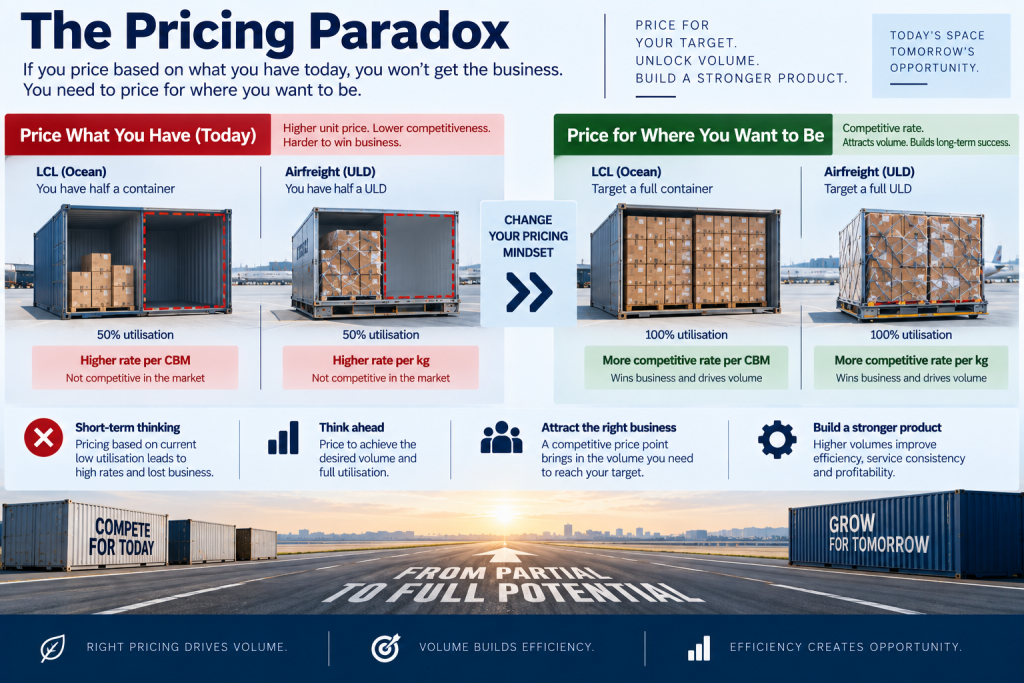
    Do we price based on the volume we have today or the volume we intend to build?

    Pricing purely on today’s low volume can create a self-defeating cycle:

    Low Volume → High Unit Cost → High Selling Price → Low Conversion → Low Volume

    The gateway may then fail not because the market was insufficient, but because its initial pricing prevented it from attracting the volume required to become competitive.

    A better approach is to model the economics at different volume levels.

    For example:

    LCL: 20 → 40 → 60 → 80 CBM per week

    Airfreight: 2 → 5 → 10 → 20 tonnes per week

    At each level, calculate utilization, departure frequency, buying rates, handling costs and resulting unit cost.

    This produces a gateway cost curve and identifies the critical-mass point at which the product becomes commercially sustainable.

    Pricing can then be established against a target-volume business case rather than solely against today’s volume.

    However, the difference between today’s actual cost and the competitive rate required to build future volume cannot simply be ignored.

    It is an investment.

    Management should explicitly identify:

    Actual cost: The cost at current volume.

    Target-volume economics: The expected cost at the planned level of activity.

    Development gap: The investment required while moving between the two.

    That gap should have an approved budget, volume milestones and a defined timeframe. If the expected volume does not materialize, the assumptions need to be revisited.

    Volume First Changes the Incentive Model

    The gateway development sequence is:

    Volume → Frequency → Utilization → Buying Power → Profitability

    That has a major implication for incentives.

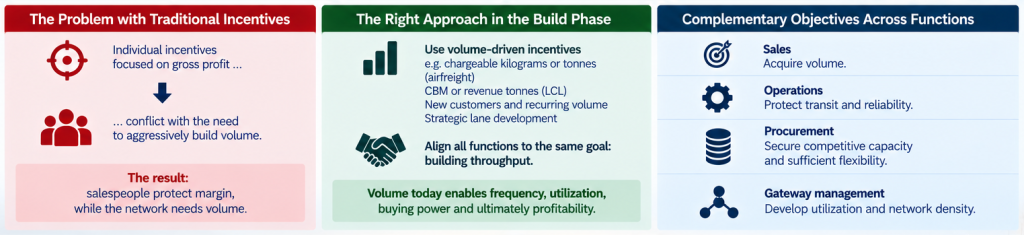
    Classic freight forwarding profit-share models are poorly suited to the Build phase.

    If salespeople are rewarded primarily on gross profit while management asks them to aggressively build a new gateway, the objectives conflict. The individual is encouraged to protect margin while the network needs volume.

    During the Build phase, incentives therefore need to be volume driven.

    For airfreight this could be chargeable kilograms or tonnes. For LCL it could be CBM or revenue tonnes. New customers, recurring volume and strategic lane development can also be recognized.

    And this alignment cannot stop with sales.

    Operations cannot be measured only on local station profitability if the objective is to build regional throughput. Procurement cannot be rewarded solely for preferred-carrier compliance if the product requires multiple carrier options.

    The functions need complementary objectives:

    Sales: Acquire volume.

    Operations: Protect transit and reliability.

    Procurement: Secure competitive capacity and sufficient flexibility.

    Gateway management: Develop utilization and network density.

    Profitability remains important, but expecting mature-gateway profitability while the network is still being built can prevent it from reaching maturity in the first place.

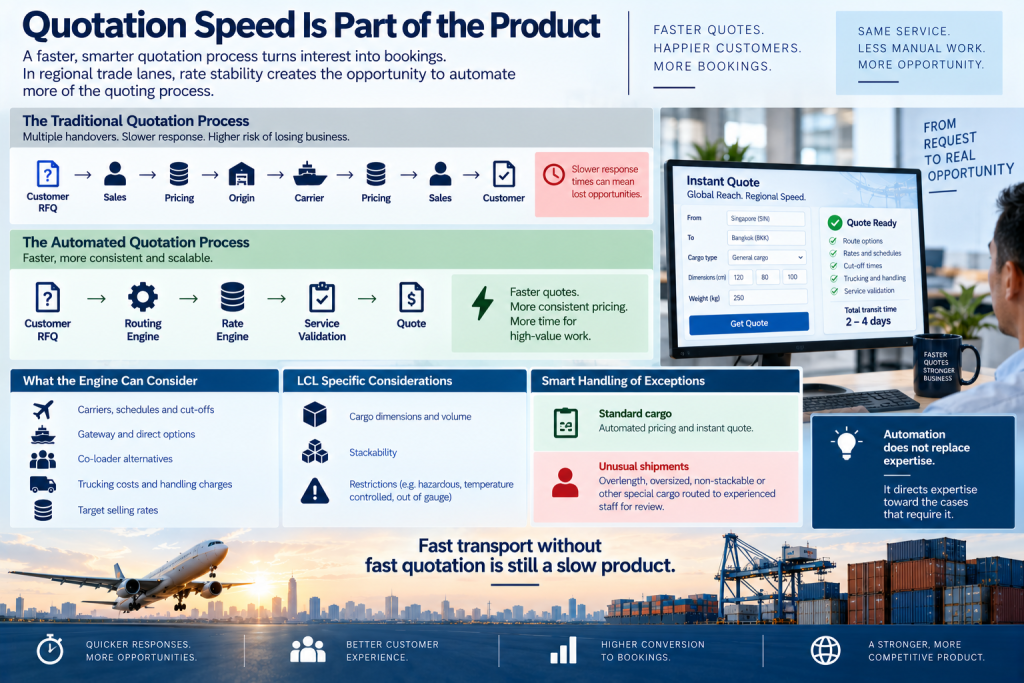
    Another form of speed matters: quotation speed.

    Regional rates can often be more stable than long-haul rates, creating an opportunity for greater automation.

    Instead of:

    Customer RFQ → Sales → Pricing → Origin → Carrier → Pricing → Sales → Customer

    the process can increasingly become:

    Customer RFQ → Routing Engine → Rate Engine → Service Validation → Quote

    The engine can consider carriers, schedules, cut-offs, gateway and direct options, co-loader alternatives, trucking costs, handling charges and target selling rates.

    For LCL it can also consider cargo dimensions, stackability and restrictions.

    Standard cargo can move through automated pricing, while overlength, oversized, non-stackable or otherwise unusual shipments become exceptions for experienced staff to review.

    Automation does not replace expertise. It directs expertise toward the cases that require it.

    Fast transport without fast quotation is still a slow product.

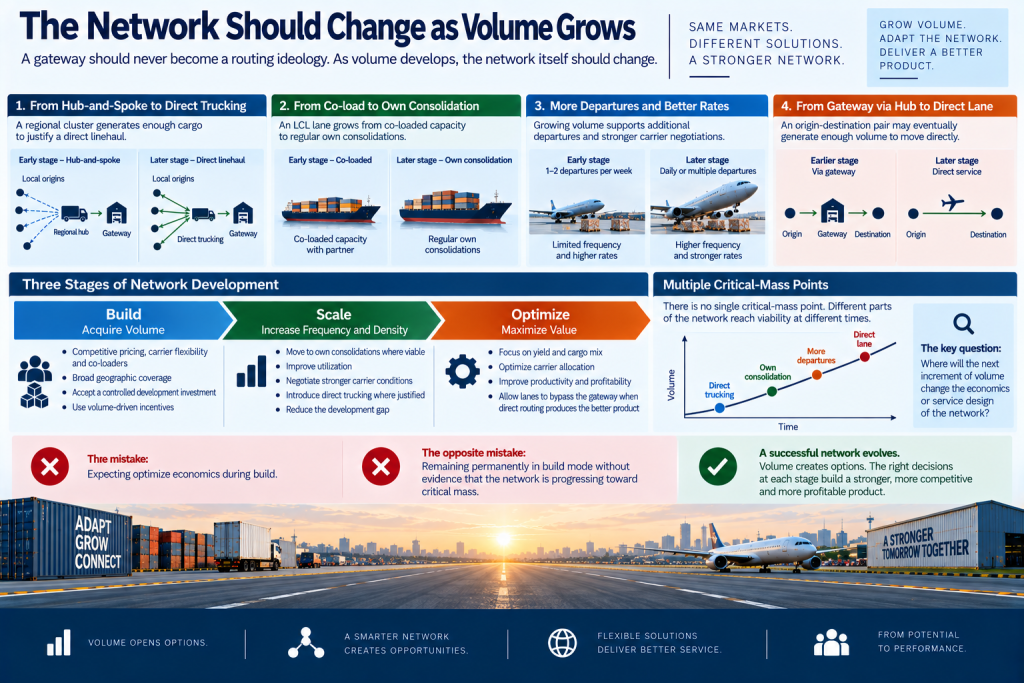
    A gateway should never become a routing ideology.

    As volume develops, the network itself should change.

    A geographic cluster may generate enough cargo to replace hub-and-spoke trucking with a direct linehaul.

    An LCL lane may generate enough volume to move from predominantly co-loaded capacity to regular own consolidations.

    Growing gateway volume may support additional departures and stronger carrier negotiations.

    Eventually, a specific origin-destination pair may generate enough cargo to move directly rather than through the gateway at all.

    There is therefore no single critical-mass point.

    There are multiple critical-mass points throughout the network, and each can trigger a different operational decision.

    The important question becomes:

    Where will the next increment of volume change the economics or service design of the network?

    This naturally creates three stages of development.

    Build

    Acquire volume using competitive pricing, carrier flexibility, co-loaders and broad geographic coverage. Accept a controlled development investment and use volume-driven incentives.

    Scale

    Use growing cargo density to increase own-consolidation frequency, improve utilization, negotiate stronger carrier conditions, introduce direct trucking where justified and reduce the development gap.

    Optimize

    Once critical mass is established, place greater emphasis on yield, cargo mix, carrier allocation, productivity and profitability. Where individual lanes have developed sufficient density, allow them to bypass the gateway when direct routing produces the better product.

    The mistake is expecting Optimize economics during Build.

    The opposite mistake is remaining permanently in Build mode without evidence that the network is progressing toward critical mass.

    Summary

    Regional short-haul gateways can work, but they cannot simply be smaller versions of traditional long-haul gateways.

    They need to be designed around the realities of short-haul transportation: limited tolerance for waiting, frequent transport options, different levels of operational control and a strong relationship between volume and service frequency.

    Airfreight needs particular attention to terminal processes, ULD handling rights, airline access and out-of-hours flexibility.

    LCL offers greater flexibility through coordinated own consolidations and co-loaders, but cargo characteristics and first-mile trucking can have a significant impact on effective capacity and transit time.

    The commercial model is equally important. Pricing purely against today’s low volume can prevent the gateway from ever attracting the cargo required to become competitive. Building the product therefore requires a controlled investment against target-volume economics.

    That also means classic profit-share incentives are inappropriate during the initial build. If volume is the strategic objective, incentives need to support volume.

    The network can then evolve as cargo density develops:

    Build → Scale → Optimize

    The overall principle is simple:

    Start with the customer product and work backwards.

    Design the handling, trucking, carrier strategy, consolidation schedule, pricing and incentives required to deliver it. Then allow the network to change as volume reaches different critical-mass points.

    And for short-haul LCL in particular, one operating principle captures the balance between consolidation economics and customer service:

    Consolidate when you can. Move when you must.

    Because in short-haul freight forwarding, improving transit time is often not about moving the cargo faster.

    It is about stopping it from standing still.

  • 🚢 Large vs. Small Freight Forwarders: What Makes Them Tick?

    Post 7/7: What Happens When They Compete Outside Their Sweet Spot

    When small forwarders pursue large global clients:

    • They may underprice or overcommit.
    • Risk reputational damage if execution fails.
    • Lose focus on their core SME base.

    When large forwarders pursue small clients:

    • Clients may feel neglected or priced out.
    • Service personalization often suffers.
    • Internal processes may not suit transactional needs.

    Bottom line:
    The winners understand their lane—and stay in it or grow with clarity.

    #LogisticsLeadership #FreightForwarding #SupplyChainStrategy #LargeVsSmall #Forwarders #SME #GlobalForwarding #BusinessStrategy #CorporateStructure #FreightForwardingStrategy #ClientFit #ForwarderGrowth #BusinessScaling #CustomerCentricity #LocalExpertise #ForwarderTech #Digitization

  • 🚢 Large vs. Small Freight Forwarders: What Makes Them Tick?

    Post 6/7: What Small Forwarders Struggle With

    Trying to do everything often backfires.

    Common pitfalls:

    • Limited rate leverage
    • Overstretching into services beyond core strength
    • Fragmented tech stack
    • Dependency on key staff or clients
    • Difficulty competing in global tenders

    #LogisticsLeadership #FreightForwarding #SupplyChainStrategy #LargeVsSmall #Forwarders #SME #GlobalForwarding #BusinessStrategy #CorporateStructure #FreightForwardingStrategy #ClientFit #ForwarderGrowth #BusinessScaling #CustomerCentricity #LocalExpertise #ForwarderTech #Digitization

  • 🚢 Large vs. Small Freight Forwarders: What Makes Them Tick?

    Post 5/7: What Small Forwarders Do Well

    Small forwarders build trust through agility.

    Strengths include:

    • Tailored service delivery
    • Personal client relationships
    • Speed in quoting & execution
    • Success in underserved or emerging markets
    • Entrepreneurial problem solving

    #LogisticsLeadership #FreightForwarding #SupplyChainStrategy #LargeVsSmall #Forwarders #SME #GlobalForwarding #BusinessStrategy #CorporateStructure #FreightForwardingStrategy #ClientFit #ForwarderGrowth #BusinessScaling #CustomerCentricity #LocalExpertise #ForwarderTech #Digitization

  • 🚢 Large vs. Small Freight Forwarders: What Makes Them Tick?

    Post 4/7: What Large Forwarders Struggle With

    Size comes with trade-offs.

    Challenges include:

    • Inflexibility in service customizations
    • Slower response time for smaller clients
    • Complexity in internal processes
    • Less personal account management
    • Struggles in niche, low-volume lanes

    #LogisticsLeadership #FreightForwarding #SupplyChainStrategy #LargeVsSmall #Forwarders #SME #GlobalForwarding #BusinessStrategy #CorporateStructure #FreightForwardingStrategy #ClientFit #ForwarderGrowth #BusinessScaling #CustomerCentricity #LocalExpertise #ForwarderTech #Digitization

  • 🚢 Large vs. Small Freight Forwarders: What Makes Them Tick?

    Post 3/7: What Large Forwarders Do Well

    Large forwarders excel when the task is complex, global, or regulated.

    They shine in:

    • Serving multinational clients
    • Managing high-volume, multi-lane shipments
    • Delivering standardized SOPs
    • Investing in automation, ESG, and innovation
    • Winning and running RFQs

    #LogisticsLeadership #FreightForwarding #SupplyChainStrategy #LargeVsSmall #Forwarders #SME #GlobalForwarding #BusinessStrategy #CorporateStructure #FreightForwardingStrategy #ClientFit #ForwarderGrowth #BusinessScaling #CustomerCentricity #LocalExpertise #ForwarderTech #Digitization

  • 🚢 Large vs. Small Freight Forwarders: What Makes Them Tick?

    Post 2/7: Characteristics of Small Freight Forwarders

    Small forwarders are agile, customer-centric, and often locally dominant.
    They thrive in flexibility, service quality, and personal relationships.

    Key traits:

    • Niche market expertise
    • Hands-on customer service
    • Quick decisions, no red tape
    • Customizable solutions
    • Strong regional agent networks

    #LogisticsLeadership #FreightForwarding #SupplyChainStrategy #LargeVsSmall #Forwarders #SME #GlobalForwarding #BusinessStrategy #CorporateStructure #FreightForwardingStrategy #ClientFit #ForwarderGrowth #BusinessScaling #CustomerCentricity #LocalExpertise #ForwarderTech #Digitization #mmlogistix

  • 🚢 Large vs. Small Freight Forwarders: What Makes Them Tick?

    Post 1/7: Characteristics of Large Freight Forwarders

    Large forwarders (USD 2B+ revenue) are built for scale.
    They operate global networks, run proprietary systems, and handle end-to-end supply chains. Think compliance, capacity, and cross-border coordination.

    Key traits:

    • Global offices & assets
    • Deep sector specialization
    • Digital platforms & integrations
    • Strong procurement power
    • Focus on large contracts & tenders

    #LogisticsLeadership #FreightForwarding #SupplyChainStrategy #LargeVsSmall #Forwarders #SME #GlobalForwarding #BusinessStrategy #CorporateStructure #FreightForwardingStrategy #ClientFit #ForwarderGrowth #BusinessScaling #CustomerCentricity #LocalExpertise #ForwarderTech #Digitization #mmlogistix

  • 🚢 Large vs. Small Freight Forwarders: What Makes Them Tick?

    Introduction

    In today’s global logistics landscape, both large multinational forwarders and agile regional players play critical roles. But their strengths—and weaknesses—are not created equal.

    Over the next 7 posts, I’ll break down:
    ✅ What large forwarders do well
    ✅ Where small forwarders outperform
    ✅ Where each fall short
    ✅ And what happens when they step into each other’s turf

    Whether you’re a forwarder, shipper, or supply chain leader, this series will help you better understand the strategic choices that shape the forwarding industry.

    Follow along and share your thoughts as we explore both sides of the freight equation.

    #LogisticsLeadership #FreightForwarding #SupplyChainStrategy #LargeVsSmall #Forwarders #SME #GlobalForwarding #BusinessStrategy #CorporateStructure #FreightForwardingStrategy #ClientFit #ForwarderGrowth #BusinessScaling #CustomerCentricity #LocalExpertise #ForwarderTech #Digitization