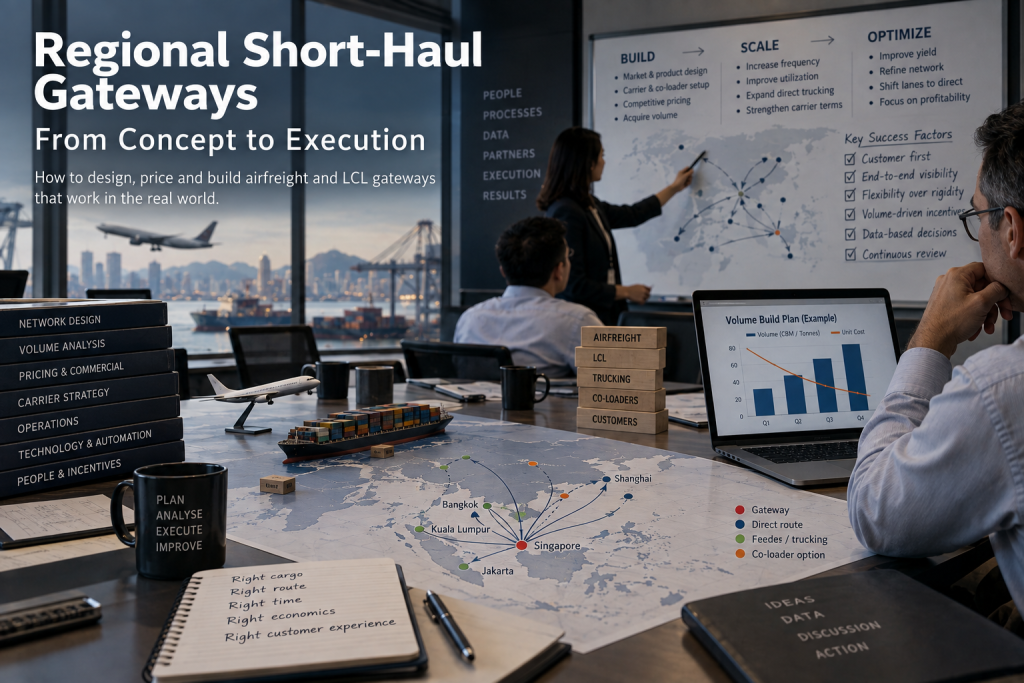
Gateway concepts are well established in freight forwarding.
Cargo from multiple origins is concentrated at a gateway, consolidated into larger movements and transported to destination. On long-haul trades, the logic is relatively straightforward. Consolidating volume creates buying power, improves capacity utilization and allows forwarders to build controlled products around major intercontinental trunk routes.
But can the same concept work for regional short-haul airfreight and LCL?
It can, but simply applying a traditional long-haul gateway model to regional trades is unlikely to produce the desired result.
Short-haul economics are different. Customers expect fast transit, direct transportation options are plentiful and departures can be frequent. A few hours of unnecessary handling can represent a significant percentage of the total door-to-door journey.
A successful regional gateway therefore needs to optimize:
Volume + Frequency + Transit Time + Capacity + Flexibility + Cost
That requires looking beyond consolidation itself. Physical handling, first-mile trucking, carrier policy, co-loaders, pricing, quotation speed and internal incentives all become part of the design.
Most importantly, the starting point should not be the infrastructure the forwarder already has.
It should be the product the customer needs.
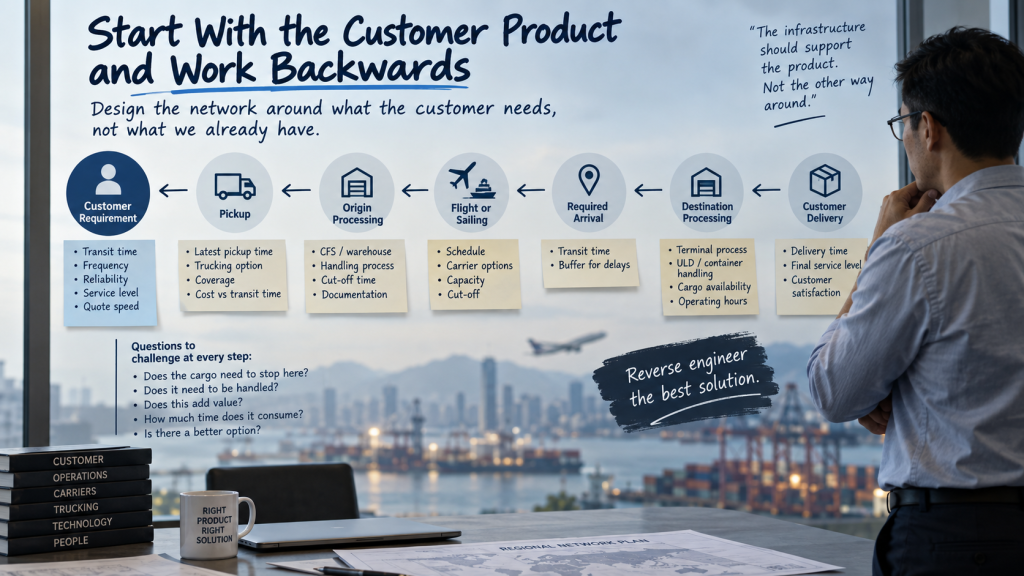
A common approach to gateway development is to begin with the existing organization.
We have these warehouses, handling partners, carriers, trucking providers and consolidations. How can we build a gateway around them?
For short-haul freight, I believe this should be reversed.
Start with the customer proposition.
What door-to-door transit time are we promising? How frequently must we depart? What reliability is required? What is the latest acceptable pickup time? How quickly must we quote?
Then work backwards:
Customer delivery requirement → Destination processing → Required arrival → Flight or sailing → Origin processing → Cut-off → Pickup
Only then should the physical and commercial network be designed.
If an existing warehouse adds six unnecessary hours, question the warehouse. If the carrier policy prevents access to the required departures, change the policy. If the trucking network causes cargo to miss the intended consolidation, reconsider the trucking model.
The infrastructure should support the product. The product should not be compromised to accommodate the infrastructure.
Consider Intra-Asia airfreight.
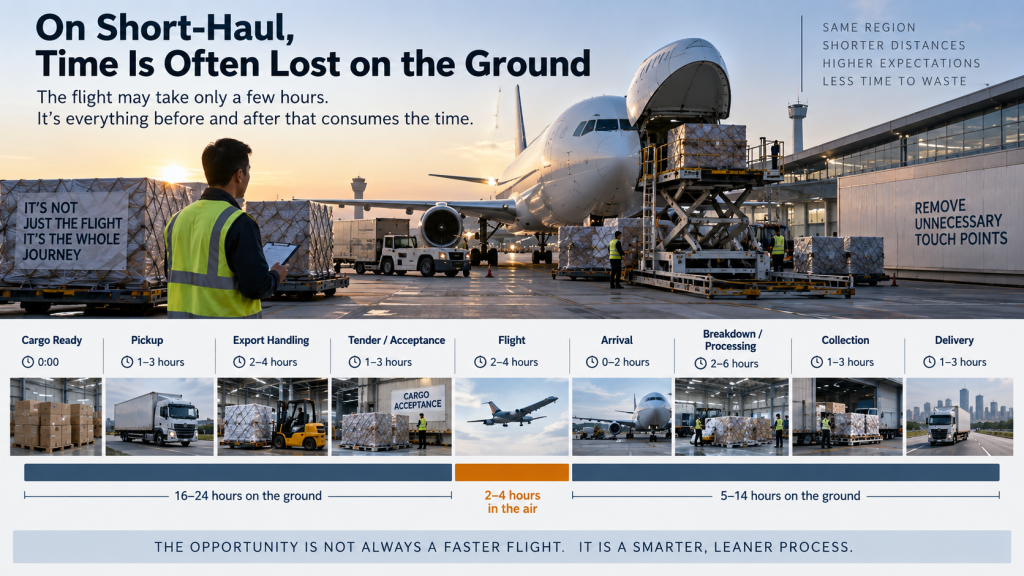
Customers may expect approximately one day door-to-door, with two days representing the upper end for many standard regional movements. Losing six hours somewhere in the process can therefore consume 25% of an entire 24-hour service window.
The flight itself may only take a few hours. The larger problem can be everything happening around it.
I have seen this first-hand on Singapore-Hong Kong airfreight movements. Cargo could arrive at the airport terminal in Hong Kong, be collected and then transported to another warehouse outside the airport for breakdown and processing. That additional movement could easily consume six hours.
Every physical touch point therefore needs to be challenged.
Does the cargo actually need to stop there? Does it need to be unloaded? Does it need to move to another warehouse? What value does the process add, and how much time does it consume?
The relevant measurement cannot simply be airport-to-airport transit. It needs to cover the complete journey:
Cargo ready → Pickup → Export handling → Tender → Departure → Arrival → Breakdown → Collection → Delivery
Sometimes eliminating one physical cargo touch creates more customer value than negotiating another few percentage points from the freight rate.
Not every physical touch can simply be eliminated.
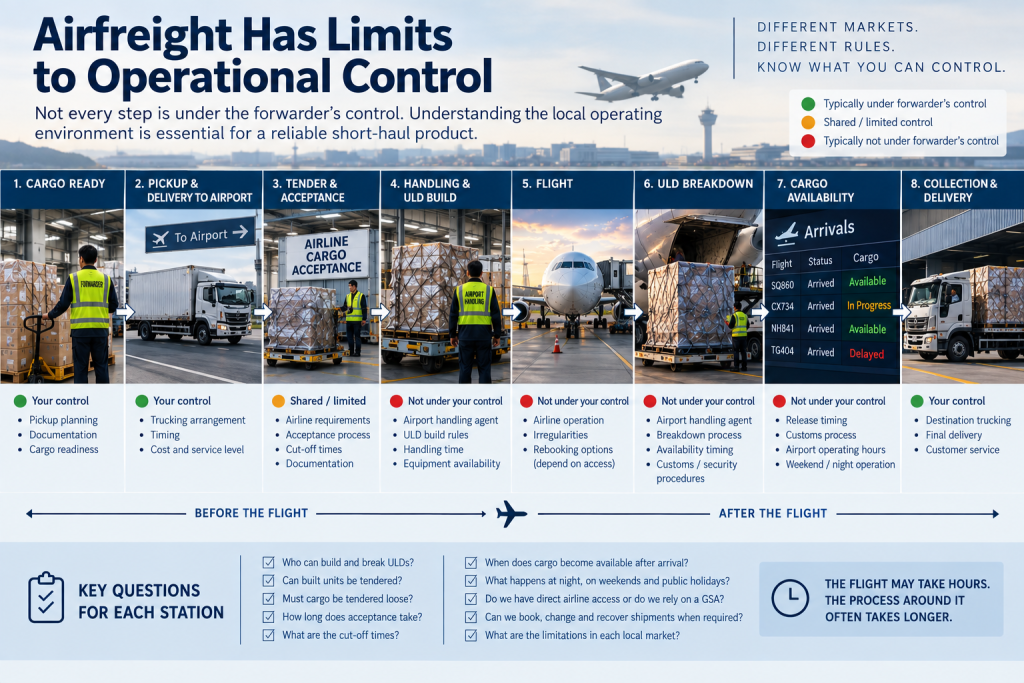
The ability of a forwarder to control cargo handling varies by market and airport. In some Asian operating environments, forwarders cannot independently build or break airline pallets or ULDs. Cargo may have to be tendered loose and collected loose after arrival.
The process can therefore become:
Loose cargo tender → Acceptance → Handling → ULD build → Flight → ULD breakdown → Cargo availability → Collection
Gateway analysis must consequently understand the actual operating environment at each location.
Who can build and break ULDs? Can built units be tendered? How long does acceptance take? When does cargo become available after arrival? What happens at night, on weekends and on public holidays?
Commercial access matters as well.
Forwarders without an IATA license that depend on GSAs, may have significantly less flexibility outside normal working hours.
That becomes critical when a shipment misses a Friday evening flight, additional capacity is required on Saturday or cargo needs to be switched to another carrier.
For short-haul airfreight, there are therefore three different forms of availability:
Schedule availability: The flight exists.
Commercial availability: Space and a rate are available.
Operational availability: The shipment can actually be booked, tendered, changed, recovered and collected within the required timeframe.
Only when all three are present is the flight genuinely useful to the gateway product.
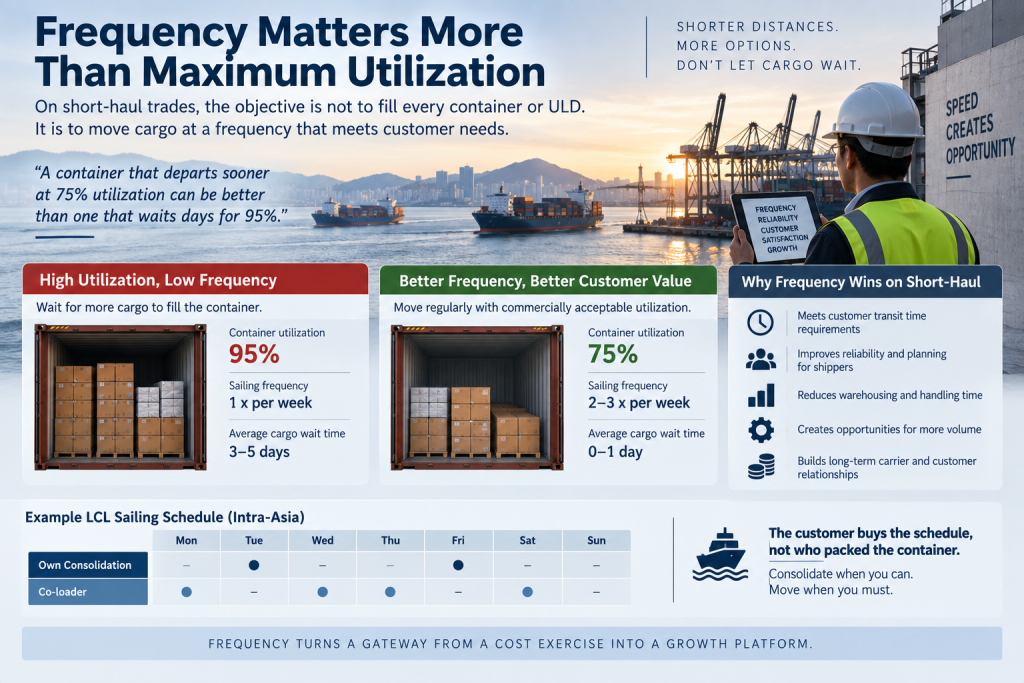
A short-haul gateway cannot depend on infrequent consolidations.
If the underlying transportation takes one or two days but cargo waits three days for the next consolidation, the gateway has defeated the purpose of the product.
As a starting principle, a regional consolidation should probably offer at least two to three departures per week, with higher connectivity required on important time-sensitive corridors.
This creates a fundamental trade-off between utilization and frequency.
The objective should not be to maximize every ULD or container.
It should be:
Commercially acceptable utilization at a competitive frequency.
This is particularly important for LCL. On some intra-Asia corridors, several vessel sailings can be available within a single day. Holding cargo simply to achieve a fuller own container makes little sense if it damages the customer proposition.
A container departing at 75% utilization can be better than one departing at 95% if achieving the additional utilization requires holding cargo for several days.
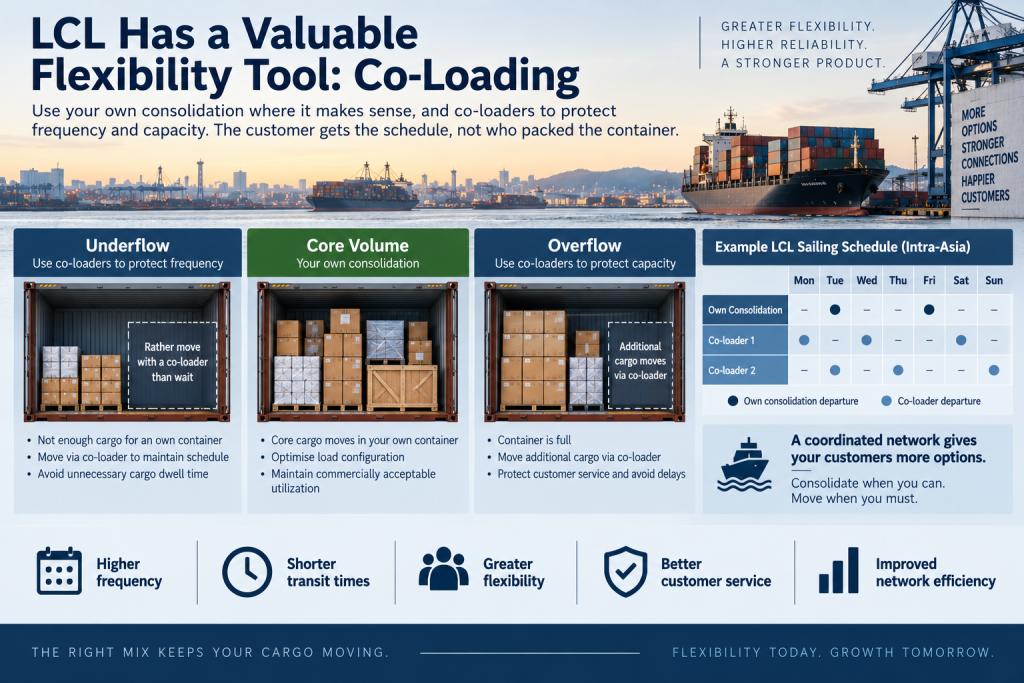
LCL has an important advantage in solving this frequency problem.
The forwarder does not need to move every shipment in its own consolidation. Qualified co-loaders can be incorporated into the product to manage both underflow and overflow.
If insufficient cargo exists to justify the planned own container and waiting would compromise the service, cargo can move through a co-loader.
If the own container is full, additional cargo can also move through a co-loader rather than waiting for the next consolidation.
The model becomes:
Underflow → Co-loader protects frequency
Core volume → Own consolidation
Overflow → Co-loader protects capacity
This should not be treated simply as a temporary arrangement while the gateway develops. Co-loading can remain a permanent flexibility layer around the forwarder’s own consolidation programme.
The key is to coordinate sailing schedules.
If own consolidations depart Tuesday and Friday, selected co-loaders should ideally provide useful departures around those sailings rather than simply duplicating them.
The combined schedule could provide departures across most of the week even though only some are operated as own consolidations.
From the customer’s perspective, the product is the schedule, not who packed the container.
This leads to a useful operating principle:
Consolidate when you can. Move when you must.
Each shipment effectively has a maximum permissible dwell time. If the next own consolidation falls within that window, use it. If it does not, move the cargo through the best qualified alternative.
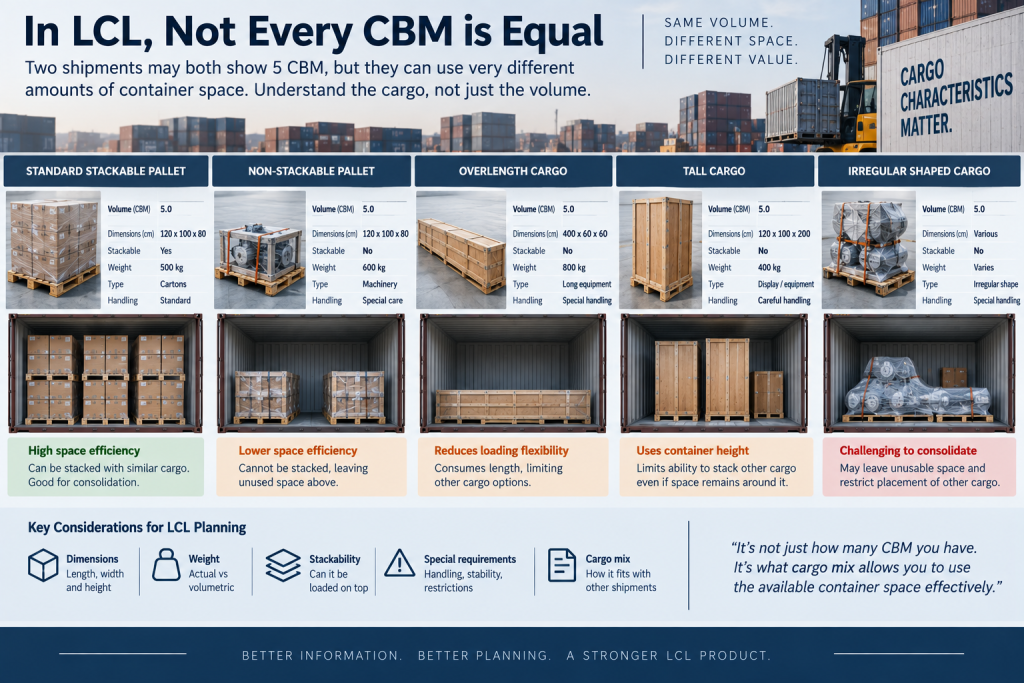
Volume analysis for LCL also needs to consider the physical characteristics of the cargo.
Cargo on relatively low pallets, for example around 80 cm high and safely stackable, is attractive consolidation cargo because suitable freight can potentially be loaded above it.
Non-stackable pallets, non-standard skids, overlength pieces, machinery, tall cargo and irregularly shaped freight are very different.
Two shipments may both show 5 CBM in the forwarding system while consuming completely different amounts of usable container capacity.
A non-stackable skid can leave substantial unused space above it. An overlength piece may prevent several other shipments from being positioned efficiently.
The gateway therefore needs to understand effective capacity, not simply booked CBM.
Dimensions, packaging type, stackability, weight and loading restrictions should form part of the analysis.
The important question is not simply:
How many CBM do we have?
It is:
What cargo mix allows us to use the available container space effectively?
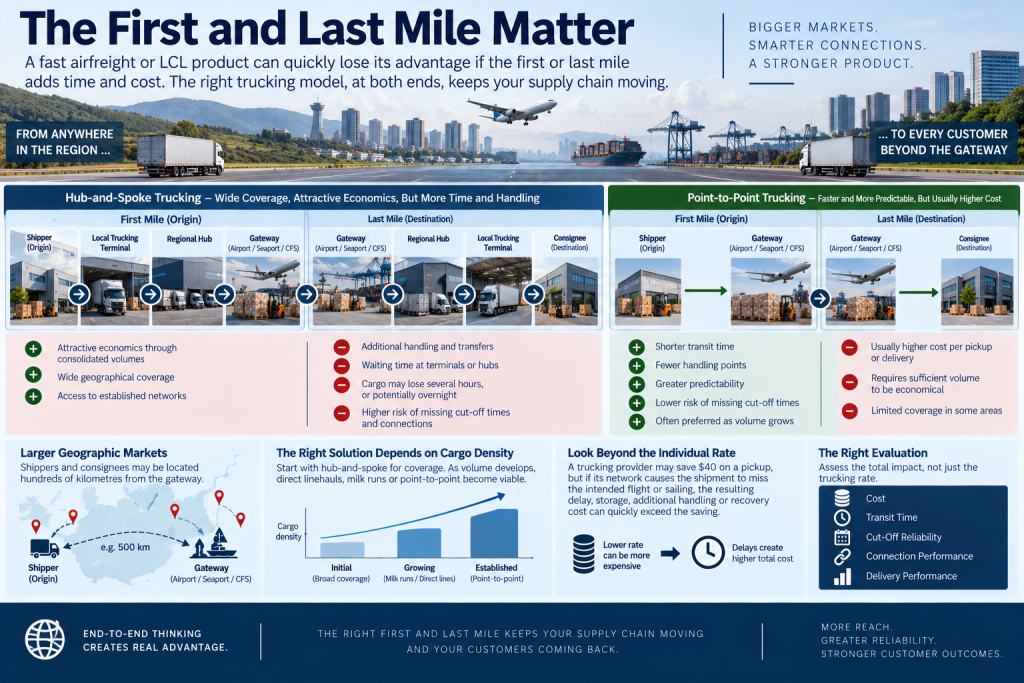
The same end-to-end thinking needs to include both first- and last-mile trucking.
This becomes particularly important in larger geographic markets where shippers and consignees may be located hundreds of kilometres from the gateway. A fast international airfreight or LCL product can quickly lose its advantage if significant time is added before departure or after arrival.
Large trucking companies often operate hub-and-spoke networks. On the first mile, the movement may look like:
Shipper → Local trucking terminal → Regional hub → Gateway
At destination, the process can effectively operate in reverse:
Gateway → Regional hub → Local trucking terminal → Consignee
These networks can provide attractive economics and broad geographical coverage because cargo from many customers is combined. However, every additional terminal introduces another transfer, handling activity and potential waiting period. Cargo may lose several hours, or potentially overnight, at either end of the international movement.
The alternative is a more direct trucking solution:
Shipper → Gateway
and
Gateway → Consignee
Point-to-point trucking can reduce handling, improve predictability and shorten door-to-door transit. The trade-off is cost. Without sufficient cargo density, direct trucking can be considerably more expensive than using an established hub-and-spoke network.
The appropriate solution therefore depends on both geography and volume.
During the early development of a gateway, hub-and-spoke trucking may provide the most economical way to achieve broad market coverage. As cargo density develops within particular regions, direct linehauls, milk runs or point-to-point trucking can become viable on either the origin or destination side.
This means first- and last-mile networks should evolve together with the gateway rather than being treated as fixed arrangements.
It also demonstrates why trucking procurement cannot be evaluated purely on the individual pickup or delivery rate.
A cheaper first-mile solution may cause cargo to miss the planned flight or sailing. A cheaper last-mile solution may add a day to delivery after the cargo has already reached the destination gateway. In either case, savings on the trucking rate can be outweighed by additional handling, storage, missed connections, recovery costs or deterioration of the customer proposition.
The relevant comparison is therefore:
Cost + Transit Time + Cut-Off Reliability + Connection Performance + Delivery Performance
not simply the cost of the pickup or delivery.
For a short-haul product, the international movement may only take a few hours or a day. The first and last mile can therefore determine whether the overall product is genuinely fast or merely appears fast on the flight or sailing schedule.
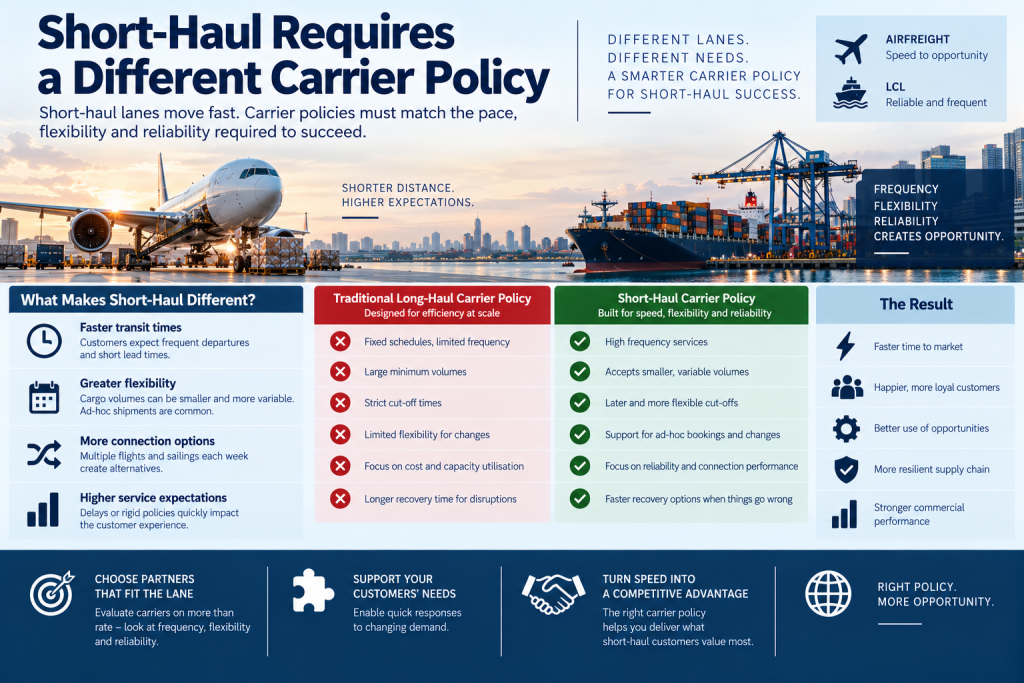
The same principle applies to carrier procurement.
Carrier concentration can make considerable sense on long-haul trades. Concentrating large volumes with selected carriers can generate attractive rates, capacity commitments and strategic benefits.
Rigidly applying the same philosophy to short-haul gateways can reduce the frequency and flexibility the product requires.
If five carriers provide useful departures but procurement policy effectively restricts the operation to one or two, the forwarder has voluntarily reduced the available network.
For short-haul traffic, the hierarchy should increasingly become:
Customer requirement → Available departure → Qualified carrier → Commercial selection
rather than:
Preferred carrier → Available departure → Customer service
This does not mean abandoning procurement discipline. It means recognizing that frequency, cut-off, recovery capability and operational flexibility have economic value.
Carrier interests can also align with this approach because carriers want volume.
Instead of discussing only today’s rate, procurement can approach carriers with a lane-development proposition based on expected recurring volume.
As the gateway grows, that volume creates greater buying leverage.
And this still requires the relationships with key GSA’s that occasionally offer attractive rates on specific flights.
This leads to perhaps the most difficult gateway question:
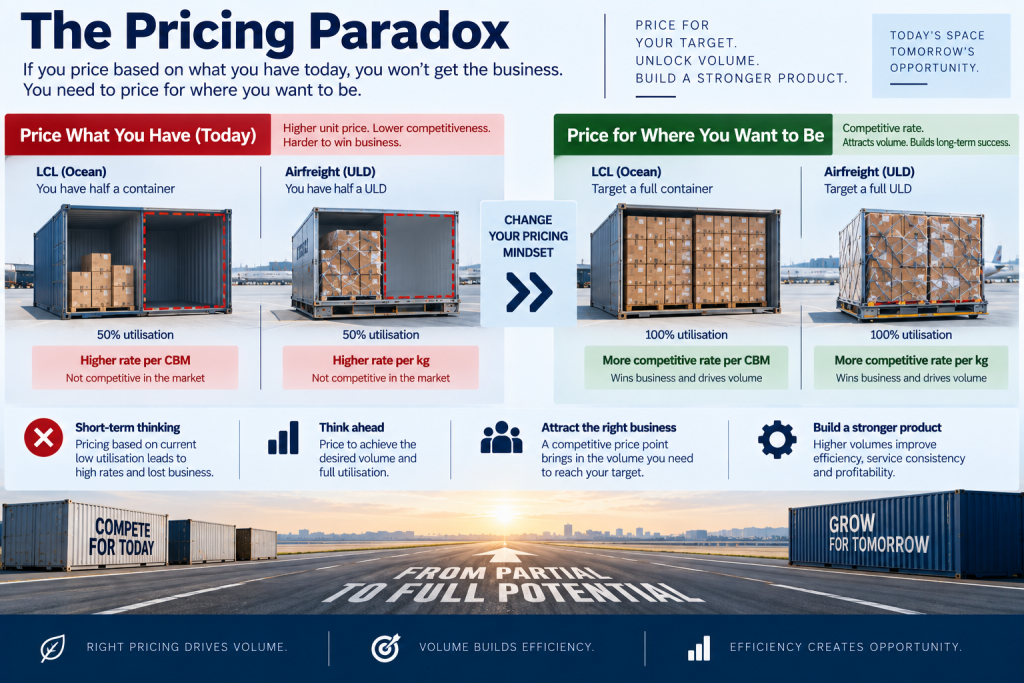
Do we price based on the volume we have today or the volume we intend to build?
Pricing purely on today’s low volume can create a self-defeating cycle:
Low Volume → High Unit Cost → High Selling Price → Low Conversion → Low Volume
The gateway may then fail not because the market was insufficient, but because its initial pricing prevented it from attracting the volume required to become competitive.
A better approach is to model the economics at different volume levels.
For example:
LCL: 20 → 40 → 60 → 80 CBM per week
Airfreight: 2 → 5 → 10 → 20 tonnes per week
At each level, calculate utilization, departure frequency, buying rates, handling costs and resulting unit cost.
This produces a gateway cost curve and identifies the critical-mass point at which the product becomes commercially sustainable.
Pricing can then be established against a target-volume business case rather than solely against today’s volume.
However, the difference between today’s actual cost and the competitive rate required to build future volume cannot simply be ignored.
It is an investment.
Management should explicitly identify:
Actual cost: The cost at current volume.
Target-volume economics: The expected cost at the planned level of activity.
Development gap: The investment required while moving between the two.
That gap should have an approved budget, volume milestones and a defined timeframe. If the expected volume does not materialize, the assumptions need to be revisited.
Volume First Changes the Incentive Model
The gateway development sequence is:
Volume → Frequency → Utilization → Buying Power → Profitability
That has a major implication for incentives.
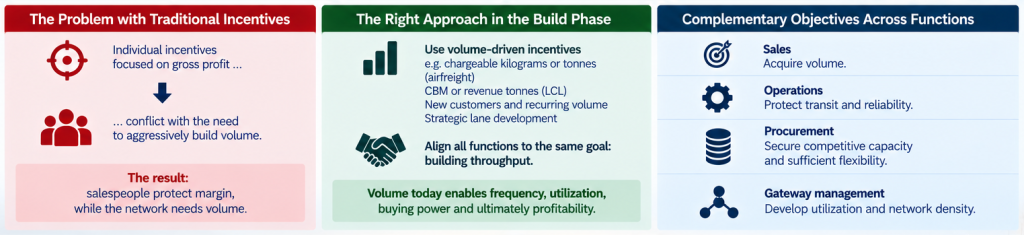
Classic freight forwarding profit-share models are poorly suited to the Build phase.
If salespeople are rewarded primarily on gross profit while management asks them to aggressively build a new gateway, the objectives conflict. The individual is encouraged to protect margin while the network needs volume.
During the Build phase, incentives therefore need to be volume driven.
For airfreight this could be chargeable kilograms or tonnes. For LCL it could be CBM or revenue tonnes. New customers, recurring volume and strategic lane development can also be recognized.
And this alignment cannot stop with sales.
Operations cannot be measured only on local station profitability if the objective is to build regional throughput. Procurement cannot be rewarded solely for preferred-carrier compliance if the product requires multiple carrier options.
The functions need complementary objectives:
Sales: Acquire volume.
Operations: Protect transit and reliability.
Procurement: Secure competitive capacity and sufficient flexibility.
Gateway management: Develop utilization and network density.
Profitability remains important, but expecting mature-gateway profitability while the network is still being built can prevent it from reaching maturity in the first place.
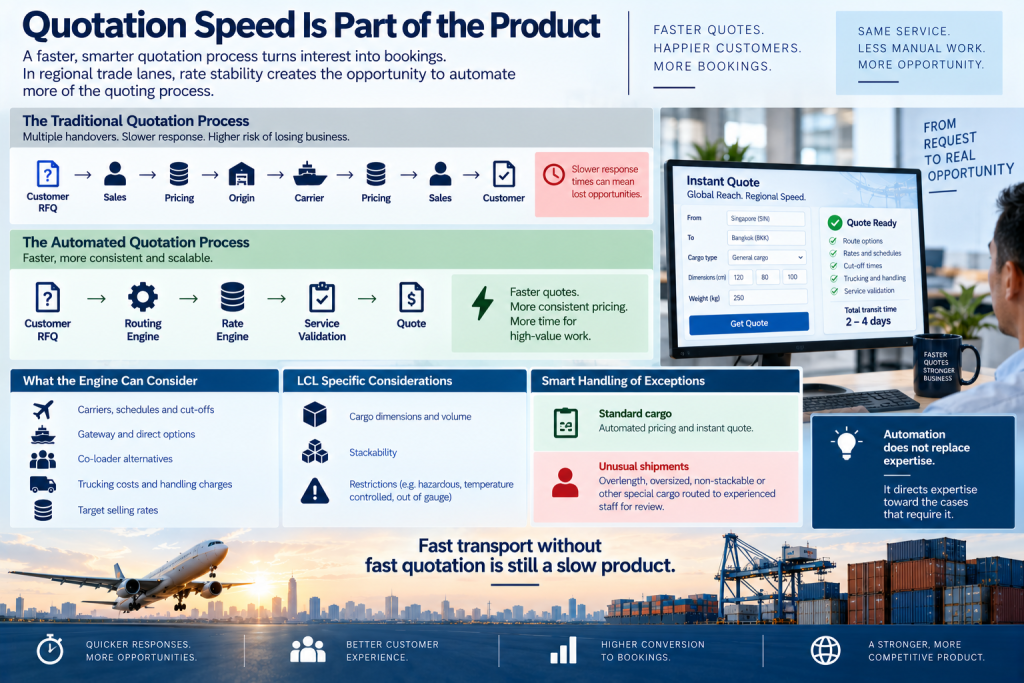
Another form of speed matters: quotation speed.
Regional rates can often be more stable than long-haul rates, creating an opportunity for greater automation.
Instead of:
Customer RFQ → Sales → Pricing → Origin → Carrier → Pricing → Sales → Customer
the process can increasingly become:
Customer RFQ → Routing Engine → Rate Engine → Service Validation → Quote
The engine can consider carriers, schedules, cut-offs, gateway and direct options, co-loader alternatives, trucking costs, handling charges and target selling rates.
For LCL it can also consider cargo dimensions, stackability and restrictions.
Standard cargo can move through automated pricing, while overlength, oversized, non-stackable or otherwise unusual shipments become exceptions for experienced staff to review.
Automation does not replace expertise. It directs expertise toward the cases that require it.
Fast transport without fast quotation is still a slow product.
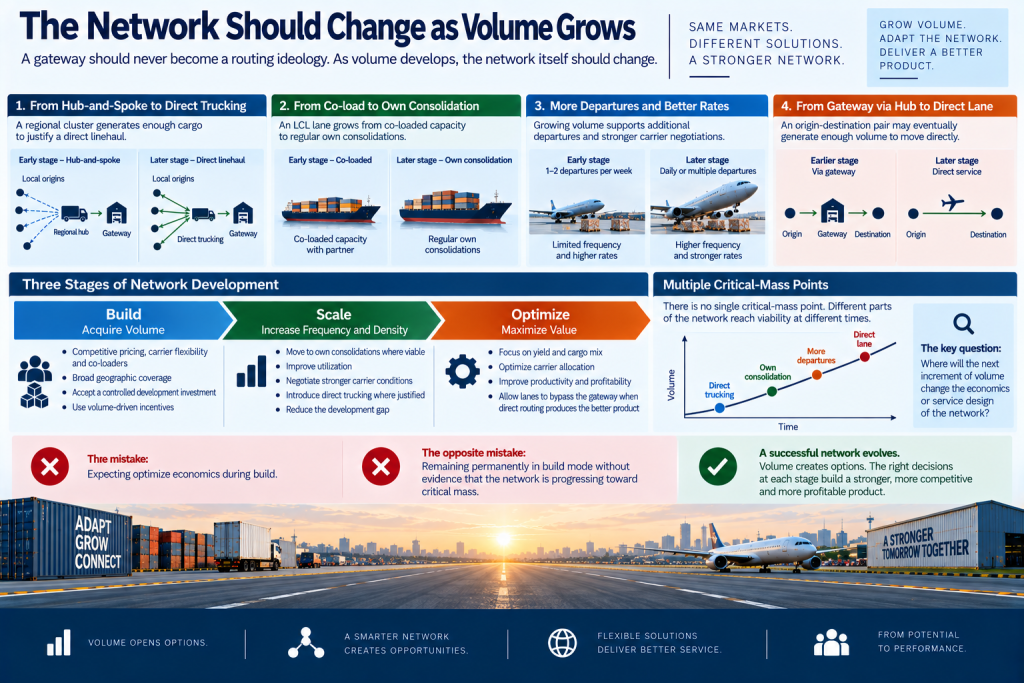
A gateway should never become a routing ideology.
As volume develops, the network itself should change.
A geographic cluster may generate enough cargo to replace hub-and-spoke trucking with a direct linehaul.
An LCL lane may generate enough volume to move from predominantly co-loaded capacity to regular own consolidations.
Growing gateway volume may support additional departures and stronger carrier negotiations.
Eventually, a specific origin-destination pair may generate enough cargo to move directly rather than through the gateway at all.
There is therefore no single critical-mass point.
There are multiple critical-mass points throughout the network, and each can trigger a different operational decision.
The important question becomes:
Where will the next increment of volume change the economics or service design of the network?
This naturally creates three stages of development.
Build
Acquire volume using competitive pricing, carrier flexibility, co-loaders and broad geographic coverage. Accept a controlled development investment and use volume-driven incentives.
Scale
Use growing cargo density to increase own-consolidation frequency, improve utilization, negotiate stronger carrier conditions, introduce direct trucking where justified and reduce the development gap.
Optimize
Once critical mass is established, place greater emphasis on yield, cargo mix, carrier allocation, productivity and profitability. Where individual lanes have developed sufficient density, allow them to bypass the gateway when direct routing produces the better product.
The mistake is expecting Optimize economics during Build.
The opposite mistake is remaining permanently in Build mode without evidence that the network is progressing toward critical mass.
Summary
Regional short-haul gateways can work, but they cannot simply be smaller versions of traditional long-haul gateways.
They need to be designed around the realities of short-haul transportation: limited tolerance for waiting, frequent transport options, different levels of operational control and a strong relationship between volume and service frequency.
Airfreight needs particular attention to terminal processes, ULD handling rights, airline access and out-of-hours flexibility.
LCL offers greater flexibility through coordinated own consolidations and co-loaders, but cargo characteristics and first-mile trucking can have a significant impact on effective capacity and transit time.
The commercial model is equally important. Pricing purely against today’s low volume can prevent the gateway from ever attracting the cargo required to become competitive. Building the product therefore requires a controlled investment against target-volume economics.
That also means classic profit-share incentives are inappropriate during the initial build. If volume is the strategic objective, incentives need to support volume.
The network can then evolve as cargo density develops:
Build → Scale → Optimize
The overall principle is simple:
Start with the customer product and work backwards.
Design the handling, trucking, carrier strategy, consolidation schedule, pricing and incentives required to deliver it. Then allow the network to change as volume reaches different critical-mass points.
And for short-haul LCL in particular, one operating principle captures the balance between consolidation economics and customer service:
Consolidate when you can. Move when you must.
Because in short-haul freight forwarding, improving transit time is often not about moving the cargo faster.
It is about stopping it from standing still.
Leave a Reply
You must be logged in to post a comment.