Introduction
When people hear that AI will “automate shipment creation” or “handle finance workflows,” it sounds abstract. It feels technical. Hard to visualize.
A simpler way to understand it is this:
Imagine you hire a personal assistant. For months, this assistant sits next to you and watches everything you do – every click, every email you read, every field you fill in, every document you check.
At first, the assistant just observes.
Over time, the assistant understands the steps.
Eventually, the assistant can perform the task independently – and only calls you when something unusual happens.
That is what operational AI in freight forwarding looks like.
Let’s make this concrete with two examples — one from operations, one from finance.
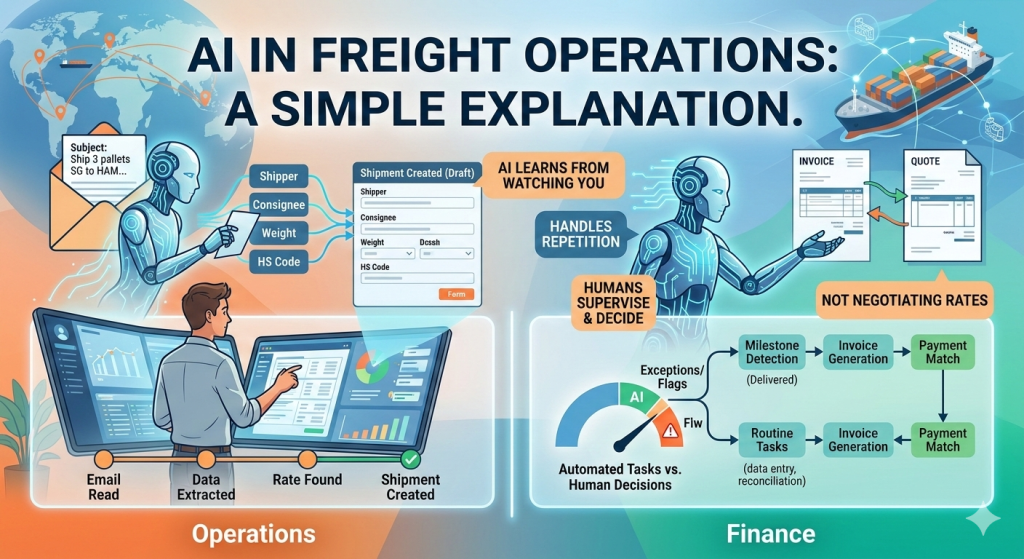
Example 1: Shipment Creation in Operations
The Traditional Way
A customer sends an email:
“Please ship 3 pallets from Singapore to Hamburg. Cargo ready Friday. HS code attached.”
An operations executive typically:
- Opens the email
- Downloads the attachment
- Checks weight and volume
- Looks up the rate
- Enters shipment details into the system
- Selects carrier and service
- Creates booking request
- Updates internal reference
- Sends booking confirmation to the customer
This can take 15–30 minutes per shipment, sometimes longer if documents are incomplete.
What AI Looks Like in Practice
Now imagine the personal assistant has been watching this process for months.
When the email arrives, AI:
- Reads the email automatically
- Extracts shipper, consignee, weight, volume, HS code
- Validates whether the customer is approved
- Pulls contracted rates from the database
- Suggests the most suitable service
- Creates the shipment file in the system
- Prepares the booking draft
- Generates a confirmation email
By the time the operations manager opens the system, the shipment is already created — waiting for approval.
If something unusual appears (missing HS code, unusual weight, expired rate), the AI flags it and asks for review.
Instead of doing the work, the human supervises it.
The assistant now handles the repetition.
The human handles judgment.
Example 2: Milestone Updates and Finance Reconciliation
Let’s move to finance.
The Traditional Way
After shipment completion:
- Operations updates delivery milestone manually
- Finance checks proof of delivery
- An invoice is generated
- Accounts receivable tracks payment due date
- If payment is late, reminders are sent
- Statement reconciliation is done monthly
Each step often involves checking multiple systems and emails.
What AI Looks Like in Practice
Now imagine the assistant again.
The moment delivery is confirmed:
- AI detects the delivery milestone automatically (from carrier API or document upload).
- It triggers invoice generation immediately.
- It matches the invoice amount against the original quote.
- It checks whether margin is within expected range.
- It schedules payment reminders based on customer credit terms.
If payment is not received by the due date:
- The assistant drafts a reminder email.
- It flags high-risk accounts.
- It updates cash flow forecasts.
If payment arrives:
- AI matches the bank transaction to the correct invoice.
- It clears the outstanding balance.
- It updates the financial dashboard.
The finance manager no longer spends time chasing routine payments.
They focus on credit risk and strategic cash management.
The Key Difference: Doing vs. Monitoring
In both examples, the important shift is this:
Humans move from typing and copying
to supervising and deciding.
AI does not “think” like a human. It executes structured steps extremely consistently.
If the process is:
- Repetitive
- Rule-based
- Data-driven
- Predictable
AI can learn it.
When something falls outside the rule set, it escalates.
Just like a well-trained assistant.
What AI Is Not Doing
It is not:
- Negotiating carrier space during a tight market
- Deciding whether to extend risky credit
- Managing claim disputes
- Making strategic pricing decisions
Those remain human responsibilities.
AI handles the predictable.
Humans handle the unpredictable.
Summary
The easiest way to understand AI in freight forwarding is to imagine a personal assistant that:
- Watches every operational and finance step
- Learns the sequence
- Executes routine tasks automatically
- Flags exceptions for human review
In operations, it can create shipments and manage milestone updates.
In finance, it can generate invoices, reconcile payments, and monitor receivables.
The result is not fewer responsibilities — it is different responsibilities.
Less typing.
Less copying.
Less manual checking.
More supervision.
More analysis.
More decision-making.
That is what AI looks like when it actually works inside a freight forwarder.
Leave a Reply
You must be logged in to post a comment.