Tag: CorporateStructure

  • From Good to Great: How Freight Forwarders Build, Scale and Transform

    Part 1: From Zero to Good: Building a Freight Forwarding Company
    A proven model of building a freight forwarding company:

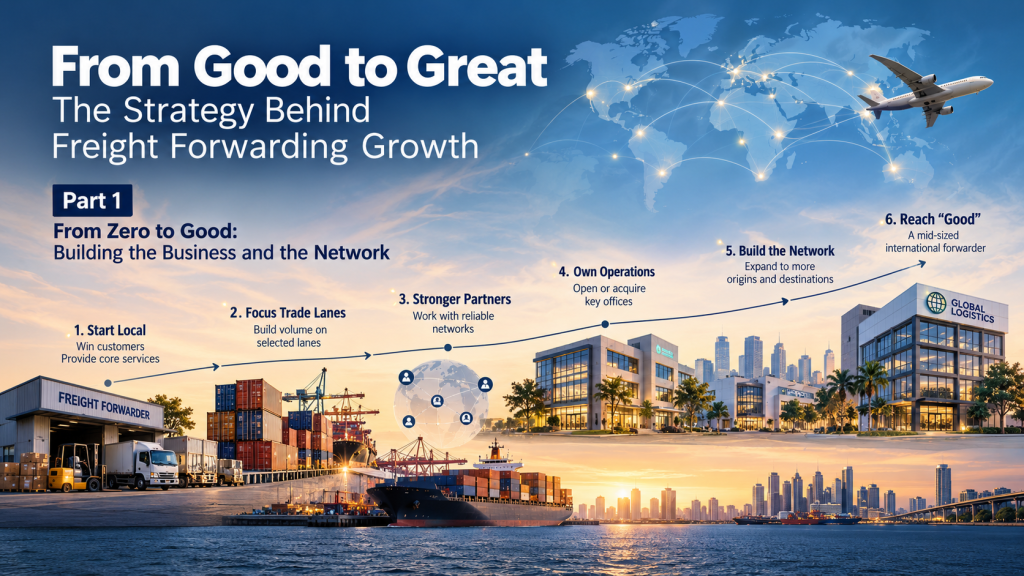
    Start locally. Win customers. Develop relationships with overseas forwarders. Concentrate on trade lanes where the business grows. Replace partners with your own operations when sufficient volume justifies the investment. Then repeat the process.

    Over time, a small local forwarder can become a substantial international company.

    Two characteristics make this model particularly interesting.

    The first is that freight forwarding can be operated as an asset-light business. The company makes little to no investment in capital-intensive logistics assets such as warehouses, CFS facilities, large truck fleets or other physical logistics infrastructure. It may own selected assets, such as office premises, individual trucks or equipment, where there is a practical or economic reason to do so, but physical asset ownership is not central to the business model.

    The second is the way growth can be financed.

    Instead of relying heavily on debt or external investors, expansion can be financed primarily from the profits generated by the existing business.

    Together, these principles create a disciplined growth model:

    Build the business first. Let the business justify the investment. Use the investment to strengthen the network. Then allow the stronger network to create more business.

    This is the journey from zero to good.

    Stage 1: Start as a Local Forwarder

    The company begins with the fundamental forwarding services:

    Pickup/delivery + handling + customs clearance + air/ocean freight

    It can control the local side of the shipment but cannot independently provide the same service overseas.

    So it joins or develops relationships with a network of other independent forwarders that provide equivalent capabilities at origin and destination.

    That creates the first viable international product:

    Local capability + overseas partner = door-to-door forwarding

    Very little fixed network investment is required.

    The company does not need its own operation in Germany to offer a Singapore-Germany service. A German forwarding partner can provide the pickup, customs clearance, handling or delivery required at the other end.

    The same model can be repeated across multiple countries.

    The company’s primary assets at this stage are therefore not warehouses or CFS facilities. They are its people, customer relationships, forwarding expertise, carrier relationships and overseas partner network.

    Capital requirements remain relatively modest, allowing management to concentrate its available resources on generating and managing business.

    Stage 2: Develop Focused Trade Lanes

    As the company grows, certain trade lanes naturally become more important.

    Perhaps Singapore-Germany becomes significant, or China-Singapore, or Singapore-US.

    This matters because volume becomes concentrated rather than simply increasing in aggregate.

    The company develops deeper relationships with selected overseas partners on those lanes. Business begins flowing in both directions:

    Locally controlled business → overseas partner

    and

    Partner-controlled/routed business → local company

    This creates a reinforcing cycle:

    More local business → stronger overseas relationship → more routed business → more volume → greater relevance to the partner → more routed business

    The relationship becomes increasingly valuable to both companies.

    This is an important stage in the development of the forwarder because it begins creating trade-lane density.

    Instead of trying to become equally strong everywhere, the company develops greater strength on selected origin-destination combinations where its customer base and partner relationships are producing meaningful volume.

    At this stage, partner selection becomes strategically important.

    Stage 3: Move Toward Stronger Network Partners

    As the business becomes larger, the limitations of a loose collection of small independent agents eventually become visible.

    Service levels vary. Systems differ. Communication standards differ. Financial strength differs. Management priorities differ.

    And when something goes wrong, accountability can become difficult.

    This creates a problem for the growing forwarder.

    The customer does not particularly care that several independent companies are involved in moving the shipment.

    The customer bought a door-to-door service.

    One solution is therefore to develop a closer relationship with a larger independent or medium-sized forwarding network.

    This may reduce some flexibility in choosing individual agents, but it can improve:

    coverage, consistency, reliability, systems, buying power and accountability.

    The company is beginning to sell more than transportation between two points.

    It is developing a more dependable network product.

    Importantly, this remains a capital-efficient way of improving international capability.

    Rather than opening dozens of overseas offices, the company uses stronger partnerships to extend its reach while concentrating its own resources on the markets where it already has meaningful business.

    Stage 4: Replace Partners With Owned Operations

    Eventually, a particular trade lane becomes sufficiently important that using an agent is no longer the optimal solution.

    This creates the first major critical-mass decision.

    The question becomes:

    At what level of existing and expected business does owning the overseas operation produce better economics, control and service than continuing to use an agent?

    The company may establish its own office or acquire an existing local forwarder. That changes both the economics and the product. The company gains control over both ends of the shipment.

    It can retain more of the forwarding margin, improve accountability, introduce common processes and service standards, and gain direct access to customers in the overseas market.

    But something even more important happens.

    The new office does not only service the shipments that justified opening it.

    It starts generating business itself.

    Salespeople in the new country win local customers. Those customers generate exports and imports. Some of that freight moves to existing offices elsewhere in the network.

    The growth cycle therefore expands:

    Existing volume → own office → improved service and control → local sales → new customers → additional bilateral volume → stronger trade lane

    The investment begins reinforcing the business that originally justified it.

    Stage 5: Build an Owned Network

    The same logic can now be repeated. A second market reaches critical mass. Then another. Some locations are opened organically. Others may be acquired because acquisition provides an established customer base, experienced employees, licenses, relationships and revenue from the first day.

    Gradually, the structure changes:

    Agent network → hybrid network → predominantly owned network

    The company is no longer simply a local forwarder with overseas agents.

    It has become a multinational forwarding company.

    And every additional location potentially increases the value of the existing network.

    A new office does not simply create one additional market. It creates new commercial relationships with multiple existing locations.

    An office in Singapore can generate business with Germany. Germany can generate business with China. China can generate business with the United States. The United States can generate business with Singapore. The number of potential trade relationships grows as the network expands.

    This is where the network itself starts becoming an increasingly important competitive capability.

    Stage 6: Reach “Good”

    Continue this process for 10, 20 or 30 years and the result can be a substantial mid-sized international freight forwarder.

    Yet the organizational structure can remain surprisingly close to the model from which the company developed.

    Most employees still contribute directly to generating, executing or managing business:

    Sales → customer service → operations → customs → finance → local management

    Corporate functions remain relatively lean.

    There may be regional management, procurement, IT, finance, HR and product functions, but the company has not developed the extensive central structures associated with the largest global forwarding organizations.

    The physical asset base can also remain relatively small compared with the revenue generated.

    Warehouses, CFS facilities, large truck fleets and other capital-intensive infrastructure are generally provided by external specialists unless there is a specific strategic or economic reason for ownership.

    Capital is instead concentrated primarily on people, offices, systems and network development.

    The result can be an economically efficient forwarding organization with relatively low fixed-asset requirements.

    It has become good at freight forwarding. It has experienced people. It has customers. It has reliable basic air and ocean freight capabilities. It has an international network. It has increasing purchasing power. And it has a business model capable of generating sustainable profits.

    The Zero-to-Good Flywheel

    The entire development model can be summarized as a freight-forwarding flywheel:

    Win local customers

    → Generate export/import volume

    → Strengthen selected trade lanes

    → Develop stronger overseas partnerships

    → Receive routed business

    → Increase trade-lane density

    → Reach critical mass

    → Open or acquire an own office

    → Improve service, control and margin retention

    → Generate local business in the new market

    → Increase network volume and profitability

    → Reinvest profits into the next market

    ↺


    Each turn of the flywheel strengthens the organization.

    More customers create more freight.

    More freight creates greater trade-lane density.

    Greater density justifies greater network control.

    Greater network control improves the product and creates new commercial opportunities.

    Those opportunities generate additional profits that can finance the next stage.

    There is therefore an important principle underlying the entire Zero-to-Good model:

    Build the network behind the freight.

    The company does not first construct an expensive international network and then hope enough freight arrives to support it.

    The freight comes first.

    The network follows.

    Financing Growth From the Business

    The financing model is an essential part of this strategy.

    The company can choose to finance expansion primarily through profits generated by the existing business.

    The logic is straightforward:

    Business → profit → investment → additional capability → more business → more profit

    The asset-light operating model makes this possible.

    Because relatively little capital needs to be committed to warehouses, CFS facilities and other physical logistics assets, a greater proportion of available investment can be directed toward commercial and network development.

    Profits can finance a new office. They can finance additional salespeople. They can finance systems. They can finance regional functions. They can contribute toward acquisitions.

    And as those investments generate additional business and profit, further investments become possible.

    But there is an unavoidable consequence.

    The speed and size of investment are constrained by the profits the company generates.

    A company cannot continuously invest substantially more than it earns without obtaining capital from somewhere else.

    That means investments tend to happen progressively.

    One market is developed. Then another. One capability is added. Then another.

    The company grows within the financial capacity created by the existing organization.

    A Constraint That Creates Discipline

    At first glance, limiting investment to internally generated funds may appear to be a disadvantage.

    And in one sense it is.

    A company with access to substantial external capital could potentially expand faster.

    It could acquire several companies simultaneously, enter multiple countries, build infrastructure or invest heavily in technology and organizational capabilities ahead of existing demand.

    A self-financed company has fewer options.

    But that constraint also creates discipline.

    Every significant investment has to answer a fundamental question:

    Does the existing or realistically accessible business justify this investment?

    A new office cannot simply be opened because a market looks attractive on a strategy presentation.

    A meaningful commercial case has to exist.

    Expansion therefore tends to follow proven business rather than anticipated business.

    This reduces the risk of building an expensive network that customers never fill.

    Independence Has Value

    There is another side to the financing model.

    By relying primarily on internally generated profits, the company can preserve a high degree of financial and strategic independence.

    It is less dependent on external investors seeking returns within a particular investment horizon.

    It is less dependent on lenders imposing financial conditions on the business.

    Ownership and management can therefore take a longer-term view.

    A trade lane can be developed patiently. A market can take several years to mature. Customer relationships can be built over decades. Profits can be reinvested rather than maximized for short-term distribution.

    The trade-off is therefore not simply:

    More capital versus less capital.

    It is:

    Faster access to investment capital versus greater financial independence and control over the company’s long-term direction.

    For a company moving from zero to good, that trade-off can work remarkably well.

    From Zero to Good

    None of this requires an especially complicated strategy.

    In fact, its strength comes partly from its simplicity.

    Win customers.

    Execute their freight well.

    Concentrate on trade lanes where you develop strength.

    Build strong overseas partnerships.

    Replace partners with owned operations when the business justifies it.

    Remain asset-light where ownership does not create sufficient value.

    Generate profits.

    Reinvest those profits into the next stage of the network.

    Then repeat.

    Over many years, this can transform a small local forwarder into a substantial multinational forwarding company.

    The company has built its network largely behind the freight, allowing proven business to determine where scarce investment capital should go.

    The same discipline that limits the speed of expansion also protects the company from overextending itself and allows it to remain independent.

    For the journey from zero to good, this can be an exceptionally effective model.

    But success eventually creates a new problem.

    The company reaches a size where simply repeating what worked before may no longer be enough.

    Some of the capabilities required to attract larger customers, increase network density and compete at the next level may need to be built before the freight exists to justify them.

    The investments may also become larger than those required during the company’s earlier development.

    And suddenly the principles that helped build a successful, independent forwarder create a new strategic question:

    How do you go from good to great when the next stage of growth requires investing ahead of the business rather than behind it?

    That is the subject of Part 2.
  • Why Many Freight Forwarders Struggle With Visibility

    Freight forwarding companies invest heavily in systems, processes, and certifications. Most run complex operating platforms, accounting tools, and quality systems designed to keep operations under control.

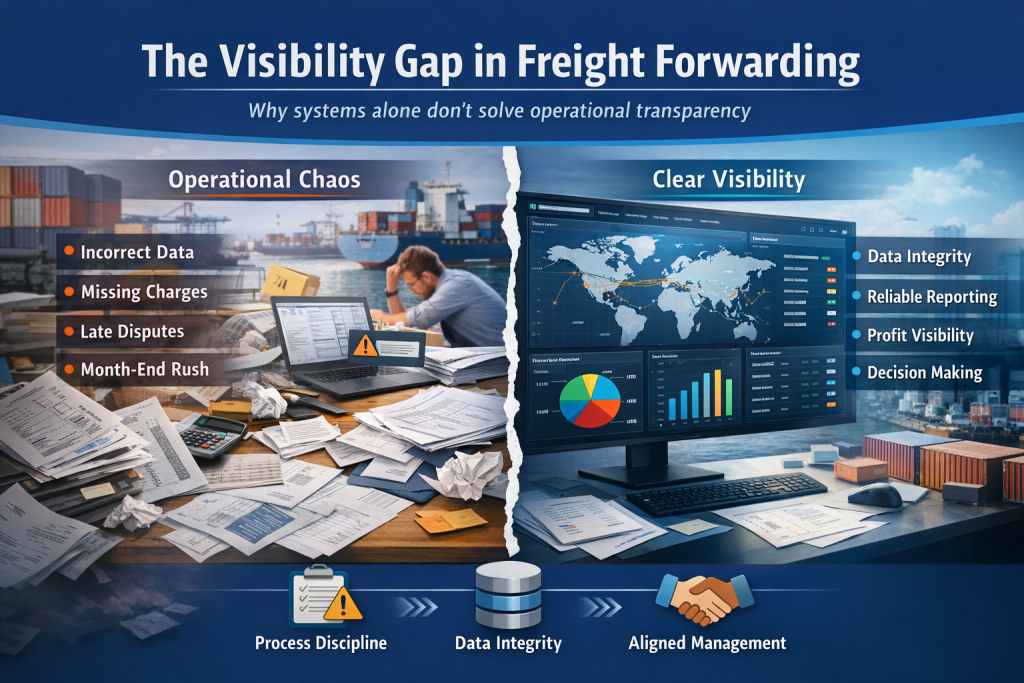
    Yet despite these investments, many management teams still struggle with a basic problem: they lack clear operational visibility.

    Monthly reporting takes too long. Forecasts are unreliable. Disputes appear weeks after shipments are completed. And management meetings often revolve around explaining numbers rather than making decisions.

    In my experience, this is rarely a technology problem. It is usually a combination of process discipline, data integrity, and operational alignment.

    Below are some of the recurring issues that quietly undermine visibility in freight forwarding operations.

    The Data Integrity Problem

    Operational systems are only as good as the data entered into them. When shipment details such as products, volumes, client names, or port pairs are entered incorrectly, the consequences cascade throughout the organization.

    Reports become unreliable. Trade lane analysis becomes distorted. And management ends up questioning the numbers rather than acting on them.

    Small inconsistencies in operational data can ultimately make strategic planning difficult.

    Revenue Leakage and Billing Friction

    Revenue leakage is rarely the result of large errors. More often it is caused by small operational gaps:

    • incidental costs that were never billed
    • disputes that are resolved months after the shipment moved
    • incorrect invoice dates or missing accruals
    • supplier invoices arriving long after the job should have been closed

    Individually these issues may seem minor. Across thousands of shipments they can significantly impact margins, cash flow, and financial reporting.

    In many organizations, these problems are amplified when operational processes rely heavily on automation without sufficient control points.

    The Month-End Chaos Cycle In some companies, the end of every month looks the same.

    Operations rush to close shipment files to ensure revenue is recognized in the current period. Finance scrambles to reconcile missing costs and issue corrections. Forecasts become difficult because the timing of billing is inconsistent.

    Instead of focusing on analysis and decision making, finance teams spend valuable time correcting operational data.

    When this pattern repeats month after month, reporting becomes reactive rather than strategic.

    Sales, Operations, and Finance Misalignment

    Freight forwarding is highly dependent on coordination between departments.

    When sales teams fail to pass complete information to operations, billing problems arise. When operational details are not documented properly, clients become frustrated. When disputes and credit notes increase, payment cycles slow down.

    These issues often appear operational on the surface but are ultimately symptoms of misalignment between commercial and operational processes.

    Limited Visibility Into Performance

    Many companies believe they have strong visibility into their business until they start asking deeper questions:

    • Which clients are actually profitable?
    • Which carriers consistently underperform?
    • Where are billing disputes originating?
    • Which trade lanes are truly growing?

    Without reliable data capture across quoting, operations, billing, and carrier performance, these questions become difficult to answer with confidence.

    Strategic discussions about trade lane development or network performance then become largely speculative.

    Process Discipline vs. Process Documentation

    Most freight forwarders have documented processes. Many hold certifications such as ISO 9001. Yet documentation alone does not guarantee operational discipline.

    Audits are often prepared at the last minute. Process errors are corrected informally rather than systematically. Training gaps appear as experienced staff compensate for weaker system users.

    Over time this creates a situation where key individuals become indispensable simply because they are holding the operational structure together.

    The Hidden Complexity of Freight Operations

    Freight forwarding is inherently complex.

    Rates vary by routing, carrier, and equipment. Charges are structured differently across countries. Networks apply different markups and charge codes. Clients increasingly require digital integrations such as e-invoicing.

    Trying to automate quoting, billing, and reporting within this environment is not straightforward. Without strong governance around data, processes, and responsibilities, systems alone cannot solve the problem.

    A Management Challenge, Not a Technology Challenge

    When companies struggle with operational visibility, the first instinct is often to look for a new system or additional automation.

    In reality, the root causes are usually much more fundamental:

    • inconsistent operational discipline
    • incomplete data capture
    • weak process ownership
    • lack of alignment between departments

    Until these foundations are addressed, additional technology often adds complexity rather than clarity.

    Final Thoughts

    Freight forwarding companies operate in a demanding environment where margins are thin and operational complexity is high. Achieving true visibility requires more than just systems and reports.

    It requires a clear understanding of where operational data originates, how processes interact across departments, and where control points are needed to prevent small issues from becoming systemic problems.

    For leadership teams, improving visibility is not about adding more dashboards. It is about ensuring that the underlying operational structure produces reliable information in the first place.

  • Will AI Replace Freight Forwarding Operations? A Realistic Look at What Changes – and What Doesn’t

    Introduction


    There is a growing belief that freight forwarding is on the brink of a major workforce reduction. The logic seems straightforward: if artificial intelligence can handle bookings, customs interfaces, documentation, invoicing, and reporting, then the need for large operational teams should disappear.

    At first glance, this argument is compelling. Much of freight forwarding is process-driven, repetitive, and rule-based. These are precisely the areas where AI performs well.

    But while AI will significantly reshape operations, it will not eliminate the structural complexity of freight. The future will not be “no humans.” It will be fewer transactional roles and more judgment-driven roles.

    Understanding that distinction is critical.

    1. What AI Will Replace

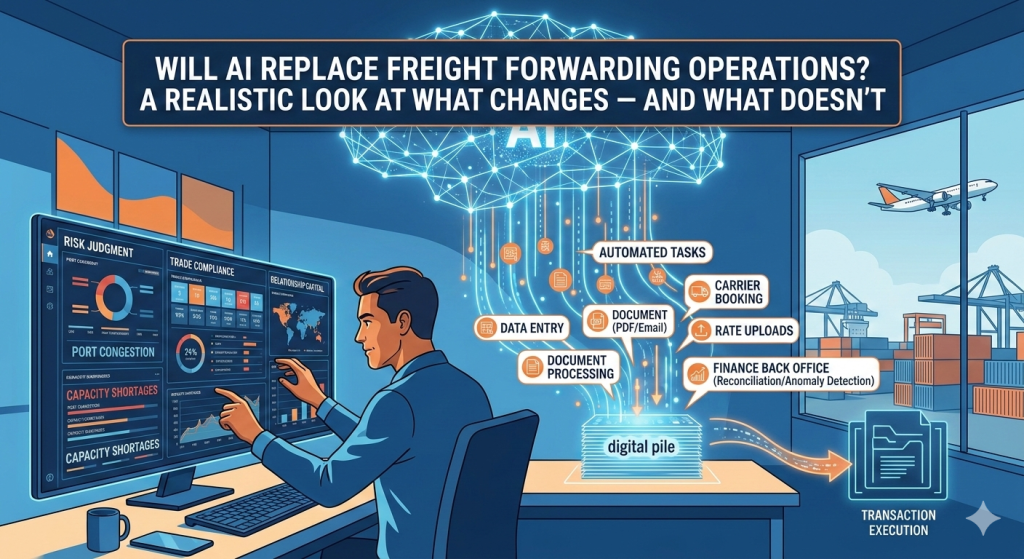
      AI will dramatically reduce manual work in three core areas:

      A. Data Entry and Document Processing

      Shipment creation, milestone updates, draft BL checks, invoice matching, rate uploads, customs documentation formatting — these tasks are structured and repetitive.

      AI systems already extract, validate, and populate structured data from emails, PDFs, and messaging platforms. Over time, these functions will require minimal human intervention.

      B. Transaction Execution

      Carrier booking, routing selection, rate comparison, and service validation can all be automated when rate data is structured and business rules are defined.

      Technically, AI is capable of executing bookings and validating service conditions. The real barrier is not capability — it is data cleanliness and system integration.

      C. Finance Back Office

      Accounts receivable reminders, payables matching, statement reconciliation, margin reporting, and even intercompany netting are highly rules-based.

      AI-driven anomaly detection can flag discrepancies, while automated workflows manage routine processes. Finance teams will shrink in size but become more analytical in focus.

      In short, repetitive operational roles will decline significantly.
    2. What AI Will Not Easily Replace

      Despite these gains, freight forwarding is not purely transactional. Several areas resist full automation.

      A. Risk Judgment Under Uncertainty

      Freight operates in constant ambiguity:

      Port congestion
      Sanctions and trade compliance risk
      Capacity shortages
      Sudden regulatory changes
      Customer credit exposure

      AI can detect patterns, but strategic trade-offs under uncertainty require experience. Deciding whether to prioritize a volatile high-margin customer over a stable long-term client is not just data-driven — it is commercial judgment.

      B. Relationship Capital

      Freight is still relationship-heavy, especially in tight markets.
      Securing space during peak season, negotiating demurrage waivers, extending credit terms, or resolving customs bottlenecks often depend on human trust and networks. AI does not build that capital.

      C. Accountability and Liability

      When shipments fail, delays occur, or claims arise, companies need accountable individuals.

      Contracts are signed by humans. Negotiations are handled by humans. Liability cannot be delegated to an algorithm.
    3. The Likely Future Structure

      The forwarder of the future will not eliminate people. It will reorganize them.

      A plausible structure includes:

      Commercial Core: Strategic sales, pricing specialists, key account managers
      Control Tower / Exception Team: Escalation managers, compliance experts, risk controllers
      Technology & Data Layer: AI oversight, system integration, data governance
      Procurement & Carrier Relations: Contract negotiation and capacity strategy
      Lean Finance: Oversight and financial analytics

      The large middle layer of shipment processing executives will shrink. Revenue per employee will rise. The organization becomes more concentrated around high-value decision-making.
    4. The Hidden Constraint: Data Quality

      All of this depends on clean master data, structured rate databases, standardized SOPs, and integrated systems.
      AI does not fix disorganized processes. It amplifies them.
      Companies that digitize chaotic foundations will not see transformative results. Companies that clean their data and standardize processes first will benefit the most.
    5. Where Differentiation Moves

      As AI absorbs transactional work, competitive advantage shifts.

      It will no longer be about:

      Faster booking input
      Cheaper documentation processing
      Invoice accuracy
      Instead, differentiation will center on:
      Industry specialization
      Risk management capability
      Network strength
      Financial stability
      Advisory capability for customers

      Technology becomes infrastructure. Judgment becomes value.

      Summary

      AI will significantly reduce repetitive operational roles in freight forwarding. Data entry, transaction execution, and back-office processing will become increasingly automated.

      However, freight remains a cyclical, risk-sensitive, relationship-driven industry. Strategic judgment, accountability, and trust cannot be automated away.

      The future is not a human-free forwarder. It is a leaner organization where low-value tasks disappear and high-accountability roles increase in importance.

      In practical terms, AI will compress the middle layer of operations — but elevate the value of leadership, commercial strategy, and risk management.

      Freight will change.

      Its economic DNA will not.
  • 🚢 Large vs. Small Freight Forwarders: What Makes Them Tick?

    Post 7/7: What Happens When They Compete Outside Their Sweet Spot

    When small forwarders pursue large global clients:

    • They may underprice or overcommit.
    • Risk reputational damage if execution fails.
    • Lose focus on their core SME base.

    When large forwarders pursue small clients:

    • Clients may feel neglected or priced out.
    • Service personalization often suffers.
    • Internal processes may not suit transactional needs.

    Bottom line:
    The winners understand their lane—and stay in it or grow with clarity.

    #LogisticsLeadership #FreightForwarding #SupplyChainStrategy #LargeVsSmall #Forwarders #SME #GlobalForwarding #BusinessStrategy #CorporateStructure #FreightForwardingStrategy #ClientFit #ForwarderGrowth #BusinessScaling #CustomerCentricity #LocalExpertise #ForwarderTech #Digitization

  • 🚢 Large vs. Small Freight Forwarders: What Makes Them Tick?

    Post 6/7: What Small Forwarders Struggle With

    Trying to do everything often backfires.

    Common pitfalls:

    • Limited rate leverage
    • Overstretching into services beyond core strength
    • Fragmented tech stack
    • Dependency on key staff or clients
    • Difficulty competing in global tenders

    #LogisticsLeadership #FreightForwarding #SupplyChainStrategy #LargeVsSmall #Forwarders #SME #GlobalForwarding #BusinessStrategy #CorporateStructure #FreightForwardingStrategy #ClientFit #ForwarderGrowth #BusinessScaling #CustomerCentricity #LocalExpertise #ForwarderTech #Digitization

  • 🚢 Large vs. Small Freight Forwarders: What Makes Them Tick?

    Post 5/7: What Small Forwarders Do Well

    Small forwarders build trust through agility.

    Strengths include:

    • Tailored service delivery
    • Personal client relationships
    • Speed in quoting & execution
    • Success in underserved or emerging markets
    • Entrepreneurial problem solving

    #LogisticsLeadership #FreightForwarding #SupplyChainStrategy #LargeVsSmall #Forwarders #SME #GlobalForwarding #BusinessStrategy #CorporateStructure #FreightForwardingStrategy #ClientFit #ForwarderGrowth #BusinessScaling #CustomerCentricity #LocalExpertise #ForwarderTech #Digitization

  • 🚢 Large vs. Small Freight Forwarders: What Makes Them Tick?

    Post 4/7: What Large Forwarders Struggle With

    Size comes with trade-offs.

    Challenges include:

    • Inflexibility in service customizations
    • Slower response time for smaller clients
    • Complexity in internal processes
    • Less personal account management
    • Struggles in niche, low-volume lanes

    #LogisticsLeadership #FreightForwarding #SupplyChainStrategy #LargeVsSmall #Forwarders #SME #GlobalForwarding #BusinessStrategy #CorporateStructure #FreightForwardingStrategy #ClientFit #ForwarderGrowth #BusinessScaling #CustomerCentricity #LocalExpertise #ForwarderTech #Digitization

  • 🚢 Large vs. Small Freight Forwarders: What Makes Them Tick?

    Post 3/7: What Large Forwarders Do Well

    Large forwarders excel when the task is complex, global, or regulated.

    They shine in:

    • Serving multinational clients
    • Managing high-volume, multi-lane shipments
    • Delivering standardized SOPs
    • Investing in automation, ESG, and innovation
    • Winning and running RFQs

    #LogisticsLeadership #FreightForwarding #SupplyChainStrategy #LargeVsSmall #Forwarders #SME #GlobalForwarding #BusinessStrategy #CorporateStructure #FreightForwardingStrategy #ClientFit #ForwarderGrowth #BusinessScaling #CustomerCentricity #LocalExpertise #ForwarderTech #Digitization

  • 🚢 Large vs. Small Freight Forwarders: What Makes Them Tick?

    Post 2/7: Characteristics of Small Freight Forwarders

    Small forwarders are agile, customer-centric, and often locally dominant.
    They thrive in flexibility, service quality, and personal relationships.

    Key traits:

    • Niche market expertise
    • Hands-on customer service
    • Quick decisions, no red tape
    • Customizable solutions
    • Strong regional agent networks

    #LogisticsLeadership #FreightForwarding #SupplyChainStrategy #LargeVsSmall #Forwarders #SME #GlobalForwarding #BusinessStrategy #CorporateStructure #FreightForwardingStrategy #ClientFit #ForwarderGrowth #BusinessScaling #CustomerCentricity #LocalExpertise #ForwarderTech #Digitization #mmlogistix

  • 🚢 Large vs. Small Freight Forwarders: What Makes Them Tick?

    Post 1/7: Characteristics of Large Freight Forwarders

    Large forwarders (USD 2B+ revenue) are built for scale.
    They operate global networks, run proprietary systems, and handle end-to-end supply chains. Think compliance, capacity, and cross-border coordination.

    Key traits:

    • Global offices & assets
    • Deep sector specialization
    • Digital platforms & integrations
    • Strong procurement power
    • Focus on large contracts & tenders

    #LogisticsLeadership #FreightForwarding #SupplyChainStrategy #LargeVsSmall #Forwarders #SME #GlobalForwarding #BusinessStrategy #CorporateStructure #FreightForwardingStrategy #ClientFit #ForwarderGrowth #BusinessScaling #CustomerCentricity #LocalExpertise #ForwarderTech #Digitization #mmlogistix