Introduction
For many traditional freight forwarders, the business case for digitization can feel overstated. If margins are stable, customers are loyal, and operations run “well enough,” the urgency to modernize may appear low.
After all, freight forwarding has survived decades of change.
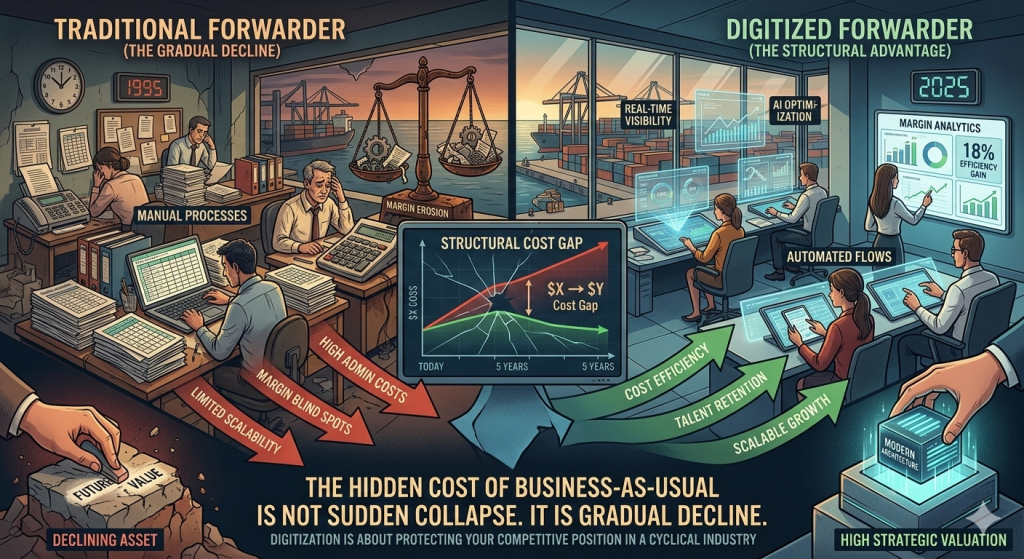
But the real risk of failing to digitize is not sudden collapse. It is gradual competitive erosion. Forwarders that continue operating under a business-as-usual model may remain profitable in the short term — yet steadily lose structural advantage in the long term.
The danger is not disruption. It is decline.
1. Structural Cost Disadvantage
Digitized competitors operate with:
- Fewer people per shipment
- Lower error rates
- Automated billing cycles
- Faster quote turnaround
- Better margin visibility
Over time, this creates higher revenue per employee and stronger cost efficiency.
Traditional forwarders that rely on manual processes carry higher administrative costs. Initially, this may not be visible. But as automation spreads, cost gaps widen.
Eventually, competitors can either:
- Undercut pricing while maintaining margin, or
- Reinvest efficiency gains into sales and growth
The non-digitized forwarder becomes structurally less competitive.
2. Margin Blind Spots
Manual systems often mean:
- Fragmented rate data
- Limited real-time profitability tracking
- Inconsistent branch-level reporting
- Delayed financial visibility
Without integrated data, pricing discipline weakens. It becomes harder to:
- Identify unprofitable customers
- Track margin erosion by trade lane
- React quickly to carrier rate changes
Digitization does not guarantee higher margins — but it enables transparency. Without that visibility, forwarders risk making decisions based on incomplete information.
3. Increasing Customer Expectations
Large shippers increasingly expect:
- API connectivity
- Automated document exchange
- Real-time milestone visibility
- Data reporting dashboards
- Integration with ERP systems
Even if customers tolerate manual processes today, procurement standards evolve.
Forwarders unable to meet digital interface requirements may find themselves excluded from tenders — not because of poor service, but because of integration limitations.
Gradually, they are pushed toward smaller accounts and more price-sensitive segments.
4. Talent Drain and Operational Fragility
Non-digitized operations often rely heavily on individual experience and informal knowledge.
This creates two risks:
- Key-person dependency — when senior staff leave, operational stability weakens.
- Talent attraction challenges — younger professionals prefer data-driven environments over manual, spreadsheet-heavy workflows.
Over time, the organization becomes less scalable and more vulnerable to turnover.
Digitization distributes knowledge across systems rather than individuals.
5. Limited Scalability
Manual operations can handle moderate volume efficiently — but scaling requires proportional headcount increases.
Digitized forwarders can grow shipment volume faster without linear staff growth.
Traditional forwarders face a choice:
- Hire more people to grow
- Or cap growth to maintain control
Both limit long-term expansion potential.
6. M&A and Valuation Pressure
In consolidation cycles, buyers increasingly value:
- Standardized systems
- Clean data architecture
- Integrated reporting
- Automated workflows
Forwarders that fail to digitize may still be profitable — but their valuation multiples may suffer due to modernization costs required post-acquisition.
In other words, they remain viable businesses but become less attractive strategic assets.
7. Risk Exposure in a More Complex World
Trade compliance, sanctions regimes, ESG reporting, and customs regulation are becoming more complex.
Digitized systems allow:
- Automated compliance checks
- Data-driven audit trails
- Faster regulatory reporting
Manual models increase exposure to errors, fines, and compliance breaches.
In a world of tightening regulation, process control becomes a competitive advantage.
Summary
Freight forwarders that fail to digitize will not disappear overnight. Strong relationships and disciplined economics can sustain them for years.
But the risks accumulate gradually:
- Higher structural costs
- Reduced margin visibility
- Exclusion from digital tenders
- Talent attrition
- Scalability limits
- Lower strategic valuation
Digitization is not about following a trend. It is about protecting competitive position in an industry where margins are thin and cycles are unforgiving.
In freight, survival depends on economics.
In the long run, economics depend on efficiency.
And efficiency increasingly depends on digital capability.
Leave a Reply
You must be logged in to post a comment.