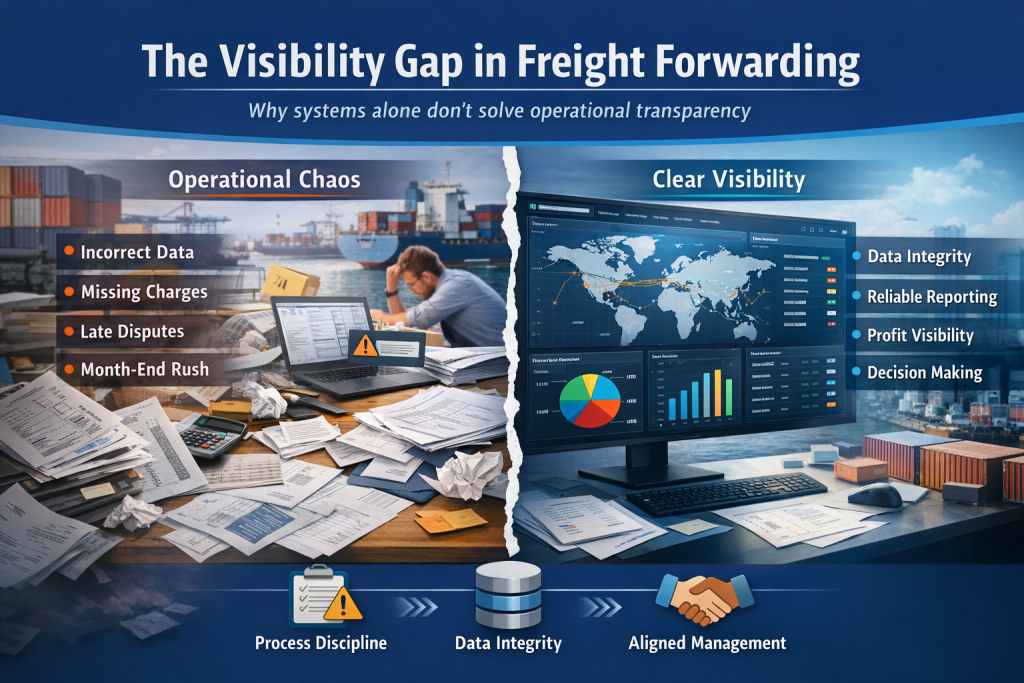
Freight forwarding companies invest heavily in systems, processes, and certifications. Most run complex operating platforms, accounting tools, and quality systems designed to keep operations under control.
Yet despite these investments, many management teams still struggle with a basic problem: they lack clear operational visibility.
Monthly reporting takes too long. Forecasts are unreliable. Disputes appear weeks after shipments are completed. And management meetings often revolve around explaining numbers rather than making decisions.
In my experience, this is rarely a technology problem. It is usually a combination of process discipline, data integrity, and operational alignment.
Below are some of the recurring issues that quietly undermine visibility in freight forwarding operations.
The Data Integrity Problem
Operational systems are only as good as the data entered into them. When shipment details such as products, volumes, client names, or port pairs are entered incorrectly, the consequences cascade throughout the organization.
Reports become unreliable. Trade lane analysis becomes distorted. And management ends up questioning the numbers rather than acting on them.
Small inconsistencies in operational data can ultimately make strategic planning difficult.
Revenue Leakage and Billing Friction
Revenue leakage is rarely the result of large errors. More often it is caused by small operational gaps:
- incidental costs that were never billed
- disputes that are resolved months after the shipment moved
- incorrect invoice dates or missing accruals
- supplier invoices arriving long after the job should have been closed
Individually these issues may seem minor. Across thousands of shipments they can significantly impact margins, cash flow, and financial reporting.
In many organizations, these problems are amplified when operational processes rely heavily on automation without sufficient control points.
The Month-End Chaos Cycle In some companies, the end of every month looks the same.
Operations rush to close shipment files to ensure revenue is recognized in the current period. Finance scrambles to reconcile missing costs and issue corrections. Forecasts become difficult because the timing of billing is inconsistent.
Instead of focusing on analysis and decision making, finance teams spend valuable time correcting operational data.
When this pattern repeats month after month, reporting becomes reactive rather than strategic.
Sales, Operations, and Finance Misalignment
Freight forwarding is highly dependent on coordination between departments.
When sales teams fail to pass complete information to operations, billing problems arise. When operational details are not documented properly, clients become frustrated. When disputes and credit notes increase, payment cycles slow down.
These issues often appear operational on the surface but are ultimately symptoms of misalignment between commercial and operational processes.
Limited Visibility Into Performance
Many companies believe they have strong visibility into their business until they start asking deeper questions:
- Which clients are actually profitable?
- Which carriers consistently underperform?
- Where are billing disputes originating?
- Which trade lanes are truly growing?
Without reliable data capture across quoting, operations, billing, and carrier performance, these questions become difficult to answer with confidence.
Strategic discussions about trade lane development or network performance then become largely speculative.
Process Discipline vs. Process Documentation
Most freight forwarders have documented processes. Many hold certifications such as ISO 9001. Yet documentation alone does not guarantee operational discipline.
Audits are often prepared at the last minute. Process errors are corrected informally rather than systematically. Training gaps appear as experienced staff compensate for weaker system users.
Over time this creates a situation where key individuals become indispensable simply because they are holding the operational structure together.
The Hidden Complexity of Freight Operations
Freight forwarding is inherently complex.
Rates vary by routing, carrier, and equipment. Charges are structured differently across countries. Networks apply different markups and charge codes. Clients increasingly require digital integrations such as e-invoicing.
Trying to automate quoting, billing, and reporting within this environment is not straightforward. Without strong governance around data, processes, and responsibilities, systems alone cannot solve the problem.
A Management Challenge, Not a Technology Challenge
When companies struggle with operational visibility, the first instinct is often to look for a new system or additional automation.
In reality, the root causes are usually much more fundamental:
- inconsistent operational discipline
- incomplete data capture
- weak process ownership
- lack of alignment between departments
Until these foundations are addressed, additional technology often adds complexity rather than clarity.
Final Thoughts
Freight forwarding companies operate in a demanding environment where margins are thin and operational complexity is high. Achieving true visibility requires more than just systems and reports.
It requires a clear understanding of where operational data originates, how processes interact across departments, and where control points are needed to prevent small issues from becoming systemic problems.
For leadership teams, improving visibility is not about adding more dashboards. It is about ensuring that the underlying operational structure produces reliable information in the first place.
Leave a Reply
You must be logged in to post a comment.