Introduction
There is a growing belief that freight forwarding is on the brink of a major workforce reduction. The logic seems straightforward: if artificial intelligence can handle bookings, customs interfaces, documentation, invoicing, and reporting, then the need for large operational teams should disappear.
At first glance, this argument is compelling. Much of freight forwarding is process-driven, repetitive, and rule-based. These are precisely the areas where AI performs well.
But while AI will significantly reshape operations, it will not eliminate the structural complexity of freight. The future will not be “no humans.” It will be fewer transactional roles and more judgment-driven roles.
Understanding that distinction is critical.
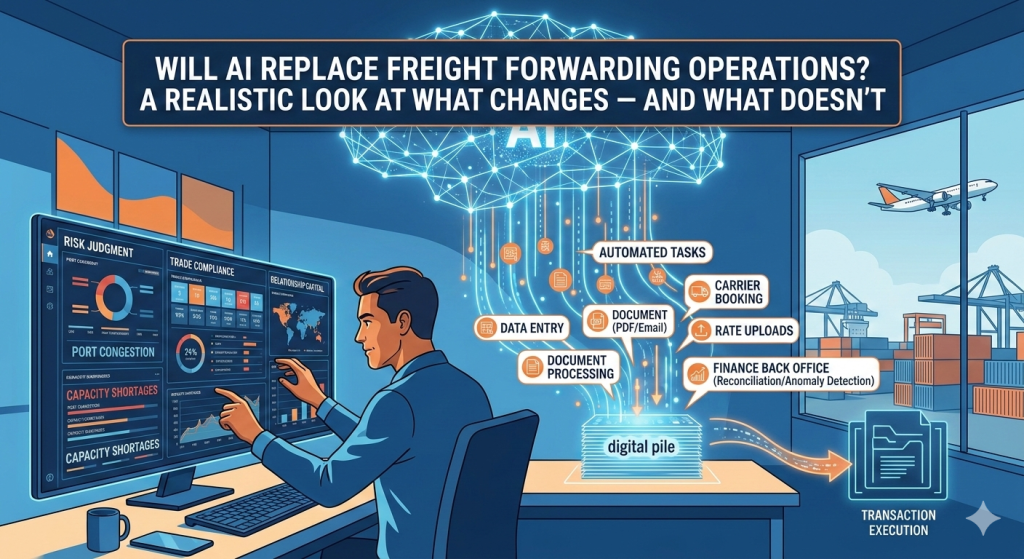
- What AI Will Replace
AI will dramatically reduce manual work in three core areas:
A. Data Entry and Document Processing
Shipment creation, milestone updates, draft BL checks, invoice matching, rate uploads, customs documentation formatting — these tasks are structured and repetitive.
AI systems already extract, validate, and populate structured data from emails, PDFs, and messaging platforms. Over time, these functions will require minimal human intervention.
B. Transaction Execution
Carrier booking, routing selection, rate comparison, and service validation can all be automated when rate data is structured and business rules are defined.
Technically, AI is capable of executing bookings and validating service conditions. The real barrier is not capability — it is data cleanliness and system integration.
C. Finance Back Office
Accounts receivable reminders, payables matching, statement reconciliation, margin reporting, and even intercompany netting are highly rules-based.
AI-driven anomaly detection can flag discrepancies, while automated workflows manage routine processes. Finance teams will shrink in size but become more analytical in focus.
In short, repetitive operational roles will decline significantly. - What AI Will Not Easily Replace
Despite these gains, freight forwarding is not purely transactional. Several areas resist full automation.
A. Risk Judgment Under Uncertainty
Freight operates in constant ambiguity:
Port congestion
Sanctions and trade compliance risk
Capacity shortages
Sudden regulatory changes
Customer credit exposure
AI can detect patterns, but strategic trade-offs under uncertainty require experience. Deciding whether to prioritize a volatile high-margin customer over a stable long-term client is not just data-driven — it is commercial judgment.
B. Relationship Capital
Freight is still relationship-heavy, especially in tight markets.
Securing space during peak season, negotiating demurrage waivers, extending credit terms, or resolving customs bottlenecks often depend on human trust and networks. AI does not build that capital.
C. Accountability and Liability
When shipments fail, delays occur, or claims arise, companies need accountable individuals.
Contracts are signed by humans. Negotiations are handled by humans. Liability cannot be delegated to an algorithm. - The Likely Future Structure
The forwarder of the future will not eliminate people. It will reorganize them.
A plausible structure includes:
Commercial Core: Strategic sales, pricing specialists, key account managers
Control Tower / Exception Team: Escalation managers, compliance experts, risk controllers
Technology & Data Layer: AI oversight, system integration, data governance
Procurement & Carrier Relations: Contract negotiation and capacity strategy
Lean Finance: Oversight and financial analytics
The large middle layer of shipment processing executives will shrink. Revenue per employee will rise. The organization becomes more concentrated around high-value decision-making. - The Hidden Constraint: Data Quality
All of this depends on clean master data, structured rate databases, standardized SOPs, and integrated systems.
AI does not fix disorganized processes. It amplifies them.
Companies that digitize chaotic foundations will not see transformative results. Companies that clean their data and standardize processes first will benefit the most. - Where Differentiation Moves
As AI absorbs transactional work, competitive advantage shifts.
It will no longer be about:
Faster booking input
Cheaper documentation processing
Invoice accuracy
Instead, differentiation will center on:
Industry specialization
Risk management capability
Network strength
Financial stability
Advisory capability for customers
Technology becomes infrastructure. Judgment becomes value.
Summary
AI will significantly reduce repetitive operational roles in freight forwarding. Data entry, transaction execution, and back-office processing will become increasingly automated.
However, freight remains a cyclical, risk-sensitive, relationship-driven industry. Strategic judgment, accountability, and trust cannot be automated away.
The future is not a human-free forwarder. It is a leaner organization where low-value tasks disappear and high-accountability roles increase in importance.
In practical terms, AI will compress the middle layer of operations — but elevate the value of leadership, commercial strategy, and risk management.
Freight will change.
Its economic DNA will not.
Leave a Reply
You must be logged in to post a comment.